Working Note · Electromagnetism · Part XIV
Ampere and Faraday: Current Creates a Field, a Field Creates Current
Two mirror laws: one says that electricity can create magnetism, the other — that magnetism can create electricity. Together, they form the entire operating principle of a power plant generator.
In 1820, Hans Ørsted accidentally noticed that a current-carrying wire deflects a compass needle — and within a week, André-Marie Ampère built a quantitative law from this. Eleven years later, Michael Faraday discovered the inverse relationship: a moving magnet induces a current in a wire. These two laws are not a coincidence, but a mirror reflection of each other, and together they form the operating principle of electric motors, generators, and transformers. In this note — both laws with numbers and an analysis of why a motor and a generator are essentially the same device.
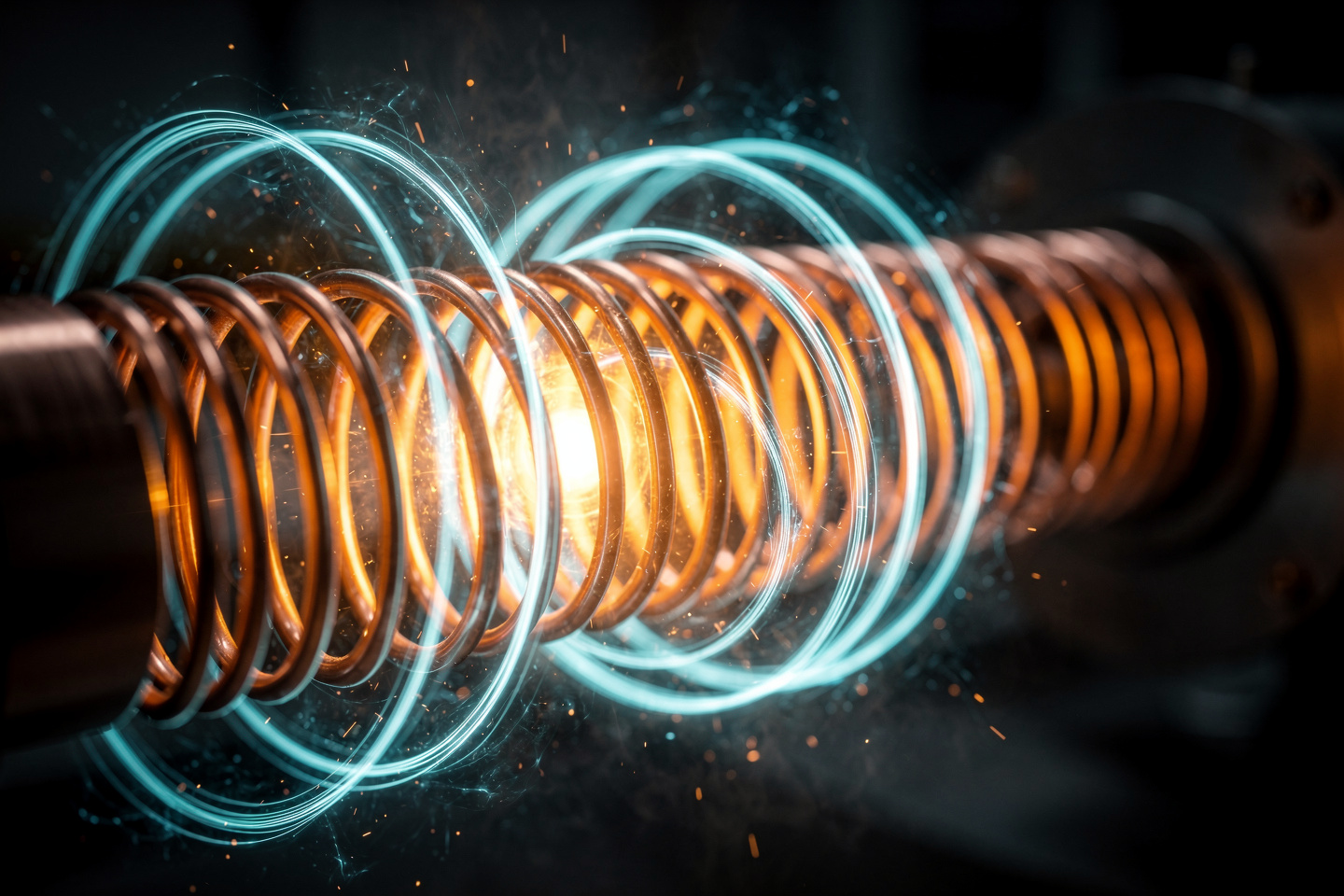
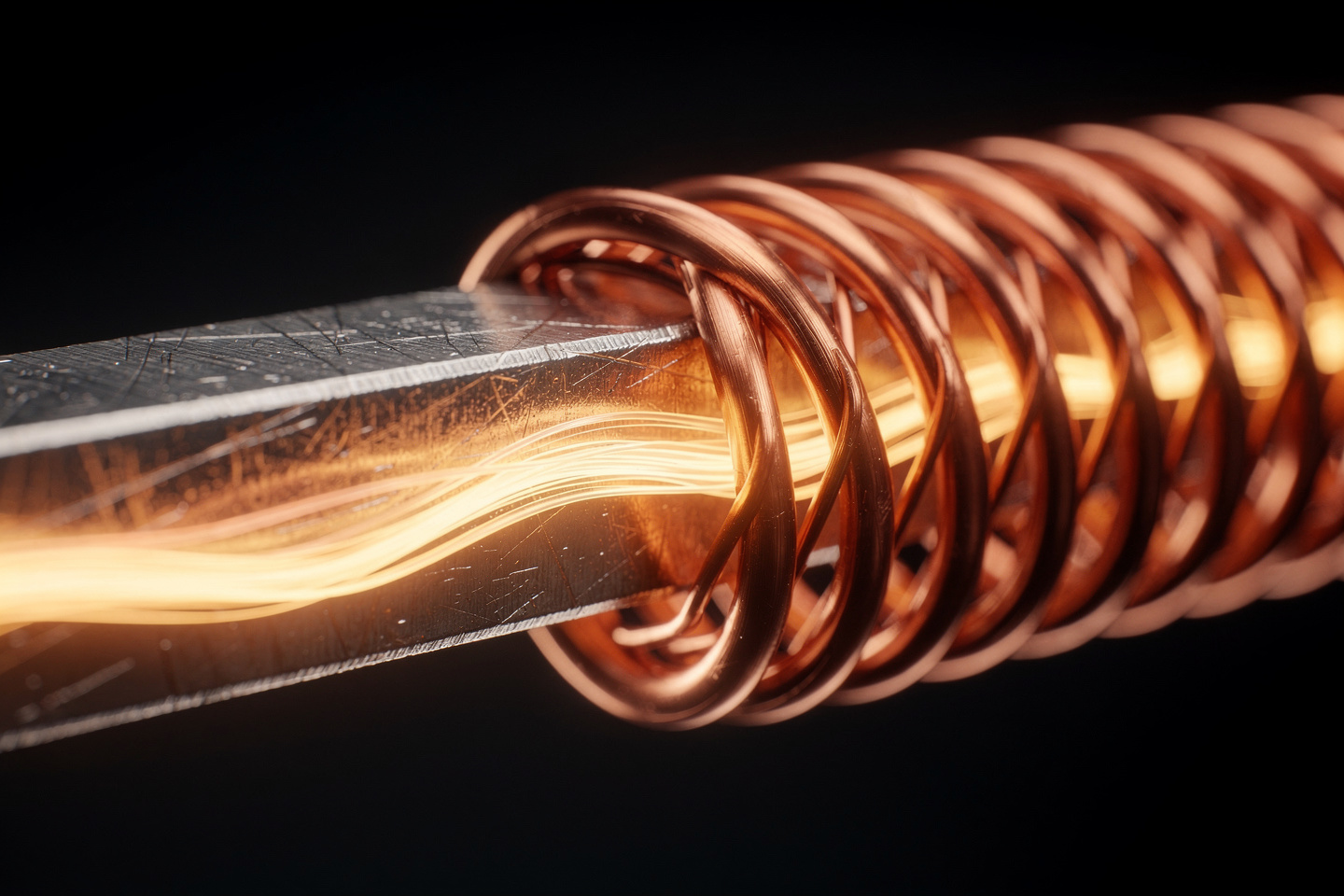
Two Laws, One Pair
| Law | Formula | Direction of the effect |
|---|---|---|
| Ampère (1820) | ∮B·dl = μ₀I | current → magnetic field |
| Faraday (1831) | ε = −dΦ/dt | changing field → current |
Both laws have already appeared as TWO OF THE FOUR lines of Maxwell's equations (part IV) — here we examine them in more detail, with practical applications: electromagnets, generators, and transformers.
Ampere's Law: Current Creates a Field
Statement. The circulation of the magnetic field along a closed loop is proportional to the current enclosed by that loop:
One of the most practical consequences of Ampère's law — the force of interaction between two parallel current-carrying conductors (this formula long served as the DEFINITION of the unit of electric current — the ampere):
Numerical example: two parallel wires with currents I₁ = I₂ = 5 A at a distance d = 0.1 m. Find the force of attraction per unit length.
Wires with current in the same direction ATTRACT (like parallel molecular currents in a permanent magnet), in opposite directions — they repel.
Faraday's Law: A Field Creates Current
Statement. The induced EMF equals the rate of change of magnetic flux through the loop, taken with a negative sign:
Numerical example: a coil of N = 200 turns is in a field, the magnetic flux through one turn increases from 0 to 0.02 Wb in Δt = 0.1 s. Find the induced EMF.
This is exactly how a pedal dynamo on a bicycle and a power plant generator work — mechanical motion (rotation) changes the magnetic flux through a coil, and Faraday's law turns this change into voltage.
Lenz's Rule: Nature Resists
The minus sign in Faraday's law is not a formality, but a separate meaningful rule (Emil Lenz, 1833): the induced current flows in such a direction that its OWN magnetic field opposes the change that caused it.
If the sign were opposite (the induced current would AMPLIFY the original flux change), the system would spin itself up to infinity — a ready-made perpetual motion machine. The law of conservation of energy (part II) directly forbids such a scenario, so Lenz's rule is not a separate arbitrary fact, but a necessary consequence of the fact that energy cannot be obtained from nothing.
Practical consequence: to move a magnet through a coil and induce a current in it, you must do WORK against the resistance that the coil itself exerts on the magnet's motion (the induced field 'brakes' the magnet) — it is this work that turns into electrical energy. Faraday's law does not give free electricity.
A Running Example: Motor in Reverse — Generator
An electric motor and an electric generator are mechanically the same device (a coil in a magnetic field), the only difference is what's 'at the input' and what's 'at the output':
| Input | Output | Operating law | |
|---|---|---|---|
| Motor | electric current | rotation (mechanical work) | Ampère force on a current in a field |
| Generator | rotation (mechanical work) | electric current | Faraday's law |
Take the same coil in a magnet's field: send current through it — according to Ampère's law, a force will arise, the coil will rotate (motor). Or, conversely, turn the coil by hand — according to Faraday's law, an EMF will be induced in it (generator). Electric vehicles use this literally: during acceleration, the motor works as a motor (consumes current from the battery), and during braking — as a generator (energy recuperation, current flows back to the battery, recharging it at the expense of the car's kinetic energy).
Where This Leads: A Transformer with No Moving Parts
A transformer is a device without a single moving part, but entirely based on Faraday's law. The alternating current in the primary coil (Ampère's law — current creates a changing field) creates a changing magnetic flux in the common iron core; this changing flux passes through the secondary coil and induces an EMF in it (Faraday's law). The turns ratio determines the voltage ratio — this is how voltage step-up/step-down works at every substation along the way from the power plant to the outlet.
If the current in the primary coil is CONSTANT (does not change over time), the magnetic flux is also constant — dΦ/dt = 0, and according to Faraday's law, no EMF is induced in the secondary coil at all. That is why the entire power system is built on alternating current — only it allows continuously changing voltage with transformers without conversion losses.
On the website, these are separate laws, if you want to go deeper:
Home Experiment
Place an ordinary compass on a table, stretch a straight wire above it connected to a battery (PARALLEL to the compass needle, literally repeating the 1820 experiment), and close the circuit for a second.
What to observe the compass needle will noticeably deflect from the northward direction while current flows, and return back as soon as the circuit is opened — exactly what Ørsted accidentally noticed during a lecture while preparing a demonstration for students, and which Ampère turned into a precise law within a week.
If you have a hand-crank flashlight at home (dynamo mechanism, without batteries — you crank a lever, a bulb/LED lights up), crank it first WITHOUT a load (bulb/LED turned off or removed), then CONNECT the load and crank again.
What to observe cranking the lever is noticeably HARDER when the bulb is connected and lit — a direct demonstration of Lenz's rule (§4): the induced current creates its own field that brakes the rotation, and it is overcoming this braking — the mechanical work you do with your hand — that turns into electrical energy lighting the bulb.
Problems to Check Understanding
First think for yourself, then open the solution. The solution everywhere follows the scheme: Given → Law → Solution → Answer.
1. Two parallel wires with currents of 10 A each are at a distance of 0.2 m. Find the interaction force per unit length.
Given I₁ = I₂ = 10 A, d = 0.2 m.
Law force between parallel conductors (§2): F/L = 2×10⁻⁷·I₁I₂/d.
Solution F/L = 2×10⁻⁷·100/0.2 = 2×10⁻⁷·500 = 10⁻⁴ N/m.
Answer 10⁻⁴ N/m (0.0001 N per meter of length).
2. A coil of 150 turns is in a field, the magnetic flux through a turn drops from 0.04 Wb to 0.01 Wb in 0.3 s. Find the magnitude of the induced EMF.
Given N = 150, ΔΦ = 0.03 Wb, Δt = 0.3 s.
Law Faraday's law (§3): ε = NΔΦ/Δt.
Solution ε = 150·0.03/0.3 = 15 V.
Answer 15 V.
3. Why does the galvanometer needle jump more when the magnet is pulled out of the coil abruptly compared to slow withdrawal (same magnet, same distance)?
Law Faraday's law (§3): ε = NΔΦ/Δt — the RATE of flux change is important, not just its final magnitude.
Solution with abrupt motion the same flux change ΔΦ occurs in a much shorter time Δt, so ΔΦ/Δt (and accordingly, ε) is greater.
Answer abrupt motion gives a greater rate of flux change , not a greater flux change as such.
4. A transformer steps down voltage from 220 V to 11 V. If the primary winding has 2000 turns, how many turns does the secondary have?
Given U₁ = 220 V, U₂ = 11 V, N₁ = 2000.
Law transformer turns ratio (§6): U₁/U₂ = N₁/N₂.
Solution N₂ = N₁·U₂/U₁ = 2000·11/220 = 100.
Answer 100 turns — a step-down by 20 times corresponds to a turns ratio of 20:1.
5. Why does the battery of an electric vehicle charge during braking (recuperation), even though the motor is not consuming current from the battery at that moment?
Law §5 — motor/generator reversibility.
Solution during braking, the wheels continue to spin the electric motor's winding by inertia — in this mode, the device operates as a GENERATOR (Faraday's law: rotation of the coil in a magnet's field induces an EMF in it), not as a motor. The induced current flows in the reverse direction — from the motor to the battery, charging it at the expense of the car's kinetic energy instead of simply dissipating it as heat through the brake pads.
Answer the motor switches to generator mode — same coil, same magnet, opposite direction of energy.
Typo, incorrect formula, numbers don't add up, poorly explained — write to us: feedback@bridge42worlds.org. Every message is actually read, analyzed, and a correction is made based on it — this is not 'for the drawer'.