Working note · classical dynamics · part II
What is conserved in motion: momentum, energy, angular momentum
Three quantities that physics forbids wasting: no matter how the picture inside the system changes, their sum — if the system is closed — remains the same before and after.
From Newton's three laws (see part I) follow three quantities that in a closed system do not change over time: momentum, energy, and angular momentum. These are not random coincidences but a direct consequence of the symmetries of space and time (Noether's theorem, §6). In this note — all three conservation laws separately with numerical examples, and then one working example (elastic and inelastic collision), where it is clear that momentum is always conserved, but energy only sometimes.


Three conserved quantities
Newtonian mechanics gives not only the equation of motion but also three 'accounts', the sums of which do not change as long as no one touches the system from the outside.
| Quantity | Formula | Conserved when... |
|---|---|---|
| Momentum | p = mv | no external forces (ΣFext = 0) |
| Energy | E = K + U | no friction/resistance (forces are conservative) |
| Angular momentum | L = Iω | no external torque (Στext = 0) |
It is important to immediately distinguish two different meanings of the word 'conserved': inside the system the quantity can freely redistribute between parts (momentum — from one body to another, energy — from kinetic to potential) — only the total sum over the whole system is conserved, not the value for each individual body.
Note: the conditions for the three laws are different. A collision of two clay balls conserves momentum always, but does not conserve mechanical energy (part goes into deformation heat) — this is analyzed in detail in §5.
Momentum: the sum does not change
Statement. If no external forces act on a system of bodies (or their resultant is zero), the total momentum of the system remains constant. This is a direct consequence of Newton's third law (part I, §4): interaction forces within the system are always paired and opposite, so they cancel out in the sum over the system.
A cannon of mass 500 kg stands motionless and fires a cannonball of mass 5 kg with a speed of 100 m/s. The forward momentum of the cannonball equals the recoil momentum of the cannon backward — in magnitude, not in speed (the cannon has a lower speed because its mass is larger).
The same calculation as for the skaters in part I, §4 — there forces arise in pairs and momentum simply 'pours' from one body to another, remaining zero in total if the system was at rest before the interaction.
Momentum is conserved in any collision — elastic (the balls fly apart, the total kinetic energy is the same) and inelastic (the bodies stick together or deform, part of the energy goes into heat/sound). The difference between them is about energy, not momentum. A detailed numerical example of both types — §5.
Energy: changes costumes
Statement. In a system where only conservative forces act (gravity, elasticity — but not friction), the total mechanical energy — the sum of kinetic and potential — is constant:
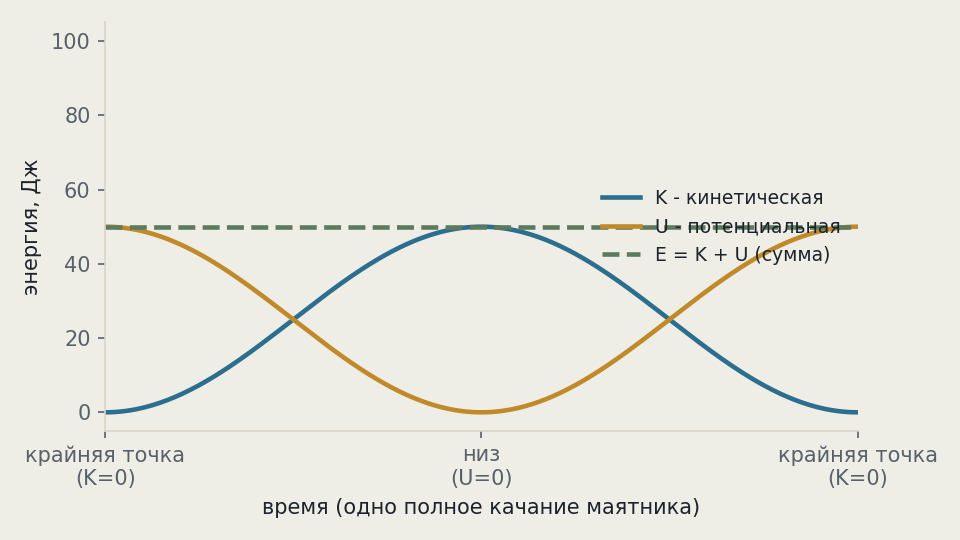
A classic example — a pendulum or a swing: at the extreme point the speed is zero (K = 0), all energy is potential; at the lowest point the height is minimal (U = 0), all energy is kinetic. In the middle of the path — some fraction of each, but the sum is the same at any point of the swing.
Numerical example: a body falls from a height h = 5 m with no initial speed (air resistance neglected). What is its speed at the ground?
The mass canceled out — falling without air resistance does not depend on the body's mass (the same result for a feather and a weight if you remove the air — the famous feather and hammer experiment on the Moon).
The law of conservation of energy is not an empirical observation but a direct prohibition: for a device to work forever and do useful work, it needs to take energy for that work from somewhere without an external source — that is, create it from nothing. Real mechanisms always lose some energy to friction and resistance (it converts into heat — also energy, just a less 'useful' form), so they stop if not fed.
Angular momentum: the skater speeds up
Statement. If no external torque acts on a body, its angular momentum is constant. For a rotating rigid body L = Iω, where I is the moment of inertia (a measure of 'how hard it is to spin', depends on how the mass is distributed relative to the axis), ω is the angular velocity:
A skater spins with arms extended (large I, slowly), then pulls arms to the body (I drops by a factor of four) — the rotation sharply speeds up, exactly so that L remains the same. This is not a stretched metaphor: it is exactly how skaters physically speed up rotation, without any additional force.
Numerical example: a skater spins with arms extended with a moment of inertia I1 = 4 kg·m² and angular velocity ω1 = 2 rad/s. By pulling in his arms, he reduces the moment of inertia to I2 = 1 kg·m². Find the new angular velocity.
The rotation sped up by a factor of four — exactly as many times as the moment of inertia dropped. No muscle of the skater does work 'for spinning acceleration' directly at the moment of pulling in the arms — the source of the increase in rotational kinetic energy here is different (the work of muscles against the 'centrifugal' effect when pulling the arms to the body), but the conservation of L holds exactly in any case, regardless of the mechanism.
Kepler's second law (1609): a planet sweeps out equal areas in equal times, moving along an elliptical orbit faster near the Sun and slower away from it. This is exactly the conservation of the planet's angular momentum relative to the Sun — 70 years before Newton even formulated the laws of dynamics. More details — Kepler's second law.
A working example: elastic and inelastic collision
Let's take two balls of equal mass (m = 2 kg each): ball A flies at a speed of 6 m/s and collides with stationary ball B. Let's analyze both collision scenarios.
Elastic collision (energy is also conserved)
With equal masses in a perfectly elastic collision, the speeds simply swap places: A stops (vA = 0), B flies off with the speed that A had (vB = 6 m/s). Check against both laws:
| Before collision | After collision | |
|---|---|---|
| Momentum, kg·m/s | 2·6 + 2·0 = 12 | 2·0 + 2·6 = 12 |
| Kin. energy, J | ½·2·6² = 36 | ½·2·6² = 36 |
Inelastic collision (energy is NOT conserved)
Cart m1 = 3 kg moves at a speed of 4 m/s and couples with a stationary cart m2 = 1 kg, then they move together:
| Before collision | After collision | |
|---|---|---|
| Momentum, kg·m/s | 3·4 + 1·0 = 12 | 4·3 = 12 |
| Kin. energy, J | ½·3·4² = 24 | ½·4·3² = 18 |
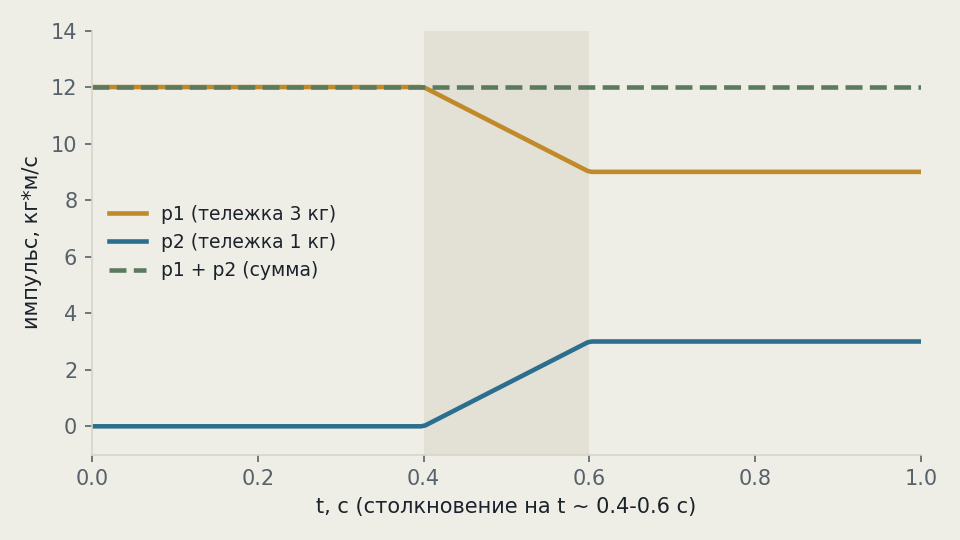
24 − 18 = 6 J of kinetic energy 'disappeared' — in fact it did not disappear, but transformed into heat and sound of the coupling deformation (the law of conservation of energy §3 is not violated, just mechanical energy turned into non-mechanical form). Momentum, however, is a vector quantity without 'non-mechanical' forms, it simply has nowhere to go except to remain in the motion of the bodies — hence the difference in the behavior of the two laws.
Where this leads: Noether's theorem
In part I (§6) there was already an announcement: Noether's theorem (Emmy Noether, 1918) connects each of the three conservation laws with a symmetry of space-time — not a coincidence, but a rigorous mathematical consequence of the principle of least action.
| Symmetry | What it means | Gives conservation of |
|---|---|---|
| Homogeneity of time | laws of physics do not change from epoch to epoch — an experiment set up yesterday and today gives the same result | energy |
| Homogeneity of space | laws of physics do not change from point to point — move the laboratory a kilometer away, the result is the same | momentum |
| Isotropy of space | laws of physics do not depend on direction — there is no preferred axis in the Universe | angular momentum |
This turns the intuitive order of cause and effect upside down: it usually seems that 'first there are conservation laws, and symmetries are their consequence'. Actually the opposite — space-time symmetries are primary, and conservation laws are derived formally from them, via the Euler-Lagrange equation applied to the action S (see part I, §6, formula (4)).
All three laws survive the transition to quantum mechanics (momentum, energy and angular momentum become operators, but their conservation for an isolated system remains exact) and to special relativity (energy and momentum unite into a single 4-vector of energy-momentum, and rest mass is linked to it via E = mc² — a separate big topic). General relativity is an exception: there energy conservation generally ceases to be locally well-defined due to the absence of a global time symmetry in curved space-time, which is still debated at the border of physics and philosophy of science.
On the site these are separate laws, if you want to go deeper:
Law of conservation of momentum · Law of conservation of energy · Law of conservation of angular momentum · Noether's theorem
Experiment at home
Sit on an office chair that spins freely, take something heavy in each hand (books, dumbbells, water bottles) and extend your arms to the sides. Ask someone to gently spin you (or push off the floor with your feet yourself). While spinning — sharply pull your hands to your chest.
What to notice the rotation speed will noticeably increase right before your eyes, without any additional push — exactly the same physics as the skater in §4: the moment of inertia dropped, the angular velocity increased so that L = Iω remained the same. Extend your arms back to the sides — the rotation will slow down again.
If you have a tabletop 'Newton's cradle' at home (5 metal balls on threads in a row) — pull back the end ball and release it. Notice: from the other end, exactly ONE ball bounces out, with the same speed, and not, say, two balls with half the speed each.
What to notice both options ('1 ball fast' and '2 balls twice as slow') formally conserve momentum — but only the option with one ball ALSO conserves kinetic energy (the collision between the balls is almost perfectly elastic, the metal barely deforms). Nature 'chooses' the outcome that is compatible with both laws at once.
Problems to check
First think for yourself, then open the solution. Numbers are chosen so that the answer comes out whole. The solution everywhere follows the scheme: Given → Law → Solution → Answer.
1. An astronaut of mass 80 kg in outer space is stationary relative to the station and throws a wrench of mass 0.5 kg away from himself with a speed of 8 m/s. At what speed will the astronaut himself begin to drift?
Given mastr = 80 kg, mwrench = 0.5 kg, vwrench = 8 m/s, total momentum before throw = 0.
Law conservation of momentum (§2): 0 = mastrvastr + mwrenchvwrench.
Solution vastr = −0.5·8/80 = −0.05 m/s.
Answer 0.05 m/s, in the direction opposite to the throw — slowly, but unstoppably without outside help.
2. A ball of mass 4 kg rolls down without friction from a hill of height 2 m. What is its speed at the bottom?
Given m = 4 kg, h = 2 m, g ≈ 10 m/s².
Law conservation of energy (§3): mgh = ½mv².
Solution v = √(2gh) = √(2·10·2) = √40 ≈ 6.3 m/s — the mass does not enter the answer.
Answer ≈6.3 m/s (the ball's mass doesn't matter — it will match any other ball without friction).
3. A skater spins with a moment of inertia of 6 kg·m² and angular speed of 1.5 rad/s, then pulls in his arms and reduces the moment of inertia to 2 kg·m². Find the new angular speed.
Given I1 = 6 kg·m², ω1 = 1.5 rad/s, I2 = 2 kg·m².
Law conservation of angular momentum (§4): I1ω1 = I2ω2.
Solution ω2 = 6·1.5/2 = 4.5 rad/s.
Answer 4.5 rad/s — three times faster (I dropped threefold).
4. Two railroad cars of 5000 kg each couple at speed: the first moves at 6 m/s, the second is stationary. Find the common speed after coupling and the loss of kinetic energy.
Given m1 = m2 = 5000 kg, v1 = 6 m/s, v2 = 0.
Law conservation of momentum in inelastic collision (§5): m1v1 = (m1+m2)vtotal.
Solution vtotal = 5000·6/10000 = 3 m/s. Kbefore = ½·5000·6² = 90000 J. Kafter = ½·10000·3² = 45000 J.
Answer 3 m/s, 45000 J lost (exactly half — went into the crash and deformation of the coupling).
5. A boy of mass 40 kg stands on a stationary skateboard of mass 4 kg and jumps forward with a speed of 2 m/s relative to the ground. At what speed will the skateboard roll back?
Given mboy = 40 kg, vboy = 2 m/s, mboard = 4 kg, total momentum before jump = 0.
Law conservation of momentum (§2, the same trick as for the boat in part I).
Solution vboard = −40·2/4 = −20 m/s.
Answer 20 m/s, in the direction opposite to the jump — the small mass of the skateboard gives it a disproportionately high recoil speed.
A typo, wrong formula, number doesn't add up, poorly explained — write to us: feedback@bridge42worlds.org. Every message is actually read, analyzed, and a correction is made based on it — it's not 'into the void'.