Working Note · Electromagnetism · Part XIII
Coulomb’s Law and Ohm’s Law: From Stationary Charge to Flowing Current
One law describes frozen charges repelling or attracting in space; the other describes what happens when those charges break free and start to flow.
In 1785, Charles Coulomb measured how electric force decreases with distance — exactly like gravity (inverse square law, part VII). Forty-one years later, Georg Ohm discovered another, equally simple relationship: the current through a conductor is directly proportional to the applied voltage. This note presents both laws with numbers and shows how the same quantity — electric charge — links Coulomb’s statics to Ohm’s dynamics through the simple definition of current: I = q/t.
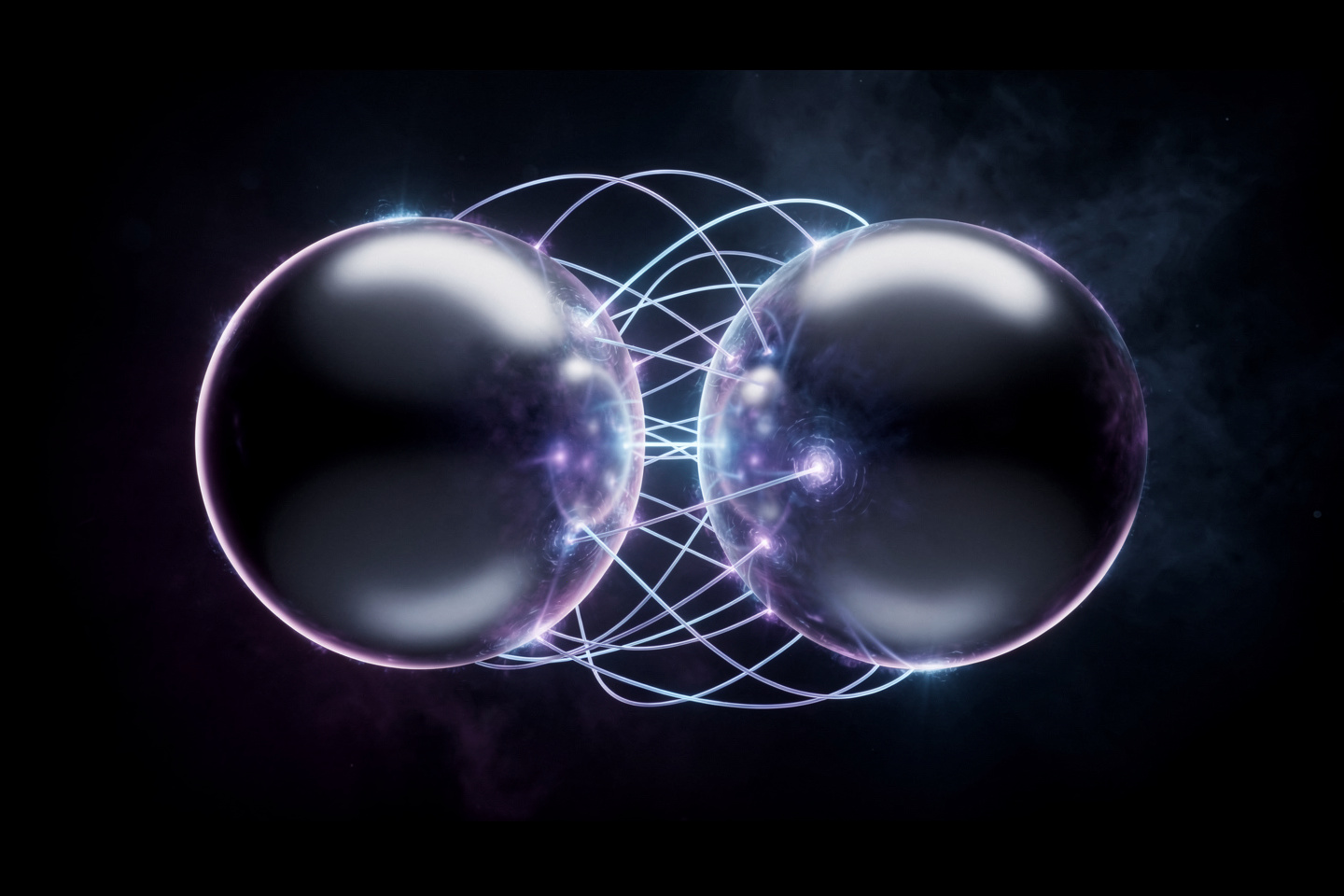
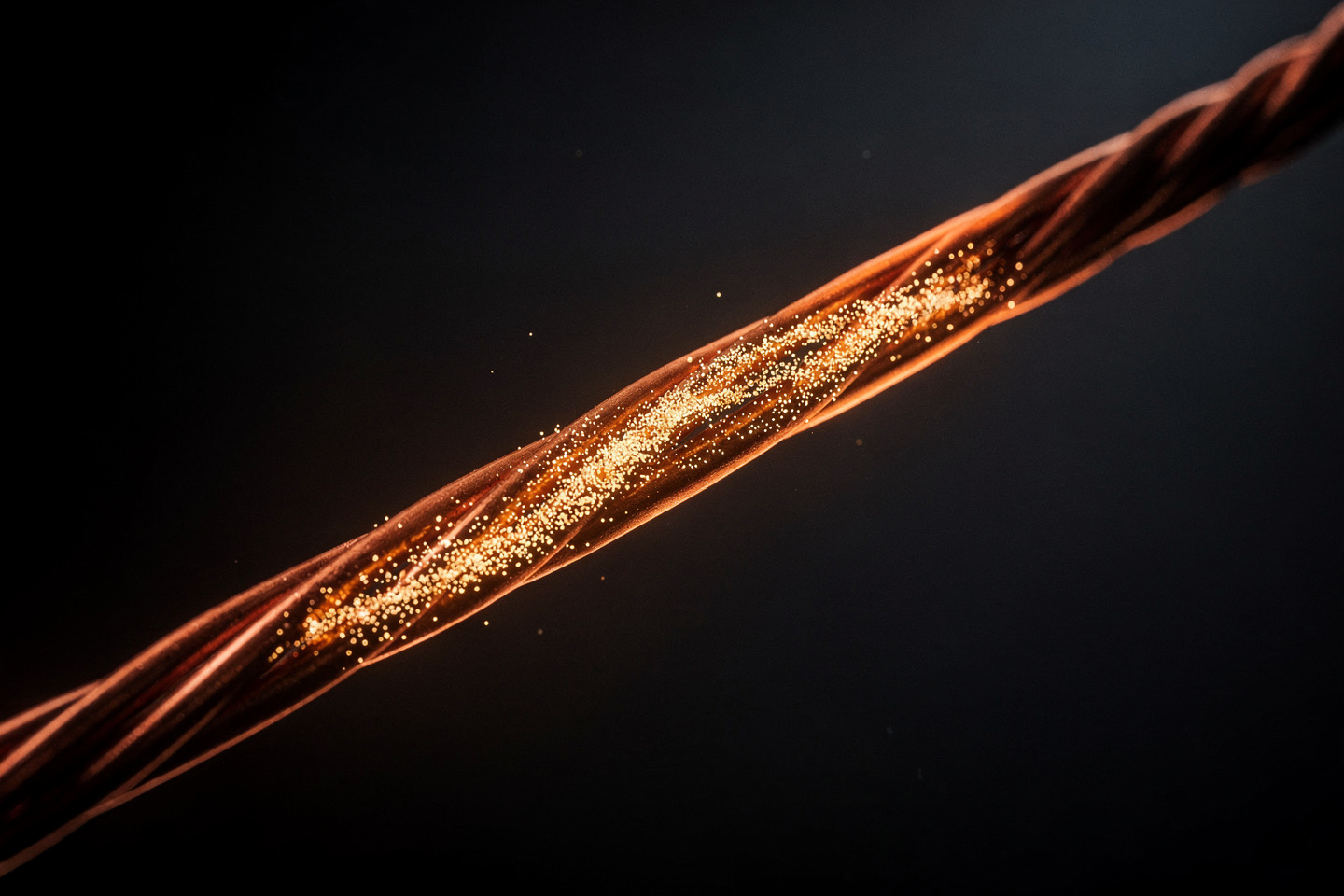
Two Laws, One Structure
| Law | Formula | What it describes |
|---|---|---|
| Coulomb (1785) | F = kq₁q₂/r² | force between two STATIONARY charges |
| Ohm (1826) | I = U/R | current through a conductor under voltage |
Coulomb deals with STATIC charges — simply the force of attraction/repulsion in space, without motion. Ohm describes DYNAMICS — what happens when charges move in an organized way through a conductor under a potential difference. The bridge between them is a simple definition: electric current I is the amount of charge q passing through a cross-section of the conductor per time t: I = q/t (detailed numerical transition — §4).
Coulomb’s Law: Force Between Charges
Statement. The interaction force between two point charges is proportional to their product and inversely proportional to the square of the distance:
Numerical example: two charges q₁ = q₂ = 1 µC (microcoulomb) are at a distance r = 3 cm = 0.03 m. Find the force between them.
Compare: the gravitational attraction between two 1 kg bodies at a distance of 1 m is about 6.674×10⁻¹&sup9 N, vanishingly small. The electric force between two electrons at the same distance is about 2.3×10⁻²⁸ N, but it is STILL roughly 10⁴⁰ (ten thousand trillion trillion trillion) times stronger than their mutual gravitational attraction. The only reason gravity seems “more important” in everyday life is that ordinary matter is almost perfectly electrically neutral (charges are compensated), while masses add up without such compensation.
Ohm’s Law: Current as Flow
Statement. The current is directly proportional to the voltage and inversely proportional to the resistance:
Classic analogy — water pipes: voltage U is the “pressure” (pressure difference at the ends of the pipe), resistance R is the narrowness of the pipe, and current I is how much water actually flows per second. A wide pipe (small R) at the same pressure lets more water (current) through; a narrow pipe (large R) lets less.
Numerical example: a car battery (U = 12 V) is connected to a bulb with resistance R = 4 Ω. Find the current through the bulb.
Worked Example: From Charge to Current
Let’s link both laws directly. A charge q = 2 C flows uniformly through a conductor in a time t = 4 s (this is the definition of current — §1):
Now apply Ohm’s law: what voltage is needed for exactly this current to flow through a resistance R = 10 Ω?
The entire chain of reasoning — from the static charge q (Coulomb’s world) via the definition of current I=q/t to Ohm’s law (the world of moving charges) — shows that these are not two isolated facts, but the same entity (electric charge), considered first at rest, then in motion.
Where This Leads: The Origin of Resistance
Ohm’s law is not a fundamental law of nature like Coulomb’s law, but an empirical relationship that holds for many (but not all) materials. At the microscopic level, resistance arises from collisions of moving electrons with the vibrating atoms of the conductor’s crystal lattice — the more vigorously the lattice “shakes” (higher temperature), the more frequent the collisions, and the higher the resistance. That is why the resistance of most metals increases with heating.
During collisions, the kinetic energy of the electrons’ directed motion is converted into heat — this same energy is related to Joule’s law, P = I²R (power dissipated as heat), a direct application of energy conservation (part II) to an electric circuit. In our example from §3: P = 3²·4 = 36 W — that is exactly how much heat the bulb releases every second.
When certain materials are cooled below a critical temperature (sometimes just a few degrees above absolute zero, sometimes — for “high-temperature” superconductors — at liquid nitrogen temperature), the electrical resistance drops EXACTLY to zero. A current can flow around a closed superconducting loop practically forever, with no voltage at all — a direct contradiction of U = IR when R = 0 and I ≠ 0. Both laws in this note have already appeared in the unified picture of Maxwell’s equations (part IV) — they are special cases of the more general theory of the electromagnetic field.
On the site these are separate laws, if you want to dive deeper:
Home Experiments
Run a plastic comb through dry hair several times (or rub a balloon on a wool sweater), then bring it near small pieces of paper or a thin stream of water from a tap.
What to notice pieces of paper jump up and stick to the comb, the water stream noticeably bends — friction “ripped” electrons from one surface to another, charging the comb, and Coulomb’s law (§2) makes it attract any charged (or polarizable, like water) objects nearby.
If you have a simple “battery–bulb(LED)–wires” circuit at home (or build one from a coin battery, an LED, and two wires), insert the lead of an ordinary pencil (sharpened at both ends) into the circuit gap instead of one of the wires.
What to notice the LED glows dimmer than with a direct wire connection — the pencil lead (unlike metal) has noticeable resistance. If you can clamp the contacts at different points along the lead, changing the length of the active section — the brightness will change before your eyes: longer path through the lead → larger R → smaller I according to Ohm’s law (§3) → dimmer light.
Check Your Understanding
First think for yourself, then open the solution. Each solution follows the structure: Given → Law → Solution → Answer.
1. The distance between two charges is doubled. By what factor does the force between them change?
Given rr₂ = 2r₁ = 2r.
Law Coulomb’s law (§2): F ∝ 1/r².
Solution FF₂ = F₁/4/F = r²/(2r)² = 1/4.
Answer decreased by a factor of 4 — the same math as for gravity (part VII).
2. Two charges of 2 µC each are 6 cm apart. Find the force between them (k ≈ 9×10⁹ N·m²/C²).
Given q₁ = q₂ = 2×10⁻⁶ C, r = 0.06 m.
Law Coulomb’s law (§2): F = kq₁q₂/r².
Solution F = 9×10⁹·4×10⁻¹²/3.6×10⁻³ = 3.6×10⁻²/3.6×10⁻³ = 10 N.
Answer 10 N.
3. A current of 4 A flows through a 5 Ω resistor. Find the voltage across the resistor and the power dissipated as heat.
Given R = 5 Ω, I = 4 A.
Law Ohm’s law (§3): U = IR; Joule’s law (§5): P = I²R.
Solution U = 4·5 = 20 V; P = 4²·5 = 80 W.
Answer U = 20 V, P = 80 W.
4. A charge of 6 C passes through a conductor in 3 seconds. What resistance is needed so that a voltage of 4 V is sufficient for this current?
Given q = 6 C, t = 3 s, U = 4 V.
Law definition of current (§1, §4): I = q/t; Ohm’s law: R = U/I.
Solution I = 6/3 = 2 A; R = 4/2 = 2 Ω.
Answer 2 Ω.
5. Why does ordinary matter around us hardly exhibit electric forces over large distances, even though the electric force is ~10⁴⁰ times stronger than gravity?
Law §2 — comparison of Coulomb force and gravitational force.
Solution ordinary bodies are almost perfectly electrically neutral: the positive charges of nuclei are almost exactly compensated by the negative charges of electrons, so the net electric force between two neutral bodies is nearly zero. Gravity, on the other hand, has no “negative mass” for compensation — the masses of all particles add up without exception, so on large scales gravity wins despite its fundamental weakness.
Answer electrical neutrality of ordinary matter — charges are compensated, masses are not.
A typo, an incorrect formula, a number that doesn’t add up, a clumsy explanation — write to us: feedback@bridge42worlds.org. Every message is actually read, analyzed, and used to make corrections — this is not “into the void.”