Working Note · Continuum Mechanics · Part VIII
Elasticity and Buoyancy: Hooke's Law and Archimedes' Principle
Two laws about how matter "resists" — stretching a spring and immersion in a fluid — and both boil down to surprisingly simple linear mathematics.
In the 1660s, Robert Hooke discovered that springs (and elastic bodies in general) resist deformation proportionally to its magnitude — the simplest linear relation underlying elasticity theory, from mattresses to skyscrapers. Two millennia earlier, Archimedes discovered another, also linear law: a fluid pushes up an immersed body with a force equal to the weight of the displaced volume. In this note — both laws with numerical examples and a through experiment that unites them in one measurement.
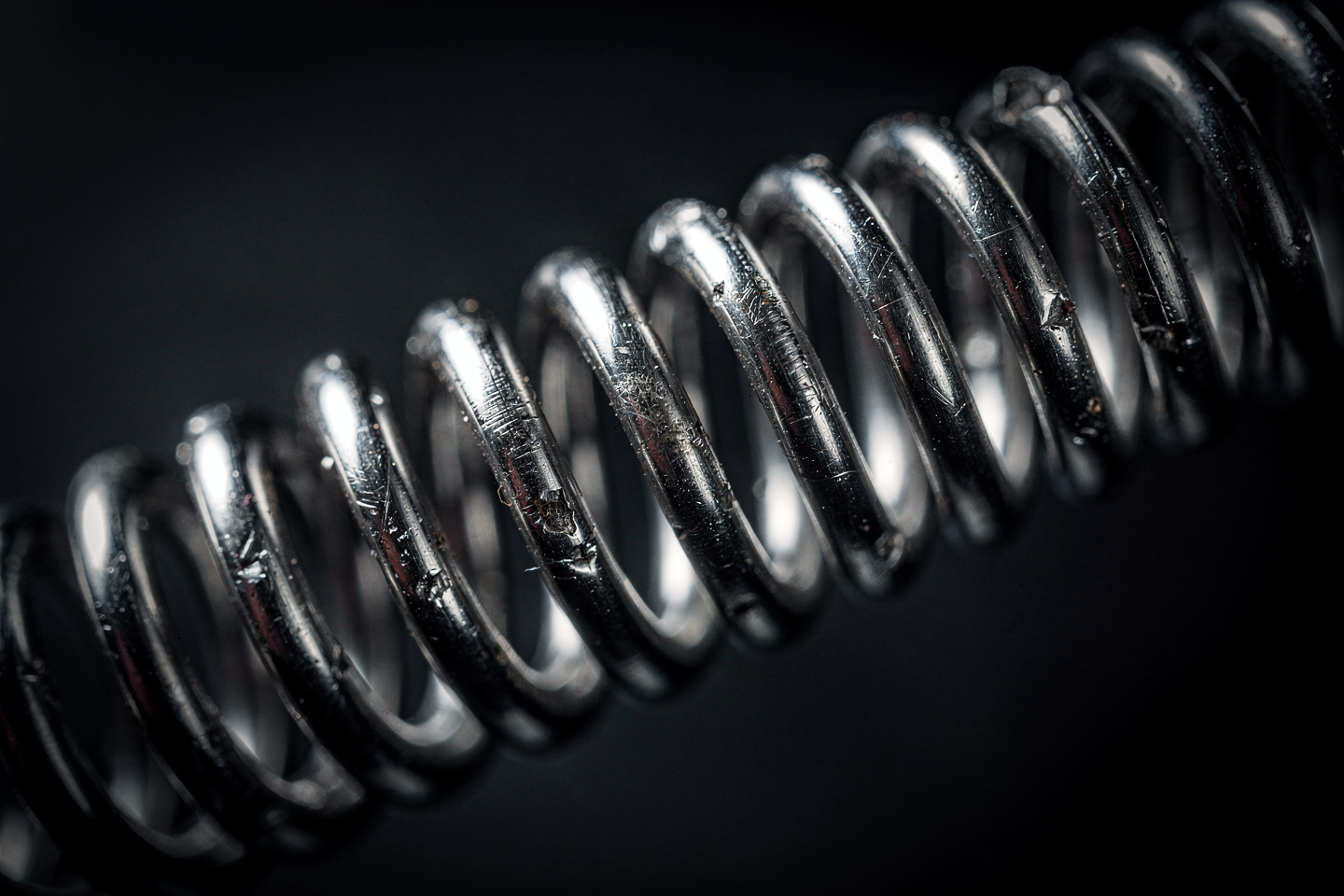

Two Forces of Resistance
| Law | Formula | About |
|---|---|---|
| Hooke | F = −kx | elastic force grows linearly with displacement |
| Archimedes | F = ρgV | buoyant force equals weight of displaced fluid |
At first glance, different phenomena — but both describe how a medium (spring, fluid) "responds" to an attempt to change its state, and in both cases the answer is surprisingly simple: either linearly from displacement, or linearly from volume. The simplicity of these laws is not a coincidence, but a consequence of the fact that both phenomena are considered in the regime of small, "gentle" disturbances, where complex microscopic physics averages down to a single constant (k or ρ).
Hooke's Law: The Spring Counts Linearly
Statement. Elastic force is proportional to deformation and directed against it:
Numerical example: a spring of stiffness k = 200 N/m is stretched by x = 0.05 m. What elastic force arises?
The minus sign in the statement reminds: the force ALWAYS tends to return the body to equilibrium — if the spring is stretched, it pulls back; if compressed, it pushes forward. It is this "restoring" nature that makes the spring a classic harmonic oscillator — release the mass, and it will oscillate back and forth (with friction — gradually damping).
From Spring to Solid Body
The same linear law works not only for coiled springs — any solid body under small deformation behaves like a spring, just the stiffness constant is replaced by a material property — Young's modulus E:
| Material | Young's modulus E, Pa |
|---|---|
| Rubber | ∼10⁶ |
| Wood | ∼10⁹ |
| Steel | ∼2×10¹¹ |
Steel is "stiffer" than rubber by about 200,000 times — but both, within small deformations, obey exactly the same linear law. Skyscrapers sway in the wind by centimeters and return to their original position precisely thanks to this elasticity — if steel did not obey Hooke's law, tall buildings would either be dangerously brittle or could not exist at all.
Linearity is an approximation, valid only up to the elastic limit. Stretch a spring too much — and it either will not return to its original shape (plastic deformation) or will break. Design engineers always include a safety margin precisely because beyond the limit, Hooke's law no longer predicts the material's behavior.
Archimedes' Principle: Weight of the Displaced
Statement. A body immersed in a fluid (or gas) experiences a buoyant force equal to the weight of the displaced volume:
Numerical example: a body of volume V = 0.002 m³ (2 liters) is completely immersed in water (ρ = 1000 kg/m³, g ≈ 10 m/s²). Find the buoyant force.
Whether the body floats or sinks is decided by comparison with gravity: if the body's weight is less than Fbuoy at full immersion, the body floats (and will submerge only partially until the weights balance); if greater — it sinks.
Steel is almost 8 times heavier than water (ρsteel ≈ 7800 kg/m³ versus 1000 for water) — a piece of steel thrown into water sinks immediately. But the HULL of a ship is mostly air surrounded by a thin steel shell: the average density of the entire construction (steel + air inside) is much lower than the density of water. It's not the density of the material that matters, but the average density of the ENTIRE displacing volume.
A Running Example: Hydrometer from a Spring Scale
Let's bring both laws together in one classic experiment: a weight is suspended on a spring scale (Hooke's law — from the spring's extension we read the force), first in air, then — we immerse in water.
In air, the spring is stretched by x₁ = 0.05 m with stiffness k = 1000 N/m — so the true weight of the load:
We immerse the load completely in water — the spring shortens to x₂ = 0.03 m (apparent weight Papp = 1000·0.03 = 30 N). The difference is precisely a direct measurement of the buoyant force:
And from Fbuoy = ρgV we can immediately calculate the volume of the load, without measuring anything with a ruler:
This is exactly the method by which (according to legend) Archimedes caught the jeweler: measuring the volume of an irregularly shaped body by displacement, without taking it apart — only here the spring scale does it without even a tub overflowing.
Where It Leads: Atomic Springs and Pressure
Hooke's law is not just a convenient approximation for engineers, but a consequence of the fact that chemical bonds between atoms in a solid behave like tiny springs: for a small displacement of an atom from its equilibrium position, the potential energy of the bond grows quadratically (like that of an ideal spring), meaning the restoring force is linear, exactly Hooke's law. Young's modulus E is a macroscopic averaging of the stiffness of billions of such atomic bonds.
Archimedes' principle, in turn, is a direct consequence of the fact that pressure in a fluid increases with depth (a taller column of fluid presses harder). The difference in pressure on the bottom and top faces of an immersed body creates a net force directed upward — this is not a separate postulate, but a consequence of the laws of hydrostatics. A deeper connection of these same ideas to fluid flow — in the next note of the series, on the Bernoulli equation.
On the website, these are separate laws if you want to go deeper:
Home Experiment
Take a rubber band, mark its original length, hang a load of known mass (for example, a bag of coins) and measure how much the rubber band stretched. Add twice as many coins.
What to notice with doubled load, the rubber band will stretch roughly twice as much (as long as it hasn't exceeded the elastic limit of the rubber) — a direct check of Hooke's law with improvised means: F ∝ x.
Drop a raw egg into a glass of ordinary tap water — it will sink. Then dissolve several tablespoons of salt in the water (stir until it no longer dissolves) and drop the egg in again.
What to notice in salt water, the egg floats (or hovers in the water column) — dissolved salt increases the density of water ρ, and thus the buoyant force Fbuoy = ρgV for the same volume of the egg, until it equals the weight of the egg. The same effect keeps bathers on the surface of the Dead Sea without effort.
Check-Up Problems
First think for yourself, then open the solution. The solution everywhere follows the scheme: Given → Law → Solution → Answer.
1. A spring of stiffness 300 N/m is stretched by a force of 15 N. By how much did it elongate?
Given k = 300 N/m, F = 15 N.
Law Hooke's law (§2): F = kx.
Solution x = F/k = 15/300 = 0.05 m.
Answer 5 cm.
2. A cube of volume 0.001 m³ (10×10×10 cm) is completely immersed in oil with density 800 kg/m³. Find the buoyant force.
Given V = 0.001 m³, ρ = 800 kg/m³, g ≈ 10 m/s².
Law Archimedes' principle (§4): Fbuoy = ρgV.
Solution Fbuoy = 800·10·0.001 = 8 N.
Answer 8 N.
3. A wooden block of mass 0.72 kg and volume 0.001 m³ is thrown into water (density 1000 kg/m³). Will it float or sink? (g ≈ 10 m/s²)
Given m = 0.72 kg, V = 0.001 m³, ρwater = 1000 kg/m³.
Law comparison of the body's weight P = mg with the maximum buoyant force Fbuoy = ρgV (§4) — equivalent to comparing densities.
Solution ρblock = m/V = 0.72/0.001 = 720 kg/m³ < 1000 kg/m³.
Answer will float — density of the block is less than water's density (typical for wood).
4. A spring scale in air shows the weight of a load as 80 N, and after immersing the load in water — 60 N. Find the volume of the load (ρ water = 1000 kg/m³, g ≈ 10 m/s²).
Given P = 80 N, Papp = 60 N.
Law method §5: Fbuoy = P − Papp, then V = Fbuoy/(ρg).
Solution Fbuoy = 80 − 60 = 20 N; V = 20/(1000·10) = 0.002 m³.
Answer 0.002 m³ (2 liters) — volume measured without a single direct measurement with a ruler.
5. Why does Hooke's law stop predicting the spring's behavior under too much stretching? What happens at the atomic level?
Law elastic limit (§3, §6).
Solution Hooke's law holds as long as the displacement of atoms from equilibrium is small and the bond potential energy is well approximated by a parabola (quadratic function) — at large displacements, the real shape of the potential deviates from the parabola, bonds begin to break or irreversibly rearrange (plastic deformation), and the linear relationship of F to x stops working.
Answer atomic bonds leave the region where the potential resembles a parabola — the approximation underlying Hooke's law ceases to be accurate.
Typo, incorrect formula, numbers don't match, clumsily explained — write to us: feedback@bridge42worlds.org. Every message is actually read, analyzed, and corrections are made based on it — it's not for the drawer.