Working Note · Celestial Mechanics · Part VII
Gravity and Orbits: Why Planets Don't Fall or Fly Away
The same force that drops an apple has kept the Moon in orbit for 4.5 billion years—it simply “misses” the Earth as it circles, never falling straight into it.
Johannes Kepler, analyzing Tycho Brahe's observations, derived three empirical rules of planetary motion—long before Newton explained where they come from. It turned out that all three of Kepler's laws are direct mathematical consequences of a single simple force that falls off as the square of the distance. This note covers the law of gravity, all three of Kepler's laws with numerical examples, and how they are used together to find planets around other stars.
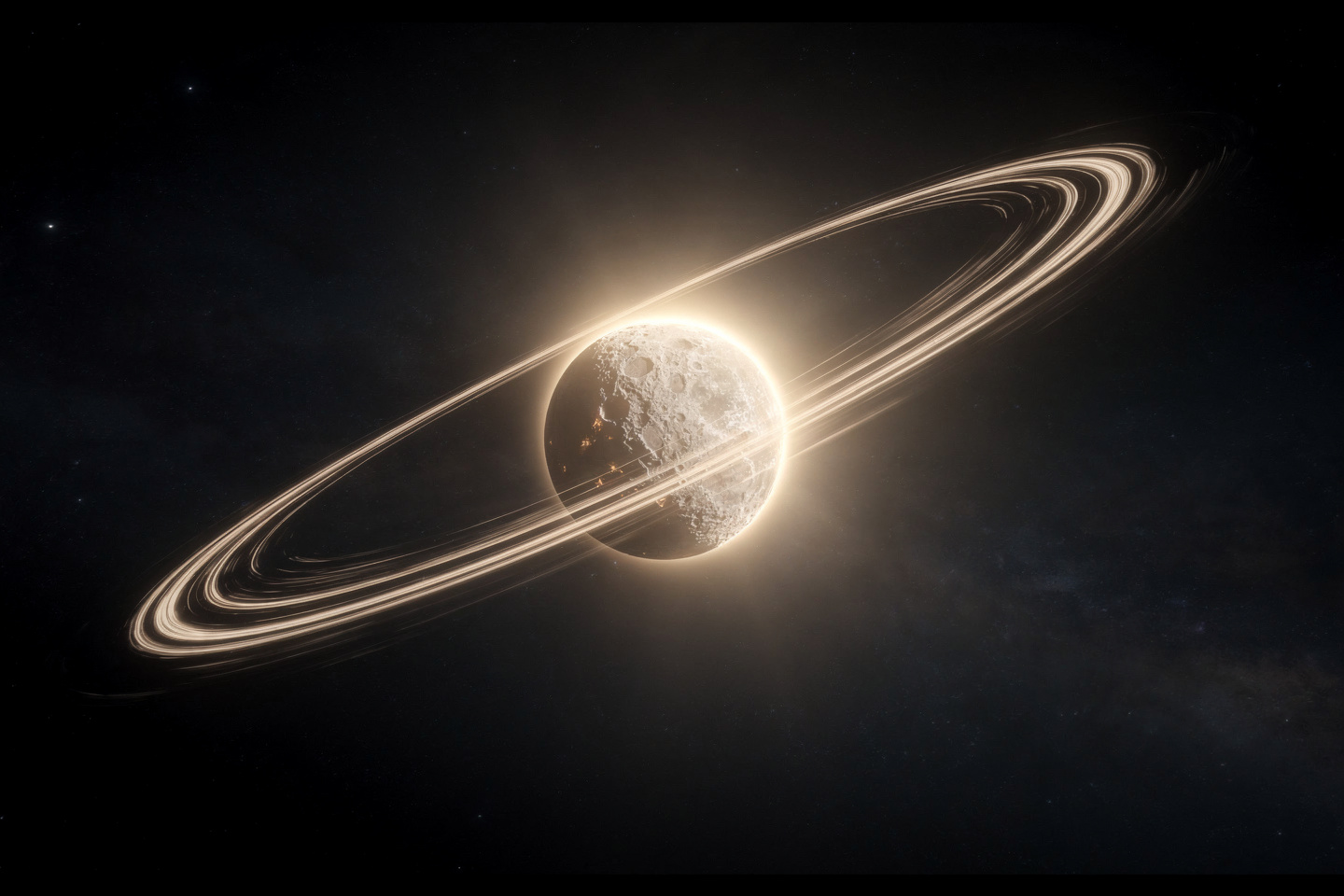

Four Laws, One Picture
| Law | What it says |
|---|---|
| Gravity (Newton) | attractive force ~ product of masses / square of distance |
| Kepler I | orbit is an ellipse, star at the focus, not the center |
| Kepler II | equal areas in equal times — faster near the star, slower far away |
| Kepler III | square of period ~ cube of orbit size |
Kepler found the first two laws in 1609 and the third in 1619, purely empirically, fitting formulas to Tycho Brahe's data. Newton showed in 1687 that all three are not separate rules but mathematical consequences of ONE force (§2). This is a rare case in the history of physics where a law was discovered “backwards”—from observations to formula, rather than from theory to prediction.
Law of Gravity: Force for Two
Statement. Any two bodies attract each other with a force proportional to the product of their masses and inversely proportional to the square of the distance between them:
“Inverse square” is the key detail: increase the distance threefold, the force drops not threefold but ninefold. This also explains why orbits are stable at all (they don’t fly apart or collapse)—with any other exponent (other than 2), orbits would be unstable to the slightest perturbations.
A common confusion: “if there is attraction, why doesn't the Moon fall?” It DOES fall—constantly, all the time. But it also has a sideways velocity (tangential to the orbit), and the fall exactly compensates for how much the Earth's surface “curves away” beneath it due to curvature. Newton illustrated this with a thought experiment “mountain cannon”: the faster you shoot a cannonball horizontally, the farther it travels before falling—and at sufficient speed, it will “fall” around the entire Earth, never reaching the ground. That is an orbit.
Kepler's First Law: Ellipse, Not a Circle
Statement. The orbit of a planet is an ellipse with the star at one focus (not at the center of the ellipse):
For 2000 years before Kepler, everyone (including Copernicus) thought orbits were perfect circles—the “perfect” shape seemed philosophically mandatory for the heavens. Kepler struggled for eight years with the orbit of Mars, trying to fit a circle to Tycho Brahe's precise data, until he gave up and tried an ellipse—it fit perfectly on the first attempt.
Earth's orbital eccentricity is only e ≈ 0.017—almost a circle to the eye, but that's why in January Earth is about 5 million km closer to the Sun than in July (this has nothing to do with seasons—those are caused by axis tilt, not ellipticity).
Kepler's Second Law: Equal Areas
Statement. The line segment joining the star and the planet sweeps out equal areas in equal intervals of time:
The blue and green areas in the diagram are two “sectors” swept out by the planet in EQUAL time: wide in angle but short in radius near the star (planet moves fast, sweeping a large angle) and narrow in angle but long in radius far away (planet crawls slowly, angle barely changes)—their areas are equal. The planet slows down and speeds up visibly in the live animation above: watch how quickly it passes the right edge of the orbit (close to the star) and how slowly the left edge (far away).
This is not a separate postulate but a direct consequence of conservation of angular momentum (part II, §4)—the star's gravity is always directed ALONG the line to the planet (central force), so the torque about the star is zero, and L = r × p is conserved. Since L is constant, and r decreases near the star, the angular speed must increase to compensate (exactly the same math as a figure skater pulling in their arms—part II, §4).
Kepler's Third Law: Scales for Stars
Statement. The square of the orbital period is proportional to the cube of the semi-major axis of the orbit:
Numerical example: a hypothetical planet orbits the Sun at a distance of a = 4 AU. What is its orbital period?
This is exactly how Neptune was discovered (1846)—from the perturbations it caused in Uranus's orbit, astronomers calculated WHERE to look for the unknown planet, even before seeing it through a telescope.
A Running Example: How Exoplanets Are Found
Let's bring all the laws together in a real astronomy problem: a telescope notices a star dimming slightly on a regular basis—a planet passes in front of it (transit method), eclipse period T = 2 years.
- From the star's spectrum, astronomers independently estimate its mass: let M = 2 M☉.
- Kepler's Third Law in the AU/years/solar masses form gives the planet's distance to the star:
No mission has ever flown to this planet—the distance was calculated purely from the star's blinking period and its mass. First law (§3) refines the orbit shape from details of the light curve (symmetry of the dip hints at eccentricity), and second law (§4) explains why transits occur at equal time intervals, not chaotically: the planet's angular speed is predictable at any point in its orbit.
This is precisely the method behind most exoplanet articles on bridge42worlds—the TESS and Kepler telescopes (named after that very Johannes Kepler) looked for such periodic eclipses, and the laws in this note are the direct math used by the authors of those articles.
Where This Leads: From Kepler to Einstein
Kepler-Newton laws work with tremendous accuracy almost everywhere in the Universe—but not perfectly. Mercury's orbit (the closest planet to the Sun, where gravity is strongest) slowly ROTATES as a whole—the ellipse does not stay in place but precesses. Newtonian mechanics predicts most of this precession (perturbations from other planets), but 43 arcseconds per century remained unexplained for nearly 60 years.
In 1915, Einstein applied his freshly derived equations of general relativity to Mercury's orbit—and got exactly the missing 43 arcseconds, without a single adjustable parameter. This was the first real experimental confirmation of GR, even before the famous 1919 eclipse with the bending of starlight. Today we know: Newton's law of gravity is an excellent approximation of general relativity in weak fields and at not-too-high speeds, but it is not the final word in physics.
On the site these are individual laws, if you want to go deeper:
Law of Universal Gravitation · Kepler's First Law · Kepler's Second Law · Kepler's Third Law
Experiment at Home
Stick two pushpins (or pencils) into cardboard 10–15 cm apart, loop a thread around them that's about three times the distance between the pins. Pull the thread taut with a pencil and trace around, keeping it taut at all times.
What to notice you'll get a real ellipse, and the pins are its foci (§3). Move the pins farther apart—the ellipse becomes more elongated (higher eccentricity); bring them almost together—you'll get nearly a circle. This is the same geometric fact that “the sum of distances to two foci is constant”—on it literally hinges all orbital mechanics.
Thread a strong string through a short tube (an old pen shell works), tie a small weight (a washer, a key) to one end, and hold the string with your hand on the other side. Spin the weight in a circle over the tube, then smoothly pull on the free end of the string, shortening the radius of rotation.
What to notice the weight will suddenly speed up its rotation as the radius decreases—this is a mechanical version of Kepler's second law (§4) and conservation of angular momentum (part II): the string tension, like the star's gravity, is directed exactly toward the center, so L is conserved, and as r decreases the angular speed must increase.
Problems to Check
First think for yourself, then open the solution. The solution always follows the scheme: Given → Law → Solution → Answer.
1. The distance between two bodies is tripled, masses unchanged. By how many times does the gravitational force change?
Given rnew = 3r.
Law law of gravity (§2): F ∝ 1/r².
Solution Fnew/F = r²/(3r)² = 1/9.
Answer decreased 9 times — the “inverse square” in action.
2. An exoplanet orbits a star of 4 solar masses at a distance of 2 AU. Find the orbital period in years.
Given M = 4 M☉, a = 2 AU
Law Kepler's third law in AU/years/solar masses (§5): T² = a³/M.
Solution T² = 2³/4 = 8/4 = 2 ⇒ T = √2 ≈ 1.41 years.
Answer ≈1.41 years — a massive star “speeds up” the orbit more than the Sun would at the same distance.
3. A planet at perihelion (closest point to the star) is twice as close to the star as at aphelion (farthest point). By how many times is its speed at perihelion greater than at aphelion?
Given raphelion = 2rperihelion.
Law conservation of angular momentum (§4): L = mvr = const at these two points (velocity is perpendicular to the radius at both).
Solution vperi·rperi = vaphe·raphe = vaphe·2rperi ⇒ vperi = 2vaphe.
Answer twice as high at perihelion—exactly like a figure skater speeding up when pulling toward the axis of rotation.
4. A satellite orbits Earth in 90 minutes at low orbit. Another satellite orbits twice as far from Earth's center. By how many times is its period longer?
Given a2 = 2a1, M is the same (Earth).
Law Kepler's third law (§5): T² ∝ a³.
Solution T2²/T1² = (2a1)³/a1³ = 8 ⇒ T2/T1 = √8 ≈ 2.83.
Answer ≈2.83 times longer — the period grows faster than the distance.
5. Why does Kepler's first law (“orbit is an ellipse”) not work for a system of three or more bodies of comparable mass (e.g., a triple star)? What assumption is violated?
Law the derivation of Kepler's laws is strictly valid for the TWO-body problem (§1-§5—everywhere one star and one planet are implied).
Solution with a third massive body, the gravitational pull is no longer a central force directed strictly toward a single focus—several attractions act on the planet simultaneously, the orbit ceases to be a closed ellipse and becomes chaotic (the three-body problem, in general, cannot be solved analytically).
Answer the assumption “only two bodies” is violated — Kepler's laws in their pure form describe only pairwise gravitational interaction.
A typo, wrong formula, number doesn't add up, poorly explained—write to us: feedback@bridge42worlds.org. Every message is actually read, examined, and a correction is made—it's not just for nothing.