Working note · classical dynamics · part I
Newton's Three Laws: How Dynamics is Born
Inertia, F = ma, and "action equals reaction" — not three separate facts, but one coherent scheme: how to calculate a body's motion if you know the forces acting on it and on its neighbors.
Newton's three laws (1687, "Mathematical Principles of Natural Philosophy") are a minimal set of axioms from which all classical mechanics is derived: why a body with no net force moves uniformly in a straight line, how force, mass, and acceleration are related, and why every action has an equal and opposite reaction. This note covers each law individually with numerical examples and graphs, and then one overarching example (rocket launch) where all three laws work together. The material is aimed at those just starting dynamics; only arithmetic and the intuitive idea of a derivative are required.


Three laws in a nutshell
Newton formulated three laws, but essentially it is one idea presented from three angles: force changes motion, and the measure of that change is the body's mass.
| Law | Statement | What it provides |
|---|---|---|
| I | A body maintains its velocity (including zero) as long as no unbalanced force acts on it | defines what "absence of forces" means |
| II | F = ma | quantitative relationship of force, mass, and acceleration |
| III | FA→B = −FB→A | forces always arise in pairs between two bodies |
The first law is not a special case of the second when F = 0, but a separate statement: it defines the class of reference frames (inertial) in which the second law holds in this simple form. The order in this note follows the historical and pedagogical tradition: first, what "no forces" means (§2), then what forces do (§3), then where forces come from — the interaction of bodies (§4).
| Quantity | Symbol | SI unit |
|---|---|---|
| Force | F | N (newton = kg·m/s²) |
| Mass | m | kg |
| Acceleration | a | m/s² |
| Velocity | v | m/s |
| Momentum (quantity of motion) | p = mv | kg·m/s |
| Time | t | s |
| Acceleration due to gravity | g | 9.8 m/s² (near Earth's surface) |
First Law: Inertia
Statement. If the net force acting on a body is zero, the body moves with constant velocity — in particular, remains at rest if it was at rest. This statement is non-trivial: before Newton (and Galileo), the intuition was "motion requires a force" because on Earth everything is slowed by friction. The first law is an idealization: remove friction and air resistance, and a hockey puck sliding on ice will glide forever.
Key word — net force. Several forces may act on the body, even substantial ones — what matters is that their vector sum is zero. A book lying on a table experiences gravity and the normal force — both are non-zero, but they balance each other.
Tablecloth trick: you sharply pull the tablecloth out from under a set table, and the dishes stay in place. While the cloth is under the plate, friction between them is small and acts for a very short time — the impulse transferred to the plate is negligible. Once the cloth is pulled away, the only horizontal force on the plate disappears, and according to the first law, it simply stays where it was.
A second crucial implication of the first law is the very existence of inertial reference frames: it holds not in any coordinate system, but only in those that are not accelerating or rotating relative to the "fixed stars." In a rotating system (e.g., inside a carousel cabin), a free body, to an observer inside, appears to deviate without any apparent force — this is a signal that the system is non-inertial.
Second Law: F = ma
Statement. The net force acting on a body equals the product of its mass and acceleration — or, more precisely and generally, the rate of change of momentum:
If mass is constant (not a rocket losing fuel, but an ordinary body), the derivative simplifies to:
The same force F pushes three weights of different mass — the same arrangement as in Fig. 1: the light one pulls ahead, the heavy one lags. The v counter is not decoration, but an honest live calculation by v=at (same numbers as in the table above at t=2 s).
Three dots move ACCORDING TO THE v(t) GRAPH in real time — the same animation as the weights above, only as a function rather than a scene. Slope of the line = acceleration a.
Here, mass acts as a measure of inertia: the greater it is, the less acceleration the same force gives. Numerical example — a cart of mass m on a smooth (frictionless) horizontal table, to which a constant force F = 6 N is applied:
| Cart mass | Acceleration a = F/m | Velocity after 2 s |
|---|---|---|
| 1 kg | 6 m/s² | 12 m/s |
| 2 kg | 3 m/s² | 6 m/s |
| 4 kg | 1.5 m/s² | 3 m/s |
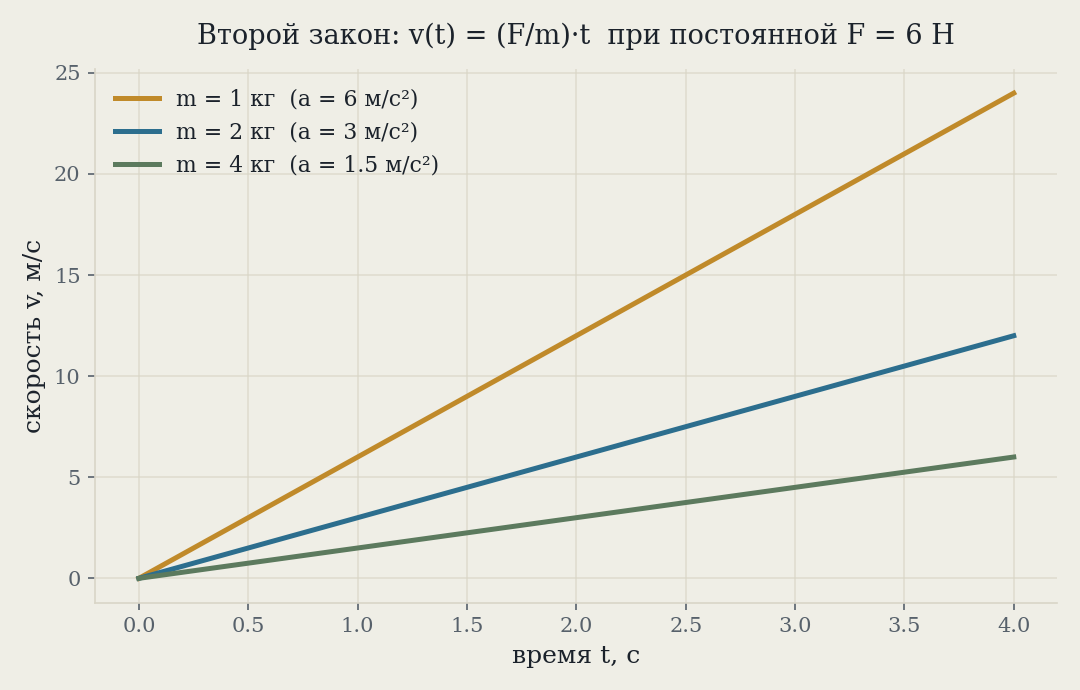
"Force is needed for a body to move" — no: force is needed to change motion (acceleration). A body acted upon by a constant force does not move with constant velocity — it constantly accelerates. Constant velocity means F = 0 (first law), not F = const.
Third Law: Action and Reaction
Statement. If body A exerts a force on body B FA→B, then body B exerts a force on body A of equal magnitude and opposite direction:
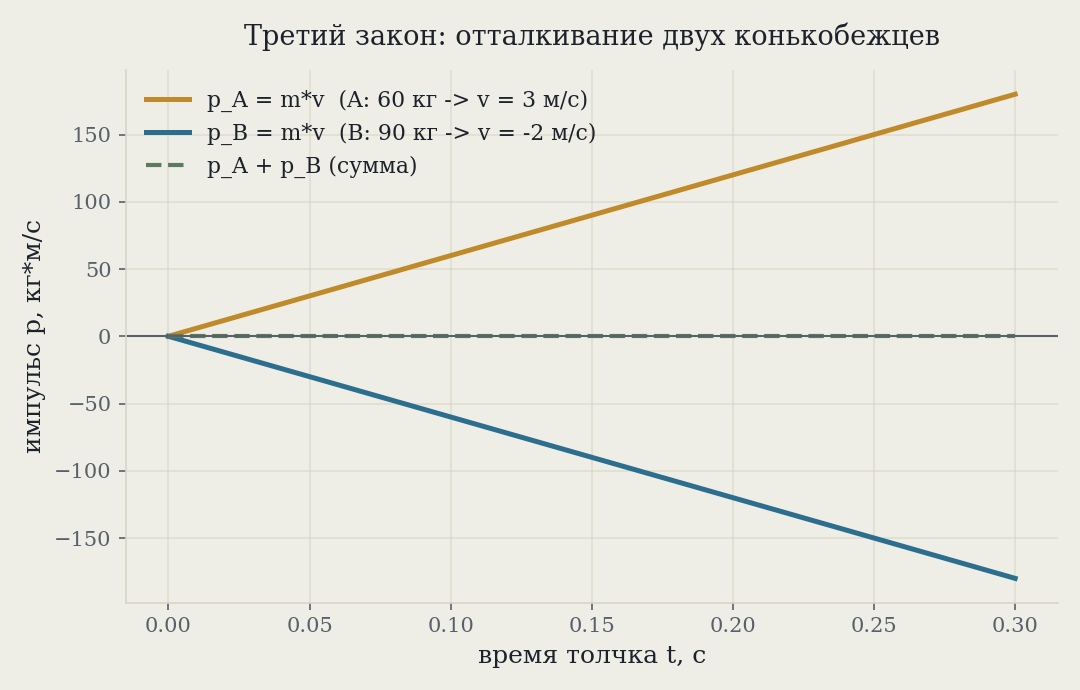
Circle size ~ skater's mass, on‑screen speed ~ actual vA/vB from the calculation — same arrangement as in Fig. 2.
A common confusion is to think that since the forces are equal and opposite, they must cancel out and no motion is possible. The mistake is that FA→B acts on body B, while FB→A acts on body A: they cannot be added in the second law (ΣF for ONE body), as they act on different objects.
Numerical example: two skaters of mass mA = 60 kg and mB = 90 kg stand still and push off each other with their hands. The interaction force at each moment is the same for both (third law) — therefore, the impulse transferred to each (integral of force over time) is also equal in magnitude:
The numbers were chosen so that the answer comes out integral (a standard technique — law first, then specific convenient numbers). With push impulse J = 180 kg·m/s: vA = J/mA = 180/60 = 3 m/s, vB = −J/mB = −180/90 = −2 m/s — the lighter skater flies off faster than the heavy one, but the total momentum of the system remains zero at all times.
A rocket does not "push against air" (there is no air in a vacuum, and rockets work fine there) — it pushes against its own fuel, expelling it backward at high speed. The force with which the rocket ejects gas backward is equal in magnitude to the force with which the gas pushes the rocket forward — this is the third law in its purest form.
All Three Together: Rocket Launch
Let's bring all three laws together in one example. A rocket of mass m = 1000 kg stands on the launch pad.
- The first law explains why it is motionless at first: engine thrust is zero, and gravity is balanced by the normal force — net force is zero, velocity remains zero.
- The engines start and eject gas backward with a reaction force F = 15000 N directed upward — this is a direct consequence of the third law: the gas pushes the rocket with the same magnitude of force as the rocket pushes the gas.
- As long as the rocket's mass is roughly constant (in the first seconds little fuel is burned), the second law gives its acceleration: thrust minus weight.
As fuel burns, the mass m in the denominator decreases, and for the same thrust the acceleration increases — hence the characteristic "increasing" acceleration of real rockets at launch, which for simplicity is not considered here (this is the next level of the problem, where m cannot be assumed constant and the full form (1) is needed).
Where It Leads: Principle of Least Action
F = ma is not the most fundamental formulation of mechanics, but its specific (though most practical) case. There is a more general statement from which all three of Newton's laws are derived, not postulated: a body moves so that the quantity called action S is stationary (in simple cases — minimal) on the actual trajectory compared to any other conceivable trajectory between the same two points:
Applying the calculus of variations (Euler–Lagrange equation) to (4) for an ordinary particle in a potential field yields exactly Newton's second law — not approximately, but identically. However, the action formulation works where "force" is an inconvenient or absent concept (general relativity, quantum mechanics via Feynman path integrals), so it, rather than F = ma, is the working language of modern theoretical physics.
Noether's theorem (1918) connects this to §4 directly: each continuous symmetry of the action (4) corresponds to a conservation law. Homogeneity of time (the laws of physics do not change from moment to moment) yields conservation of energy; homogeneity of space (shift the experiment one meter to the left — the result is the same) yields conservation of momentum — that is, the law of momentum conservation from §4 is not a separate fact but a consequence of the homogeneity of space. Isotropy of space (no preferred direction) similarly yields conservation of angular momentum.
Here mechanics touches philosophy — not accidentally, but historically: the principle was first formulated in the 1740s by Pierre-Louis Maupertuis as a teleological one — nature is "economical" and acts with minimal expenditure, almost like a plan. The modern interpretation (after Feynman) is not teleological: the particle does not "choose" the best path in advance, but actually traverses all conceivable paths simultaneously, and they combine (interfere) such that in the classical limit the path of stationary action survives. Nevertheless, the question "why nature is arranged as an optimization problem at all" remains open and is discussed by the philosophy of physics, not only by physics itself — here the connection of theoretical physics, the mathematics of variational calculus, and the philosophy of science is inseparable.
On the site these are separate laws, if you want to go deeper:
Principle of least action · Noether's theorem · Law of momentum conservation · Law of energy conservation
Experiment at Home
Take a smooth, thin piece of fabric (not fuzzy) and a light plastic cup (empty, unbreakable — start with that, not Grandma's china). Place the cup on the fabric in the middle of the table, grab the edge of the fabric, and sharply pull it horizontally toward you.
What to notice the cup hardly budges, even though the cloth is pulled out completely. The sharper the pull, the less time friction between the cloth and cup has to act — and the impulse of force (§3, F times time) is directly proportional to the duration of action. Short time — small transferred impulse — the cup "doesn't have time" to follow the cloth before it is no longer beneath it. This is the first law in its pure form: no force (cloth gone) — no change in velocity.
Inflate a balloon, don't tie it, and let it go. It will fly chaotically around the room until it deflates.
What to notice this is the third law and §5 (rocket launch) in miniature: the balloon expels air in one direction, the air pushes the balloon in the opposite direction with the same force magnitude. The chaotic flight is because the thrust force in reality is not perfectly symmetric (the neck shifts slightly), unlike the tidy rocket of §5, where thrust is strictly along the axis.
Practice Problems
First think for yourself, then open the solution — a drop‑down block under the condition. Numbers in all problems are chosen so that the answer comes out integral (a standard technique for educational problems: first the law is fixed, then convenient data are fitted to it) — you can calculate in your head, without a calculator. All solutions follow the same pattern: Given → Law → Solution → Answer.
1. A body of mass 3 kg is accelerated from rest by a force of 9 N on a smooth surface. Find the velocity after 4 s and the distance traveled.
Given m = 3 kg, F = 9 N, t = 4 s, v0 = 0.
Law Newton's second law (a = F/m) + kinematics of uniformly accelerated motion (v = at, s = ½at²).
Solution a = 9/3 = 3 m/s²; v = 3·4 = 12 m/s; s = ½·3·4² = 24 m.
Answer v = 12 m/s, path = 24 m.
2. Why in weightlessness (on an orbital station) does an astronaut, after pushing off a wall, continue to fly in a straight line at constant speed until hitting the opposite wall? Which law describes this, and why is the condition for it fulfilled especially accurately there?
Law Newton's first law (inertia, §2).
Solution the net force on the freely flying astronaut is zero — gravity is present, but the station and astronaut fall together in it (this is weightlessness, not "absence of gravity"), so according to the first law the velocity is constant. The condition is met more accurately than on Earth because there is no air resistance and no friction against a surface — the only forces that on Earth prevent observing inertia in its pure form.
Answer first law; the "no force" condition is closer to ideal than on Earth.
3. A person of mass 60 kg jumps from a stationary boat of mass 90 kg to the shore, giving themselves a horizontal velocity of 3 m/s. At what speed will the boat recoil?
Given mperson = 60 kg, vperson = 3 m/s, mboat = 90 kg, total momentum of the system before jump = 0.
Law conservation of total momentum (§4, same approach as for the skaters): 0 = mpersonvperson + mboatvboat.
Solution vboat = −mpersonvperson/mboat = −60·3/90 = −2 m/s.
Answer 2 m/s, in the direction opposite to the jump.
4. A tractor pulls two identical trailers of mass 2000 kg each, connected in series, with a common acceleration of 1 m/s². Find the tension force in the coupling between the first and second trailer.
Given m2 = 2000 kg (the second, rear trailer), a = 1 m/s².
Law Newton's second law, applied separately to the SECOND trailer — the only force acting on it is the tension T from the first trailer.
Solution T = m2a = 2000·1 = 2000 N.
Answer 2000 N (the coupling tractor↔first trailer is under greater tension — 4000 N, because it must pull both trailers at once).
5. A ball is thrown vertically upward with a speed of 20 m/s. After how many seconds will it return to the starting point? (Take g ≈ 10 m/s² — with 9.8 you can't calculate in your head.)
Given v0 = 20 m/s (upward), g ≈ 10 m/s² (rounded deliberately to avoid column arithmetic).
Law Newton's second law for free fall (the only force is gravity, a = −g) — time to reach the highest point (v = 0): tup = v0/g; the up‑and‑down flight is symmetric, total time = 2tup.
Solution tup = 20/10 = 2 s; total time = 2·2 = 4 s.
Answer 4 s (with exact g = 9.8 it would be 4.08 s — rounding changes the answer by less than 2%, and you don't need to calculate).
Typo, wrong formula, numbers don't add up, poorly explained — write to us: feedback@bridge42worlds.org. Every message is actually read, examined, and a correction is made — this is not "into a black hole."