Working note · quantum mechanics · part VI
Schrödinger equation: particle as a standing wave
An electron in an atom is not a ball on an orbit, but something much closer to a vibrating string: it has its own “notes”, and only these notes it can “play”.
In 1926, Erwin Schrödinger, developing Louis de Broglie's idea of the wave nature of matter (see Euler's formula, part V), derived an equation determining the evolution of the wave function ψ — a mathematical object whose squared modulus gives the probability of finding a particle at a given point. The equation is linear and deterministic, but it governs probabilities, not precise trajectories. In this note — the equation itself, its simplest exact solution (particle in a box) and where energy quantization comes from.
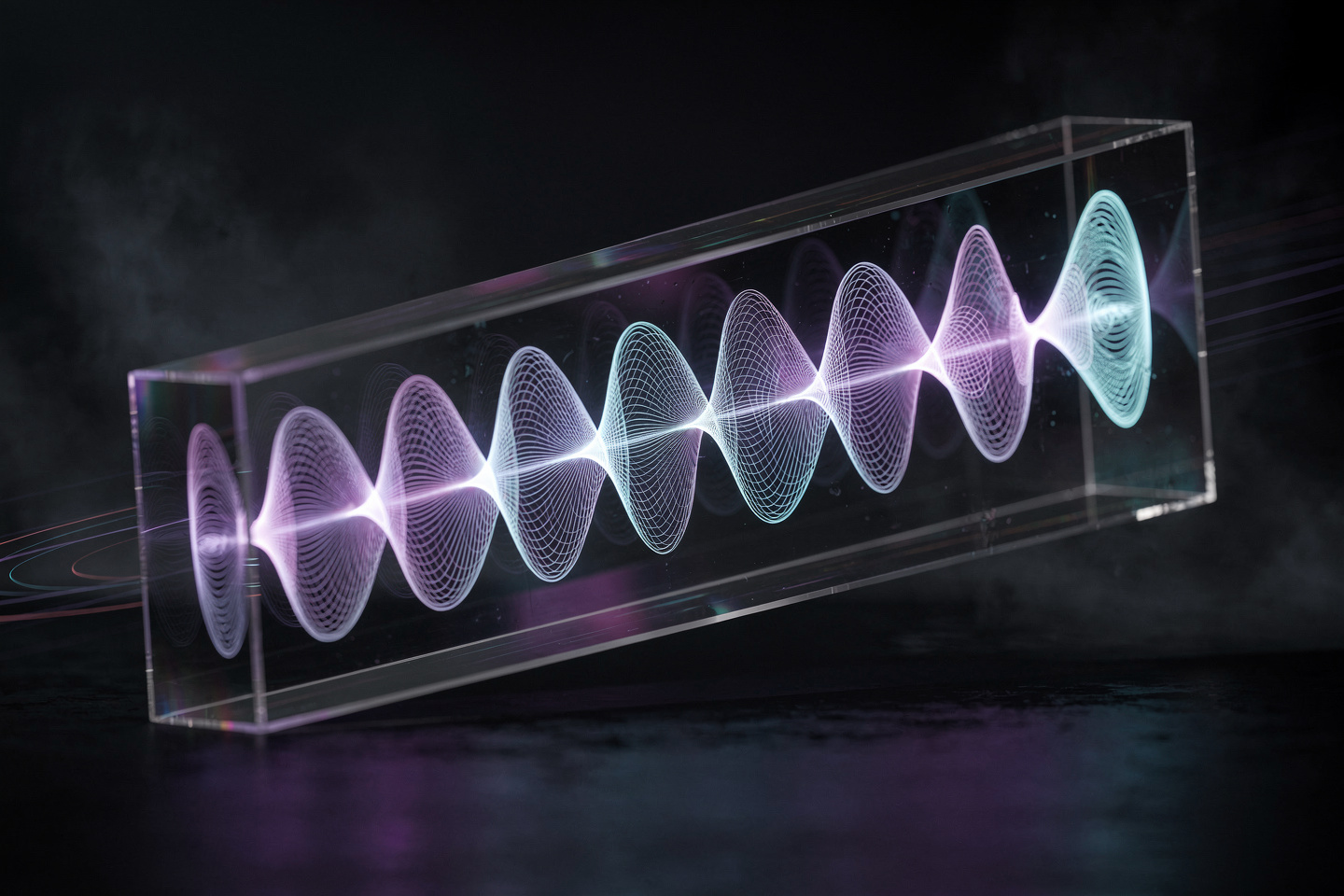

Wave function in a nutshell
In quantum mechanics, a particle does not have an exact coordinate and exact velocity simultaneously (Heisenberg uncertainty principle) — instead, it is fully described by the wave function ψ(x,t), a complex number at each point in space and moment in time.
| Object | What it means |
|---|---|
| ψ(x,t) | wave function — complete description of the particle's state (complex number) |
| |ψ(x,t)|² | probability density of finding the particle near point x at time t (Born rule) |
| ∫|ψ|²dx = 1 | the particle is definitely somewhere — total probability equals 100% |
This does not mean “the particle is smeared out in space like a cloud of dust” — it is more accurate to say: before measurement, there is no fact about where exactly the particle is, only a probability distribution for where the measurement result will land.
The equation itself
Formulation (time-dependent equation). The wave function evolves in time according to the rule:
The imaginary unit i here is not a decoration — recall Euler's formula (part V): it is precisely what ensures that the solution is a rotating phase on the complex plane, meaning |ψ|² remains constant over time if the system is left undisturbed (unitarity, the total probability does not “leak” anywhere).
For states with precisely defined energy E (stationary states) the equation simplifies to an eigenvalue problem:
It is this simpler, stationary form that is used in §3 — it turns the search for a solution into a purely geometric problem: “what shape of wave fits within the given conditions”.
Particle in a box
The simplest exactly solvable system — a particle trapped in a one-dimensional “box” of width L with infinitely high walls (ψ = 0 at the boundaries, like a string fixed at both ends). The solutions of the stationary equation (1) for such a box are exactly standing waves:
Click on n above — the wave shape changes, and with it the number of nodes (points inside the box where ψ = 0, the particle cannot be found there at all). Just like on a guitar string: n = 1 — fundamental tone without nodes, n = 2 — first overtone with one node in the middle, and so on.
Energy quantization
Substituting ψn into equation (1), we get the energy of each level:
This is exactly quantization: unlike a classical particle (a ball in a box can have any energy — push it weaker or stronger), a quantum particle in a box can only have energies from the list E1, 4E1, 9E1, 16E1, ... — no intermediate level is allowed.
The lowest allowed energy — E1, not zero. This is a direct consequence of Heisenberg's uncertainty principle: if the particle had E = 0, it would be absolutely motionless (zero momentum) AND trapped in a box of finite size (precisely known coordinate) — both facts exactly simultaneously, which is forbidden. “Trembling” at the zero level (zero-point energy) — is not a technical detail, but a fundamental prohibition.
Tunneling effect
In reality, the walls of a box are never infinitely high. If the wall has a finite height (energy barrier), the solution of the Schrödinger equation shows: the wave function does not abruptly cut off at the barrier boundary, but only rapidly decays inside it, remaining non-zero — which means there is a small but non-zero probability of finding the particle on the OTHER side of the barrier, even if classically it lacks the energy to jump over it.
It is precisely on the tunneling effect that the scanning tunneling microscope works (1981, Binnig and Rohrer, Nobel Prize): an extremely fine needle is brought almost flush to the surface (without touching!), electrons tunnel through the gap, and from the strength of the tunneling current the surface relief is reconstructed with resolution down to individual atoms. The same effect explains alpha decay of nuclei and the operation of flash memory.
Running example: energy levels
Let in some box the ground state energy E1 = 2 eV (a conventional value for the purity of calculation). According to the formula §4 (En = n²E1) we find several next levels:
| n | En/E1 | En, eV |
|---|---|---|
| 1 | 1 | 2 |
| 2 | 4 | 8 |
| 3 | 9 | 18 |
| 4 | 16 | 32 |
The spacing between adjacent levels GROWS with n (8−2=6, then 18−8=10, then 32−18=14) — not a constant step, as might seem from the word “quantization”. A particle transitioning from level 2 to level 1 emits a light quantum with exactly energy 8−2=6 eV — no more, no less; this is the mechanism that gives rise to the line spectra of atoms (see also the Planck-Einstein equation).
Where this leads: superposition and the cat
The Schrödinger equation is linear — meaning if ψ1 and ψ2 are both solutions, their sum (superposition) c1ψ1 + c2ψ2 is also a solution. A particle can be simultaneously “a bit in state 1 and a bit in state 2” — not figuratively, but literally, until a measurement is performed on it.
Schrödinger himself devised the cat thought experiment in 1935 as a critique, and not as an endorsement of the Copenhagen interpretation: a cat is locked in a box with a mechanism that releases poison with 50% probability if a radioactive atom decays (a quantum event). Formal application of the equation to the WHOLE system “atom+mechanism+cat” before opening the box gives a superposition of “cat alive” and “cat dead” simultaneously — an absurd conclusion for a macroscopic object, by which Schrödinger pointed out the unresolved measurement problem (§7, key_problems): where exactly and why the superposition turns into one definite outcome, the equation itself does not say.
On the site these are separate laws, if you want to go deeper:
Schrödinger equation · Heisenberg uncertainty principle · Superposition principle · de Broglie formula
Experiment at home
Stretch a clothesline rope or a slinky spring between two fixed points (or ask someone to hold one end) and shake it by hand with different frequencies, adjusting the speed until you “catch” a clear standing wave — first with one “antinode”, then (shake faster) with two.
What to notice the wave “stands” in a clear place only at certain shaking frequencies — at intermediate frequencies you get chaotic trembling without a clear shape. This is a VISUAL mechanical model of §3-§4: the fixed ends of the rope play the role of the box walls, and the allowed clear wave shapes are exactly the allowed quantum levels n=1,2,3, only for the rope — with sound frequency, and for an electron — with energy.
In a dark room, point a laser pointer at a thin hair (your own or from a brush), held vertically, so that the beam passes near it, onto a white wall at a distance of 2-3 meters.
What to notice on the wall you will see not just a shadow, but a series of alternating light and dark bands (a diffraction pattern) — direct evidence that light behaves as a wave bending around an obstacle, and not as a stream of particle-balls flying in a straight line. The same wave nature that the Schrödinger equation describes for electrons is visible here to the naked eye for light.
Problems for checking
First think for yourself, then open the solution. The solution everywhere follows the scheme: Given → Law → Solution → Answer.
1. The ground state energy of a particle in a box E₁ = 3 eV. What is the energy of level n = 3?
Given E1 = 3 eV, n = 3.
Law energy quantization in a box (§4): En = n²E1.
Solution E3 = 3²·3 = 9·3 = 27 eV.
Answer 27 eV.
2. The width of the box is doubled, with nothing else changed. How does the ground state energy E₁ change?
Given Lnew = 2L (width doubled).
Law formula §4: E1 ∝ 1/L².
Solution E1,new/E1 = L²/(2L)² = 1/4.
Answer decreased by a factor of 4 — the more spacious the box, the lower the energy of the trapped particle (intuitively: less “cramped”, less kinetic energy of localization).
3. How many nodes (internal points with ψ = 0) does the wave function of level n = 5 have?
Given n = 5.
Law number of internal nodes ψn equals n − 1 (§3: n=1 — 0 nodes, n=2 — 1 node, and so on).
Solution nodes = 5 − 1 = 4.
Answer 4 nodes — there are also 2 “nodes” at the walls themselves, but they are usually not counted, since they are boundaries, not internal points.
4. An electron transitions from level n = 2 (E = 8 eV) to level n = 1 (E = 2 eV), emitting one photon. What is the energy of this photon?
Given E2 = 8 eV, E1 = 2 eV.
Law conservation of energy (part II) + quantization (§6): the photon energy equals the difference of levels.
Solution Ephoton = E2 − E1 = 8 − 2 = 6 eV.
Answer 6 eV — no more, no less; this is how clear lines are born in atomic spectra.
5. Why can't a particle in a box have exactly energy 0 (be completely at rest)? What principle prohibits this?
Law Heisenberg uncertainty principle (§4-footnote).
Solution E = 0 would mean simultaneously exactly zero momentum AND precisely known coordinate (the particle is trapped in a box of finite size) — both facts exactly simultaneously are forbidden by the uncertainty principle Δx·Δp ≥ ℎ/2.
Answer Heisenberg uncertainty principle — hence the minimum, “zero” energy E1, never zero.
A typo, an incorrect formula, a number not adding up, clumsily explained — write to us: feedback@bridge42worlds.org. Every message is actually read, examined, and a correction is made based on it — it's not “into a black hole”.