Working Note · Optics · Part XV
Snell and Bragg: How Light Bends and How X-rays See Atoms
One law explains why a spoon in a glass of tea appears broken; the other — using the same mathematical trick — allowed the shape of the DNA molecule to be seen for the first time.
In Part X we already encountered the 'lifeguard on the beach' problem — a hint at how light chooses the path of least time. Here we provide a full breakdown of two laws governing wave reflection and refraction: Snell's law (1621) for visible light at the interface between media, and Bragg's law (1913) for X-rays on a crystal lattice. Formally they look different, but both are consequences of the same wave interference, and together they cover everything from high-school lens physics to deciphering DNA's structure.
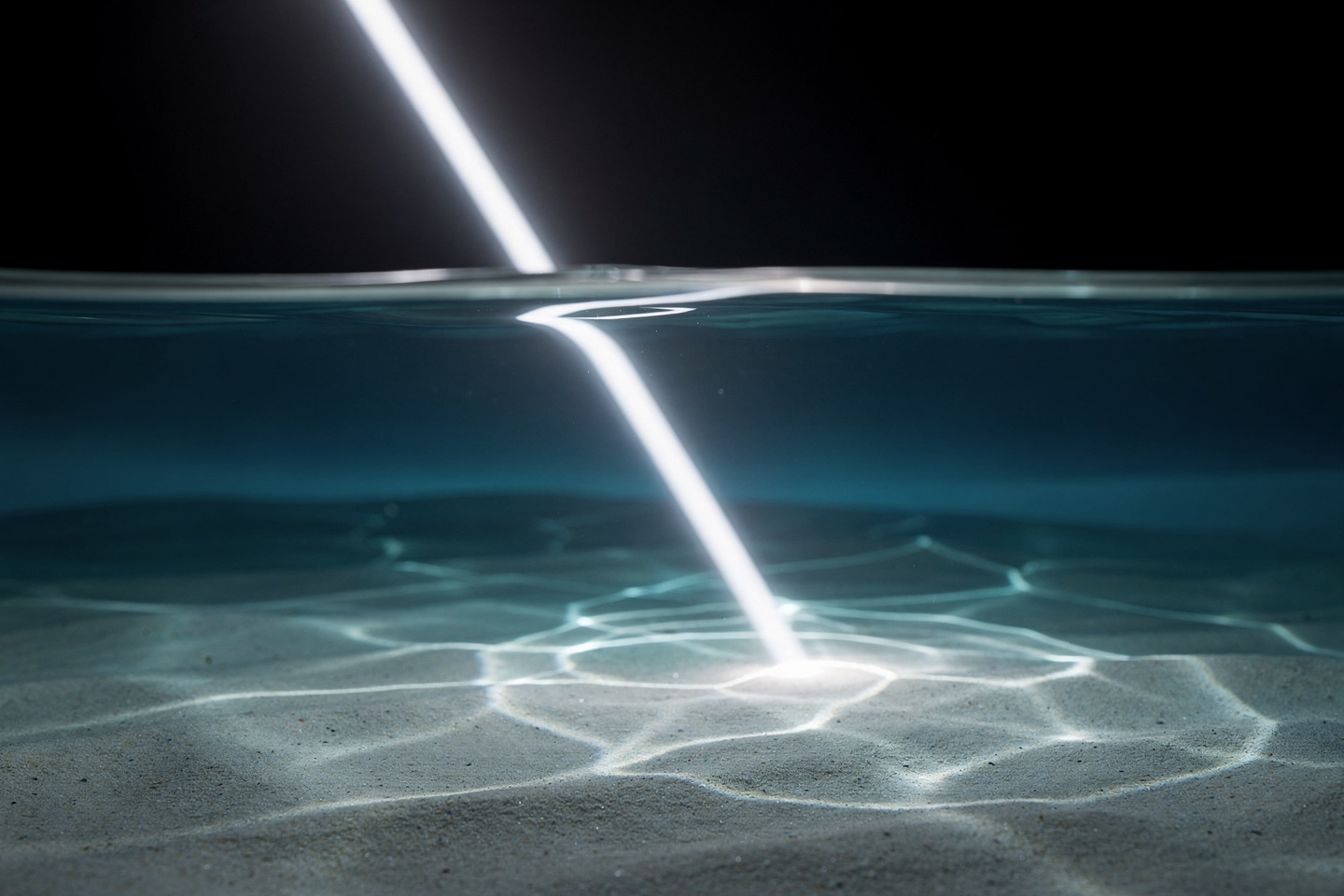
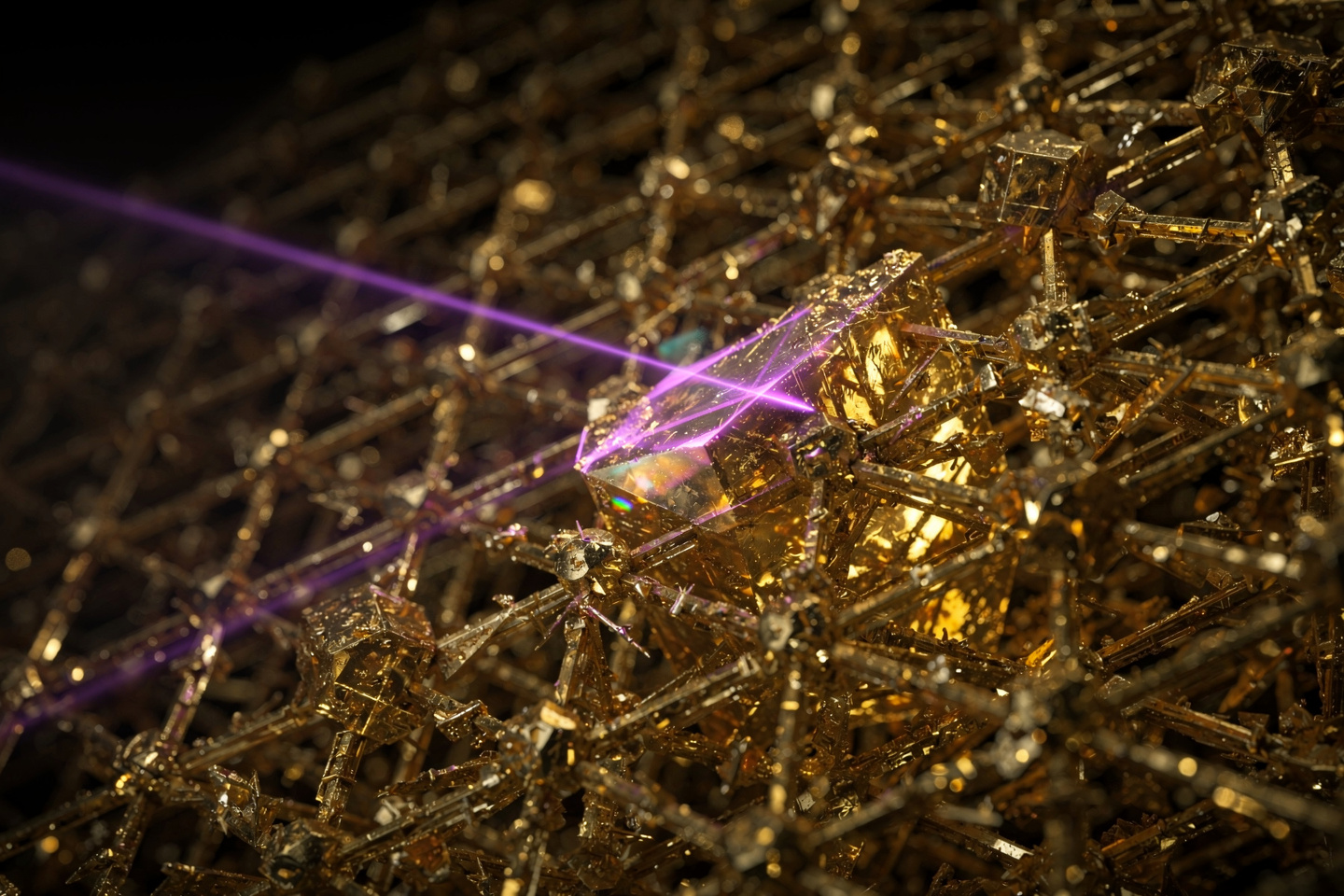
Two Laws of Reflection and Refraction
| Law | Formula | Works for |
|---|---|---|
| Snell (1621) | n₁sinθ₁ = n₂sinθ₂ | refraction of a ray at the boundary of two media |
| Bragg (1913) | nλ = 2d·sinθ | wave diffraction on a periodic lattice (crystal) |
Snell describes ONE boundary (e.g., air-glass). Bragg describes MANY parallel planes inside a crystal—but the underlying mathematics of both laws is related: a wave interacts with a periodic or boundary structure, and the result is determined by the geometry of angles.
Snell's Law: Why Light 'Bends'
Formulation.When a ray passes from one transparent medium to another:
Numerical example: a light ray from air (n₁ = 1) strikes water (n₂ = 4/3 ≈ 1.33) at an angle θ₁ where sinθ₁ = 2/3 (θ₁ ≈ 41.8°). Find the angle of refraction.
The ray moved closer to the perpendicular (41.8° → 30°) — this always happens when entering an optically denser medium (n increases). That is exactly why a pencil in a glass of water looks 'broken': light from the underwater part travels to your eye along a kink, and the brain extends a straight line.
Total Internal Reflection and Optical Fiber
When passing from a denser to a less dense medium (n₁ > n₂, e.g., glass → air), the angle of refraction is ALWAYS greater than the angle of incidence. At a sufficiently large angle of incidence, the refracted ray 'hugs' the boundary itself (θ₂ = 90°) — and if the incidence angle is even steeper, refraction stops entirely: all the light reflects back into the medium. This critical angle is found from the condition sinθcrit = n₂/n₁.
For glass (n₁ = 1.5) at the boundary with air (n₂ = 1): sinθcrit = 1/1.5 = 2/3, θcrit ≈ 41.8° — the same number as in §2, not a coincidence: glass and water have similar refractive indices.
An optical fiber cable is a thin glass thread in which light enters at an angle greater than the critical angle and reflects from the inner wall AGAIN and AGAIN, thousands of times, without any energy loss at each reflection (unlike mirrors, which lose some light at each reflection). It is total internal reflection, not some special coating, that keeps the signal inside the fiber over tens or hundreds of kilometers.
Bragg's Law: Light as a Ruler for Atoms
Formulation.X-rays reflected from parallel atomic planes in a crystal reinforce each other (constructive interference) only at specific angles:
Atomic layers in a crystal act like semi-transparent mirrors — part of the wave reflects from the top layer, part penetrates deeper and reflects from the next. If the path difference between these two reflected waves (geometrically equal to 2d·sinθ) is a multiple of the wavelength, the waves add up 'in phase' and produce a bright signal; if not, they cancel each other out.
Numerical example: X-rays with a wavelength of λ = 0.15 nm are directed at a crystal with interplanar distance d = 0.15 nm. Find the angle of the first (n = 1) bright reflection.
A Through Example: How the Double Helix of DNA Was Seen
In 1952, Rosalind Franklin directed X-rays at crystallized DNA fibers and obtained the famous 'Photo 51' — a cross-shaped pattern of dark spots. Each spot is a bright point where, for a specific angle and specific interplanar distance, the Bragg condition (§4) was satisfied. The characteristic X-shaped pattern directly indicated a HELICAL (not straight, not random) structure of the molecule — James Watson, upon seeing this photo, built the correct double helix model within a few weeks.
Bragg's law (Nobel Prize in Physics 1915 — to father and son Bragg, the youngest pair of Nobel laureates in history: William Lawrence was only 25) has since directly or indirectly been behind the decoding of the structure of insulin, hemoglobin, ribosome, and thousands of other biomolecules — X-ray crystallography remains one of the main methods of structural biology even today, more than a century later.
Where This Leads: The Fermat Principle Again
Snell's law is not a separate postulate of optics, but a direct consequence of Fermat's principle (Part X, §5): light chooses the path of least TIME, and minimizing this time at the boundary of two media with different light speeds mathematically yields exactly n₁sinθ₁ = n₂sinθ₂. The 'lifeguard on the beach' problem, solved in Part X, was not just a warm-up metaphor, but literally the same mathematics.
Bragg's law, in turn, can be derived from a more general wave interference principle — the condition under which combining waves amplify rather than cancel each other. Both pictures (Snell's ray optics and Bragg's wave interference) converge into a unified electromagnetic theory of light, described by Maxwell's equations (Part IV).
On the website these are separate laws, if you want to dive deeper:
Home Experiment
Dip a pencil (or a straw) halfway into a transparent glass of water at an angle (not strictly vertical) and look from the side, slightly from above.
What to noticethe pencil looks 'broken' right at the water-air boundary — light from the underwater part of the pencil refracts according to Snell's law (§2), changing direction at the boundary, and the eye, extending a straight line along the ray's last direction, 'sees' a break where there is no real break in the pencil.
In a dark room, make a small hole in the side of a plastic water bottle (near the bottom), let the water flow out in a thin stream into a sink, and aim a laser pointer through the bottle so that the beam enters the stream FROM INSIDE, right at the hole.
What to noticethe laser beam 'flows' along with the curved water stream, rather than flying in a straight line — this is total internal reflection (§3) in its pure form: water from the inside acts as a flexible light guide, exactly the same principle as in an optical fiber cable, only visible to the naked eye.
Problems to Check
First think on your own, then open the solution. The solution always follows the scheme:Given → Law → Solution → Answer.
1. Light passes from water (n = 4/3) into air (n = 1) at an incidence angle where sinθ₁ = 0.6. Find sinθ₂.
Given n₁ = 4/3, n₂ = 1, sinθ₁ = 0.6.
LawSnell's law (§2): n₁sinθ₁ = n₂sinθ₂.
Solution sinθ₂ = (4/3)·0.6/1 = 0.8.
Answer sinθ₂ = 0.8(θ₂ ≈ 53.1°) — the angle increased because light exits into a LESS dense medium.
2. Find the critical angle of total internal reflection for diamond (n = 2.4) at the boundary with air (n = 1).
Given n₁ = 2.4, n₂ = 1.
Lawcritical angle (§3): sinθcrit = n₂/n₁.
Solution sinθcrit = 1/2.4 ≈ 0.417 ⇒ θcrit ≈ 24.6°.
Answer ≈24.6° — very small angle (diamond has a huge n), which is why a cut diamond 'plays' so brightly: light inside almost always reflects totally, rather than exiting.
3. X-rays with a wavelength of 0.2 nm give the first (n=1) bright reflection from a crystal at a glancing angle of 30°. Find the interplanar distance d.
Givenλ = 0.2 nm, θ = 30°, n = 1.
LawBragg's law (§4): nλ = 2d·sinθ.
Solutiond = nλ/(2sinθ) = 0.2/(2·0.5) = 0.2 nm.
Answer 0.2 nm — typical scale of interatomic distances in crystals.
4. Why is total internal reflection possible only when going from a MORE dense medium into a LESS dense one, and not the reverse?
Law §3 — derivation of the critical angle condition.
Solution sinθcrit= n₂/n₁ must be ≤ 1 (sine cannot be greater than 1) — this is possible only when n₂ ≤ n₁, i.e., when going into a less dense medium. When going into a MORE dense medium (n₂ > n₁), the ratio n₂/n₁ is greater than 1, the equation sinθcrit has no solution — refraction occurs at ANY angle of incidence, a critical angle simply doesn't exist.
Answer the mathematical limitation of sine (≤1)makes the effect possible only in one direction of transition.
5. What is the fundamental difference between the angle θ in Snell's law and the angle θ in Bragg's law (apart from one being for refraction and the other for diffraction)?
Lawcomparison of definitions (§2 and §4).
Solutionin Snell's law, the angle θ is measured from the PERPENDICULAR (normal) to the interface — the standard convention of geometrical optics. In Bragg's law, the angle θ is measured from the PLANE itself (glancing angle) — a historical convention of crystallography. This is purely a convention of reference, not a physical difference, but a frequent source of errors when switching between the two laws.
Answer different angle reference points — from the normal (Snell) versus from the plane (Bragg).
Typo, wrong formula, number doesn't add up, awkwardly explained — write to us: feedback@bridge42worlds.org. Every message is actually read, analyzed, and corrections are made based on it — this is not 'into the void'.