الاهتزازات المترافقة للجسيمات في المسرّع سريع
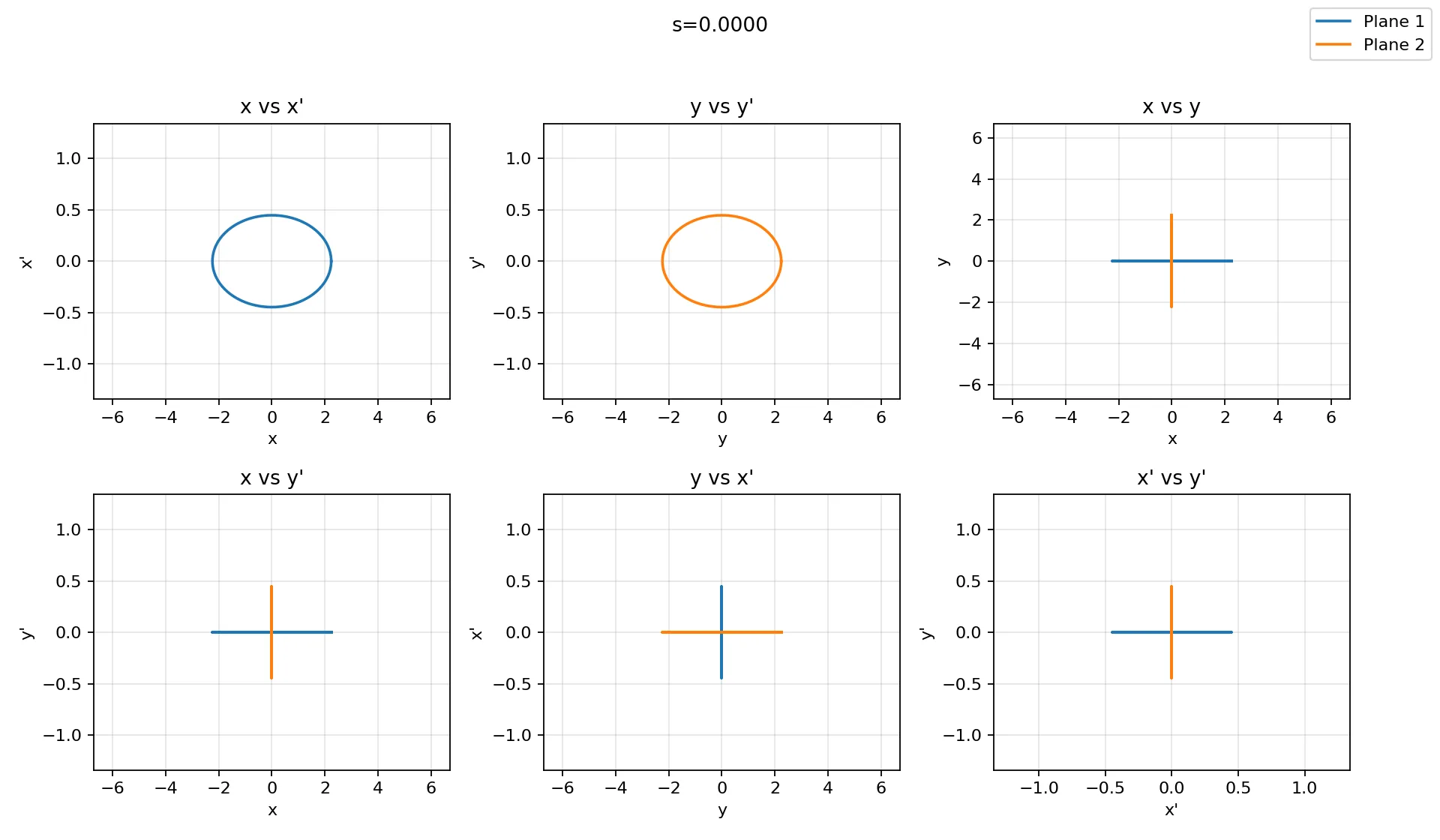
يمكن للجسيمات في المسرّع أن تهتز في اتجاهين عرضيين في آن واحد، وهذه الاهتزازات ليست دائمًا مستقلة. إذا دفعت بندولًا في اتجاه واحد، فسيبدأ بالتأرجح جانبًا أيضًا — هذه هي الاهتزازات المترافقة. في المسرّعات، يحدث هذا بسبب عيوب في المغناطيسات أو إدخالات خاصة، وعندها تصبح حركة الجسيمات معقدة.
من الصعب وصف هذه الحركة لأن الرياضيات تسمح باختيار أنظمة إحداثيات مختلفة. شخصان يصفان الغرفة نفسها: أحدهما يقيس من الجدار الشمالي، والآخر من الجدار الشرقي. الأرقام ستكون مختلفة، رغم أن الغرفة واحدة. في فيزياء المسرّعات، استخدمت مجموعات مختلفة من العلماء لعقود "جدرانها" الخاصة — وكان من الصعب مقارنة نتائجهم.
وجد مؤلفو المقال طريقة للتخلص من هذا التحكّم. لقد أدخلوا معاملات جديدة لا تتغير عند تغيير الأساس — مثل مساحة الغرفة، التي تكون نفسها لأي شخص يقيسها. سُمّيت هذه المعاملات بالحصص المترافقة الثابتة (invariant coupling fractions). علاوة على ذلك، اتضح أن الطرق الخمس المعروفة سابقًا للوصف (إدواردز-تينغ، ومايس-ريبكين، وغيرها) هي مجرد "وجهات نظر" مختلفة لنفس الشيء، مرتبطة بتحويلات مقبولة.
النهج الجديد تم اختباره بالفعل على نماذج رقمية لحلقات مسرّع مترافقة. إنه يسمح بتتبع تغير بصريات الحزمة على طول الحلقة بسلاسة ومقارنة الحسابات بالقياسات بشكل صحيح. هذه خطوة نحو أن يتحدث الجميع بلغة واحدة عند وصف الحركات المعقدة للجسيمات.
الملخص الأصلي
كما كتبه المؤلفون، بالإنجليزية arXiv:2603.04195
Coupled beam optics can be geometrically described in terms of invariant eigenmode planes of a stable symplectic ``one-turn'' map $$\mathcal M\in Sp(4)$$. We show that the non-uniqueness of symplectically normalized bases within each eigenmode plane constitutes an in-plane gauge freedom $$Sp(2)\times Sp(2)$$, and that many coupled-optics parametrizations differ primarily by gauge choice. Building on this fact, we identify basis-independent descriptors of lattice and beam optics and introduce bounded, gauge-invariant coupling parameters or fractions $$u_{k,\mathrm{inv}}$$ computed from orthogonal projectors onto the eigenmode planes. To obtain smooth $$s$$-dependent optics functions and consistent mode labeling, we present a unifying and practical approach based on an $$SO(2)$$ continuity gauge (Procrustes alignment), together with diagnostics for stability and invariance. We further relate Edwards--Teng, Mais--Ripken, Lebedev--Bogacz, Wolski, and Sagan--Rubin parametrizations as gauge-equivalent representations within the respective $$Sp(2)\times Sp(2)$$ gauge freedom. Numerical examples of coupled lattices and beam optics illustrate the proposed invariants and show how representation-dependent scalar coupling parameters (e.g.\ in the Lebedev--Bogacz gauge) can leave their nominal bounds while $$u_{k,\mathrm{inv}}$$, defined here, remain bounded and physically interpretable.
الاهتزازات المترافقة في المسرّع تشبه سلوك الشوكة الرنانة: إذا ضربت أحد الفرعين، فإن الثاني يبدأ أيضًا بالاهتزاز بسبب المقبض المشترك.