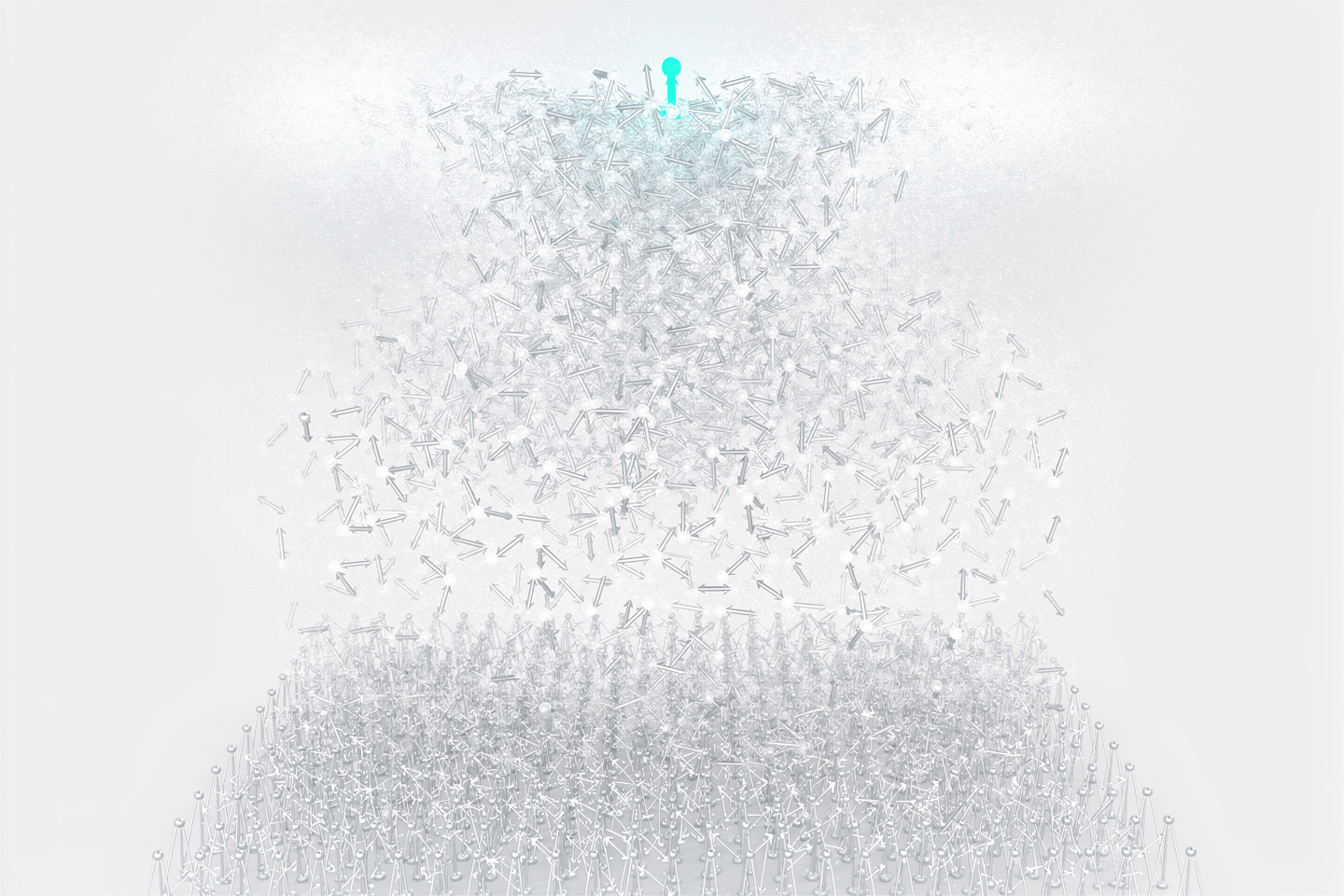
Curie's lawlaw
In 1895, while heating oxygen, palladium, and paramagnetic salts, Pierre Curie discovered a pattern: the hotter the sample, the weaker it responds to a magnetic field. The reason is the opposition between the external field, which aligns atomic magnetic moments, and thermal motion, which disorders them. At low temperatures, the field 'overpowers' the thermal chaos, but as it heats up, disorder wins, and magnetization drops. Formally, the dependence is simple: χ = C/T.
How it works
As long as the sample is cold, most atomic magnets line up nicely along the field, producing noticeable magnetization. As temperature rises, thermal vibrations increasingly break this alignment, and magnetization decreases. This effect is used in magnetic thermometers for cryogenic temperatures and is accounted for when designing MRI devices, where heating of components can weaken the magnetic field.
💡 If Curie's law worked down to absolute zero, the susceptibility would become infinite — an infinitely small field would cause infinite magnetization. In reality, at very low temperatures, quantum effects and interactions between atomic magnets come into play, smoothly transitioning to the Curie–Weiss law.
\chi = \frac{C}{T}
χ — magnetic susceptibility, C — Curie constant (depends on the material), T — absolute temperature in kelvins.