Working note · thermodynamics · part XII
Black-body radiation: how color reveals a star's temperature
A red-hot poker, an incandescent lamp, and a distant star all glow according to the same law — and the attempt to fully explain it in 1900 gave birth to quantum physics.
Any body emits thermal radiation, and the shape of this glow depends only on temperature — not on the material (for an ideal 'black body'). Wien's law (1893) gives the color of the radiation peak, the Stefan-Boltzmann law (1879/1884) gives the total power, and Planck's formula (1900) gives the exact shape of the entire curve; it was the attempt to derive this formula 'from scratch' that forced Max Planck to assume that energy is emitted in portions — quanta. This note covers all three laws with numbers and how astronomers weigh stars by their color.

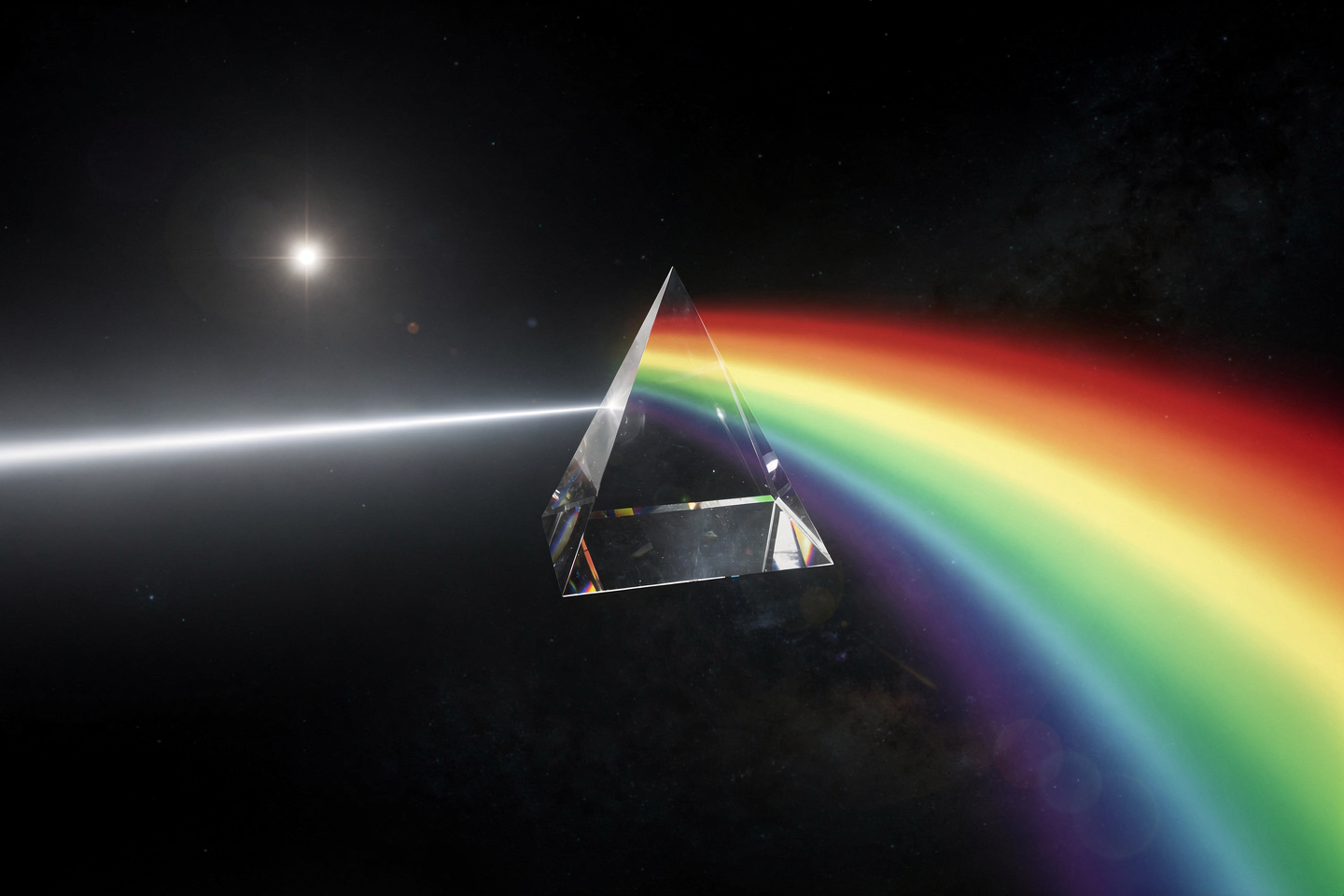
Three laws of one phenomenon
| Law | What it gives | Formula |
|---|---|---|
| Wien (1893) | at what wavelength the radiation peak occurs | λmax = b/T |
| Stefan-Boltzmann (1879/84) | total radiation power | j* = σT⁴ |
| Planck (1900) | full curve shape at every wavelength | B(λ,T) — see §4 |
All three describe the same object — a perfect black body, an ideal absorber (and therefore an ideal emitter) of any incident light. Real stars, incandescent bulbs, and glowing coals are surprisingly good approximations of this idealization.
Wien's law: color reveals temperature
Formulation. The wavelength at which the radiation peak occurs is inversely proportional to temperature:
Numerical example: a body is heated to T = 2900 K (typical incandescent lamp filament). Find the peak wavelength.
The peak for an incandescent lamp is in the infrared, NOT in the visible: the lamp heats more than it illuminates, and the visible yellowish-white light is just the 'tail' of the Planck curve (§4) extending into the visible region. That is why LED lamps (with their peak precisely in visible light) are so much more energy-efficient.
Stefan-Boltzmann law: power grows four times faster
Formulation. The total radiated power per unit area grows as the FOURTH power of temperature:
The fourth power is no small matter: heat a body to twice the absolute temperature — it radiates not twice, but 2⁴ = 16 times more powerfully. This is a sharp, 'explosive' dependence compared to a linear one.
The red giant Betelgeuse is cooler than the Sun (∼3500 K vs. 5800 K) — by temperature alone it should be dimmer. But total luminosity also depends on surface AREA (j*·4πR²), and Betelgeuse's radius is hundreds of times larger than the Sun's — the gigantic area more than compensates for the lower temperature, and the star shines tens of thousands of times brighter than the Sun.
Planck's formula and the birth of quanta
By the end of the 19th century, classical physics (Rayleigh-Jeans law) predicted that a black body should radiate INFINITE energy at short wavelengths — an absurd result dubbed the 'ultraviolet catastrophe'. Real bodies don't behave that way: they have a clear peak and drop off on both sides.
Move the temperature slider higher (§2, animation) — the entire curve shape changes: the peak shifts left (Wien's law) AND the whole curve rises (Stefan-Boltzmann law, area under the curve grows as T⁴) simultaneously, according to one formula:
Planck found this formula in 1900 almost by trial and error — it fit experimental data perfectly, bridging Wien's law (short wavelengths) and Rayleigh-Jeans law (long wavelengths) into one curve. To justify the formula theoretically, he had to assume that energy is emitted not continuously, but in portions E = hν — quanta. Planck himself long considered this a mathematical trick, not physical reality, until Einstein used the same idea to explain the photoelectric effect (part VI, Planck-Einstein equation) in 1905.
A worked example: weighing a star by its color
Astronomers cannot fly to stars with a ruler and thermometer — all data about a star usually boils down to its spectrum. Let's combine both laws in one problem.
Step 1 (Wien's law). Star B is twice as hot as the Sun (T☉ = 5800 K, TB = 11600 K) — so its spectral peak is shifted halfway to the ultraviolet: the star appears noticeably bluer than the Sun to the eye/on a spectrograph. This is how T is measured, knowing nothing about the star's distance.
Step 2 (Stefan-Boltzmann law). If star B's radius is the same as the Sun's, how many times brighter does it shine?
Combining both measurements (color yields T, brightness at a known distance yields total luminosity L), from the Stefan-Boltzmann law L = 4πR²σT⁴ we can also derive the star's radius R — the entire set of the star's physical parameters is obtained without leaving Earth, from its light alone.
Where it leads: cosmic microwave background
The most precise natural black-body spectrum ever measured is not a star, but the Universe itself. The cosmic microwave background (CMB) is cooled light that broke free about 380,000 years after the Big Bang, when the Universe cooled enough to become transparent. Today, after 13.8 billion years of expansion, it has cooled to T ≈ 2.725 K — and follows Planck's formula (§4) with an accuracy no laboratory furnace on Earth could match.
The COBE, WMAP, and Planck satellites measured this radiation with fantastic precision — tiny deviations from the perfect Planck curve (on the order of one hundred-thousandth) carry the imprint of the very first moments of the Universe's existence and underpin modern cosmology, including Hubble's law and the Friedmann equations (next note in the series).
On the website these are separate laws, for a deeper dive:
Planck's radiation law · Wien's displacement law · Stefan-Boltzmann law
Experiment at home
Turn on an electric coil burner (spiral, not induction) to maximum and observe it from a safe distance, without touching, for a minute or two.
What to notice the coil goes from dark (infrared radiation, you feel heat but see no light) to dull red, then bright orange — a direct illustration of Wien's law: heating shifts the radiation peak from invisible infrared closer to the visible spectrum.
Point a TV remote at a smartphone camera (not at your eye — the remote's infrared LED is not directly visible) and press any button while looking at the phone screen in camera mode.
What to notice on the phone screen you'll see a flashing bright dot at the tip of the remote — invisible to the naked eye. The remote's LED emits in the near-infrared (low 'temperature' compared to visible light), and the phone camera sensor (unlike the human eye) is sensitive to this range as well.
Check-up problems
Think first, then open the solution. Every solution follows the scheme: Given → Law → Solution → Answer.
1. A star's surface temperature is 5800 K (like the Sun). Find the peak wavelength of its radiation.
Given T = 5800 K, b ≈ 0.0029 m·K.
Law Wien's law (§2): λmax = b/T.
Solution λmax = 0.0029/5800 ≈ 5×10⁻⁷ m = 500 nm.
Answer 500 nm — green part of the visible spectrum (the Sun appears white because it radiates across the entire visible range, not just at the peak).
2. A star's temperature is tripled. By what factor does its total radiative power per unit area increase?
Given Tnew = 3T.
Law Stefan-Boltzmann law (§3): j* ∝ T⁴.
Solution j*new/j* = 3⁴ = 81.
Answer 81 times.
3. Two stars have the same temperature, but star B's radius is three times larger than star A's. How many times brighter is star B (total luminosity)?
Given TA = TB, RB = 3RA.
Law total luminosity L = 4πR²σT⁴ (§3) — at equal T depends only on area, R².
Solution LB/LA = (RB/RA)² = 3² = 9.
Answer 9 times — luminosity grows with area, not with radius directly.
4. The CMB today has a temperature of ≈2.7 K. At approximately what wavelength is its peak? In what range is this (visible, IR, microwave)?
Given T ≈ 2.7 K, b ≈ 0.0029 m·K.
Law Wien's law (§2, §6).
Solution λmax = 0.0029/2.7 ≈ 1.07×10⁻³ m ≈ 1.1 mm.
Answer ≈1.1 mm — microwave range (hence the name 'cosmic MICROWAVE background').
5. Why did Planck have to assume that energy is emitted in portions (quanta), not continuously, to derive the correct spectrum formula?
Law 'ultraviolet catastrophe' and Planck's formula (§4).
Solution classical physics (Rayleigh-Jeans law, continuous emission) predicted infinite energy growth at short wavelengths — an absurdity contradicting experiment. Introducing quantization (the oscillator can only emit energy in portions E=hν) cuts off the contribution of high frequencies: the higher the frequency, the 'more expensive' a single quantum, and statistically such quanta are emitted less and less — the curve drops off instead of growing infinitely.
Answer quantization eliminates the ultraviolet catastrophe — without it, classical theory yields a physically meaningless (infinite) result.
A typo, wrong formula, number doesn't add up, poorly explained — write to us: feedback@bridge42worlds.org. Every message is actually read, examined, and corrected accordingly — it's not a 'black hole'.