Working note · optics and acoustics · part XVI
The Doppler Effect: Why a Siren Changes Pitch and Stars Change Color
One and the same geometric effect — a wave source approaching or receding from you — makes the siren 'sing' and allows astronomers to weigh the entire observable Universe.
In 1842, Christian Doppler predicted: the frequency of a wave you hear or see depends on how the source moves relative to you. A source flying toward you 'squeezes' the waves in front of it — you hear a higher pitch or see a bluer light. The same effect, applied not to a siren but to distant galaxies, led to the discovery of the expanding Universe. In this note — the sound and light versions of the effect with numbers, and how it turned into a tool for measuring the speed of the cosmos' expansion.

The effect in a nutshell
| Wave | Approaching | Receding |
|---|---|---|
| Sound | higher pitch (frequency increases) | lower pitch (frequency decreases) |
| Light | blueshift (frequency increases) | redshift (frequency decreases) |
A clear analogy from Doppler's own description: if you throw a pebble into a pond every second while standing still, the circles spread out evenly. If you WALK forward while doing so, the circles ahead of you become squeezed (you almost catch up with the previous one), while those behind you are stretched. Exactly the same happens with the crests of a sound or light wave when the source moves.
Sound: ambulance siren
Formula (moving source). Frequency heard by a stationary observer when the source approaches at speed vs:
Numerical example: an ambulance siren emits f = 900 Hz, the vehicle approaches at speed vs = 34 m/s (122 km/h). Find the frequency heard by a person in front.
After the vehicle passes by, the frequency drops sharply (receding, '+' sign in the denominator) — that downward pitch jump just as it passes you is something everyone has heard at least once in their life.
Light: redshift and blueshift
Formula. For speeds much less than the speed of light (v ≪ c), the wavelength shift is proportional to the speed:
Numerical example: a star's spectral line in the lab has a wavelength λ = 500 nm. From a distant star, the same line is observed at λ' = 505 nm. Find the star's speed relative to us.
The line shifted towards LARGER wavelengths (redward in the spectrum) — meaning the star is RECEDING from us at 3000 km/s (1% of the speed of light). Astronomers measure the speeds of stars and galaxies exactly this way — not by chasing them with a radar, but by comparing the positions of familiar spectral lines (like hydrogen lines) with their lab values.
A running example: how a police radar works
The radar does not simply capture the Doppler shift once — the signal takes a DOUBLE path: the radar emits a wave towards the car (first shift, the car 'sees' a shifted frequency as a moving observer), the car reflects it back (second shift, now the car acts as a moving source for the stationary radar). Both shifts add up, and for v ≪ c the overall formula simplifies to:
Numerical example: a radar at frequency f = 10 GHz measures a shift from a car approaching at speed v = 30 m/s (108 km/h). Find the Doppler frequency shift.
The radar electronics measures exactly this 2 kHz shift (a tiny fraction of the 10 GHz carrier frequency, but easily measurable by modern electronics) and instantly converts it back into speed using the same formula — the entire calculation takes a fraction of a second.
Where this leads: Hubble's law
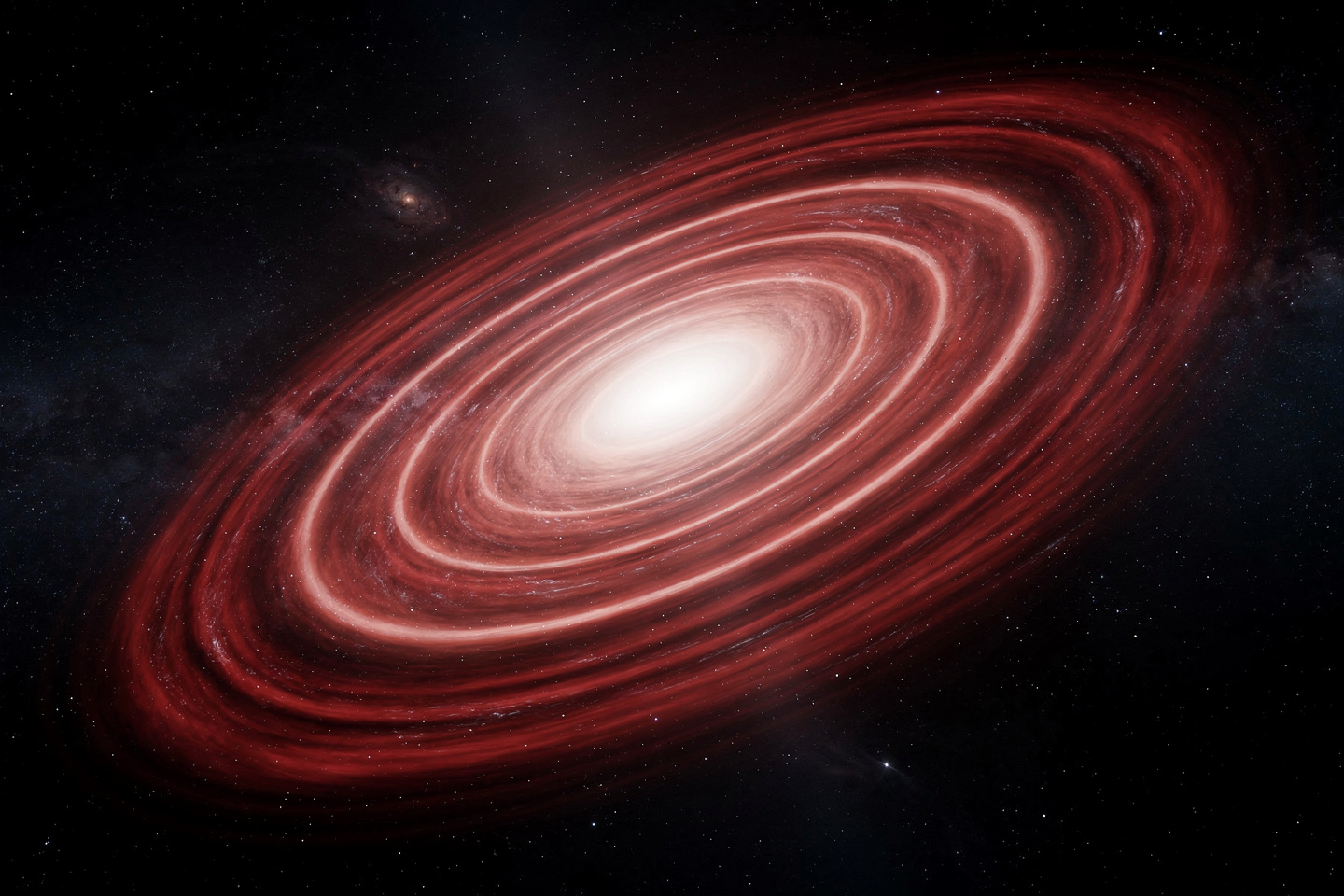
In the 1920s, Edwin Hubble, measuring the Doppler redshift of distant galaxies using the same method as in §3, noticed a pattern: ALMOST ALL galaxies are receding from us, and the farther the galaxy, the FASTER it is receding. This discovery is the direct experimental foundation of the expanding Universe theory and the Big Bang.
Strictly speaking, the cosmological redshift of distant galaxies is NOT motion of galaxies THROUGH space (as with a siren or a car), but the stretching of SPACE itself between us and the galaxy as the Universe expands, which also stretches the wavelength of light traveling through that space. At small distances and low speeds, the mathematics is indistinguishable from the ordinary Doppler effect (§3), but at very high speeds (comparable to the speed of light), precise calculations require general relativity, not just the Doppler formula. A full treatment of Hubble's law — the next note in the series, on cosmology.
On the website, this is a separate law if you want to go deeper:
Home experiments
Tie a small sounding object (e.g., a phone with an alarm/continuous tone on, wrapped in a sock for softness, or a special 'Doppler' buzzer-whistle on a string, if available) to a sturdy string about a meter long and whirl it in a circle above your head at a constant speed, standing in an open space.
What to observe the pitch noticeably 'wavers' — higher when the source flies TOWARD you (approaching along the tangent of the circle), lower when it flies away from you on the opposite side of the circle. This is the same effect as with the siren (§2), only the source moves in a circle rather than a straight line.
Next time a train, a car with an open window (playing music with a clear note), or a siren passes you — pay special attention to the moment when the source goes right past you.
What to observe a sharp downward pitch jump exactly when the source is directly opposite you (valong the line of sight changes sign from 'approaching' to 'receding') — an effect you have surely heard thousands of times without realizing it is exactly the formula from §2 in its pure form.
Practice problems
First think for yourself, then open the solution. The solution follows this scheme: Given → Law → Solution → Answer.
1. A train horn sounds at 500 Hz and is receding from you at 20 m/s (speed of sound 340 m/s). What frequency do you hear?
Given f = 500 Hz, vs = 20 m/s (receding), c = 340 m/s.
Law Doppler effect for a receding source (§2): f' = f·c/(c+vs).
Solution f' = 500·340/360 ≈ 472.2 Hz.
Answer ≈472 Hz — lower than the original 500 Hz, as expected for a receding source.
2. A galaxy's spectral line (lab wavelength 400 nm) is observed shifted to 404 nm. Find the galaxy's speed and direction (approaching/receding).
Given λ = 400 nm, λ' = 404 nm.
Law Doppler formula for light (§3): v = cΔλ/λ.
Solution Δλ = 4 nm; v = (3×10⁸)·4/400 = 3×10⁶ m/s = 3000 km/s.
Answer 3000 km/s, receding (wavelength increased — redshift).
3. A radar at 20 GHz registers a 4 kHz shift from an approaching car. Find the car's speed.
Given f = 20 GHz, Δf = 4 kHz.
Law radar formula (§4): Δf = 2vf/c.
Solution v = Δf·c/(2f) = 4000·(3×10⁸)/(2·20×10⁹) = 1.2×10¹²/4×10¹⁰ = 30 m/s.
Answer 30 m/s (108 km/h).
4. Why, when using a radar, is the frequency shift calculated with a factor of 2, and not with the ordinary single Doppler formula?
Law §4 — radar operation mechanics.
Solution the signal experiences a DOUBLE Doppler shift: first when traveling from the radar to the moving car (the car as a moving receiver sees a shifted frequency), then when reflecting back from the car to the radar (the car now acts as a moving SOURCE of the reflected wave for the stationary radar receiver). Two identical shifts in sign add up, hence the factor of 2.
Answer double pass of the signal — to the target and back to the radar.
5. How does the cosmological redshift of distant galaxies fundamentally differ from the 'ordinary' Doppler effect of a siren?
Law §5, important subtlety of Hubble's law.
Solution for a siren, the source physically moves THROUGH stationary space/air. For distant galaxies, the shift is caused by the stretching of space itself between us and the galaxy as the Universe expands — the galaxy does not necessarily 'fly' through space in the usual sense; rather, the space between us increases, stretching the wavelength of light passing through it.
Answer motion through space (siren) versus stretching of space itself (cosmological shift) — at low speeds mathematically indistinguishable, at high speeds requires general relativity.
A typo, incorrect formula, number off, poorly explained — write to us: feedback@bridge42worlds.org. Every message is actually read, reviewed, and we make corrections based on it — it's not 'for the drawer'.