منشئ الجزيئات للبطاريات سريع
داخل كل بطارية، يتحرك سائل الإلكتروليت، وكيفية تزاحم الأيونات فيه تحدد مقدار الطاقة التي ستعطيها البطارية ومدى عمرها. في السابق، كان لاستكشاف هذا التزاحم إما إجراء تجارب طويلة أو تشغيل حسابات فائقة الدقة تستهلك أسابيع من وقت الحاسوب. الآن ظهر طريق ثالث: نموذج يتعلم من ملايين الأمثلة ويعطي الصورة شبه فوريًا.
أخذ مؤلفو الدراسة نموذجين من هذا القبيل. درّبوا الأول على البلورات غير العضوية — فهو يعرف عالم المواد الصلبة. ودرّبوا الثاني على مجموعة OMol25، التي تضم عشرات الملايين من التشكيلات الجزيئية، بما في ذلك تلك الموجودة في الإلكتروليتات. اتضح أن النموذج "الجزيئي" يتنبأ بالكثافة وعوامل البنية بالأشعة السينية بدقة أعلى بشكل ملحوظ من النموذج "البلوري".
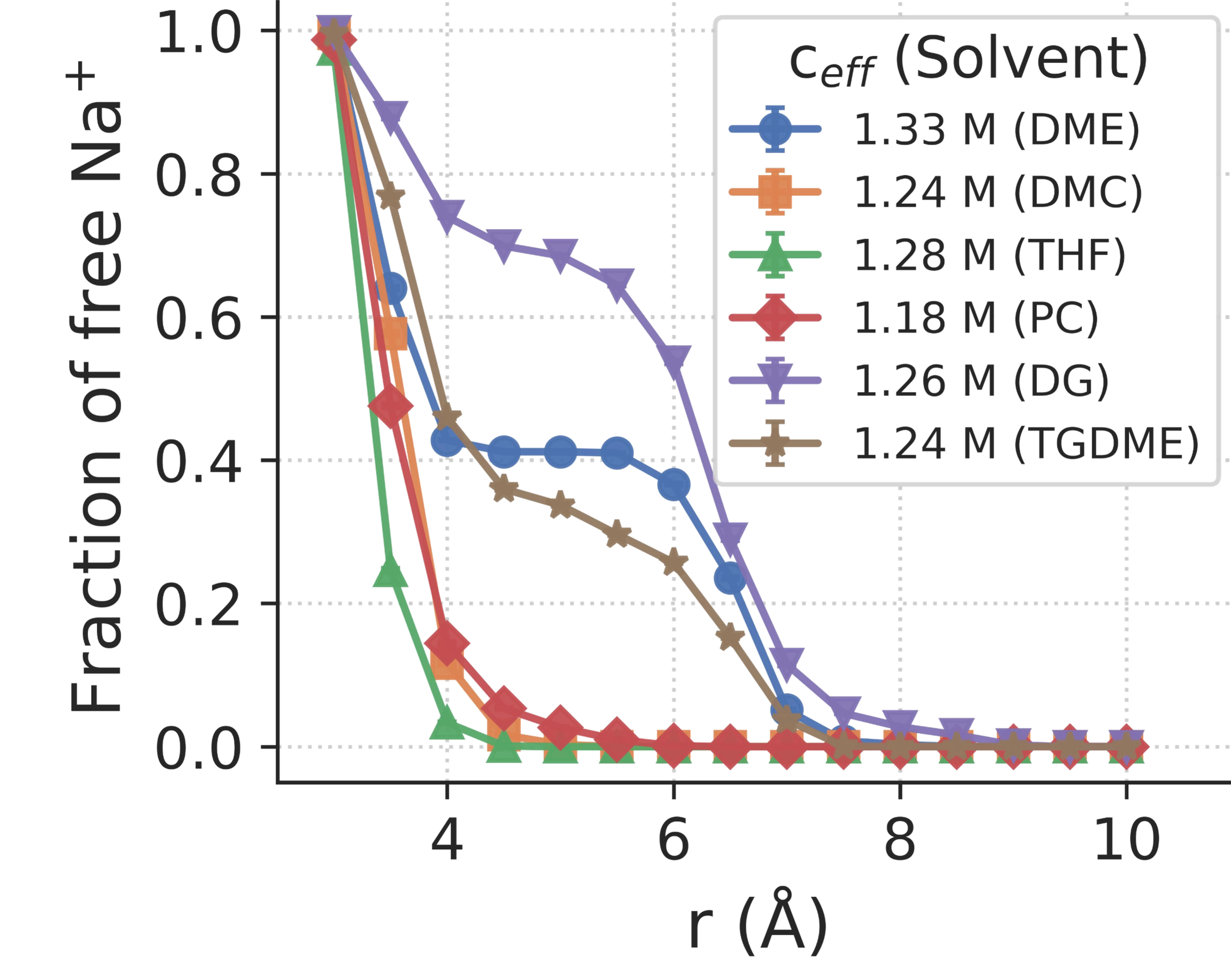
ثم أظهر النموذج كيف تتغير عملية الذوبان (solvation) حسب التركيب: أي كاتيون، وأي أنيون، وكمية الملح، وشكل جزيء المذيب. على سبيل المثال، في إلكتروليتات الغليم (glyme)، حتى التغيير الطفيف في طوبولوجيا المذيب يعيد ترتيب الارتباطات الأيونية بشكل ملحوظ. هذه الحساسية للتفاصيل كانت سابقًا تفوت النماذج التقريبية.
الآن يمكن للمهندسين تجربة تركيبات الإلكتروليت على الحاسوب وكأنها قطع من لعبة تركيب، وفقط أفضل الخيارات تُختبر في المختبر. هذا يسرّع البحث عن بطاريات صوديوم آمنة وعالية السعة — والصوديوم متوفر بكثرة أكثر من الليثيوم.
الملخص الأصلي
كما كتبه المؤلفون، بالإنجليزية arXiv:2603.20183
Machine learning interatomic potentials (MLIPs) trained on large, chemically diverse datasets are revolutionizing computational chemistry, enabling molecular dynamics simulations of battery electrolytes with near-DFT accuracy over 10,000 times faster than DFT. While previous MLIP training datasets with suitable elemental coverage for electrolytes have been based on inorganic materials, the Open Molecules 2025 (OMol25) dataset provides large-scale molecular DFT MLIP training data with broad elemental coverage and specifically samples tens of millions of electrolyte configurations. Here, we integrate computational modeling with experimental validation to systematically assess the ability of large-scale MLIPs pre-trained on materials data or on OMol25 to accurately resolve nanoscale structural organization and ion-solvation characteristics in Na-ion battery electrolytes across diverse physicochemical conditions and compositional regimes. We find that the OMol25-trained Universal Model of Atoms (UMA-OMol) predicts experimentally measured densities and X-ray structure factors in substantially better agreement compared to state-of-the-art models trained only on inorganic materials data. Using UMA-OMol, we further analyze systematic trends in solvation structure as a function of cation identity, anion chemistry, salt concentration, and solvent topology. We observe that increasing system temperature amplifies the heterogeneity within the solvation environment, perturbing cation-solvent interactions and promoting the formation of contact ion pairs (CIPs). Moreover, subtle variations in the solvent topology of glyme-based electrolytes cause pronounced changes in ion-correlations and solvation structure. The experimental agreement and microscopic insights shown here position OMol25-trained MLIPs as a practical route to predictive, high-throughput electrolyte simulations.
الصوديوم هو العنصر السادس من حيث الوفرة في القشرة الأرضية، ويمكن استخراجه من ملح الطعام العادي، لذلك بطاريات الصوديوم قد تكون أرخص من بطاريات الليثيوم.