كيف تسبح البكتيريا عبر المخاط سريع
بكتيريا الإشريكية القولونية سبّاحة صغيرة في عالم يكون فيه الماء كثيفًا كالهلام. داخل أمعائنا لا تنزلق بحرية، بل تشق طريقها عبر المخاط — شبكة معقدة من الجزيئات الطويلة تشبه كرة من الخيوط المتشابكة. كيف تتمكن البكتيريا من التحرك في مثل هذه البيئة؟
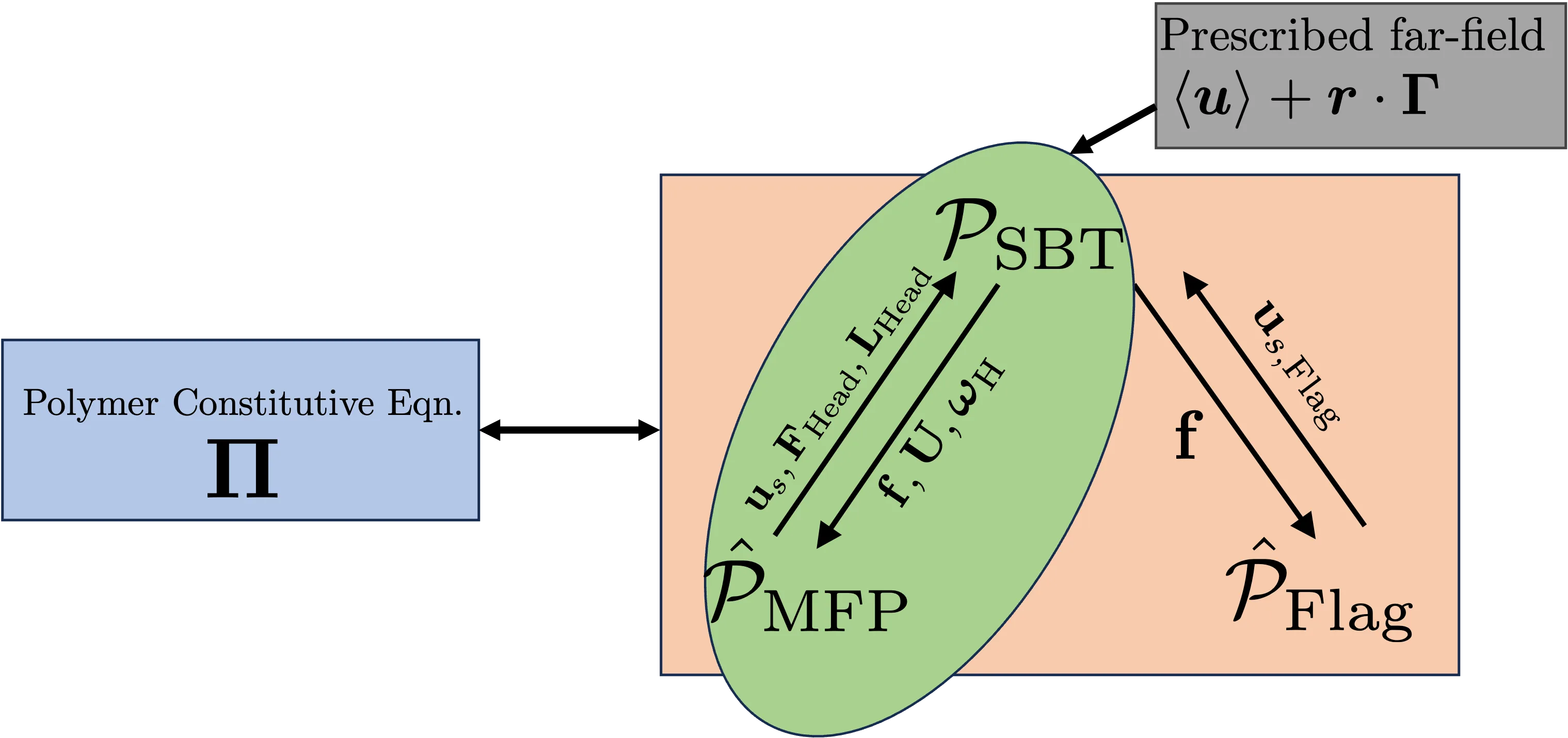
بنى العلماء نموذجًا حاسوبيًا تسبح فيه بكتيريا برأس بيضاوي وذيل سوطي رفيع عبر المخاط. يعمل الذيل كمروحة صغيرة، لكنه رفيع جدًا لدرجة أنه ينزلق بين خيوط المخاط. يُظهر النموذج أن الذيل يدفع الماء، والماء يدفع المخاط، ومن طريقة انسياب المخاط حول الرأس والذيل تتحدد سرعة البكتيريا.
النتيجة الرئيسية: يمكن تقسيم حركة البكتيريا إلى ثلاثة أجزاء — كيف تحرك الجسم بنفسها، وكيف يعمل الذيل، وكيف يضغط المخاط عليها استجابةً لذلك. وهذا يتيح حسابًا سريعًا لكيفية سباحة البكتيريا في أي مخاط. سابقًا كانت هذه الحسابات تستغرق أيامًا، أما الآن فدقائق.
هذا النهج سيساعد في فهم كيف تشق البكتيريا الممرضة طريقها عبر المخاط الواقي في الرئتين أو الأمعاء، وربما يلمّح إلى كيفية إيقافها.
الملخص الأصلي
كما كتبه المؤلفون، بالإنجليزية arXiv:2603.27445
We develop a numerical framework to simulate the locomotion of a flagellated bacterium with a spheroidal head (such as Escherichia coli) in biological fluids like mucus, which are entangled polymer solutions exhibiting elasto-viscoplastic (EVP) rheology and porous microstructure. To account for the scale disparity between the large bacterial head and the slender flagellar bundle, whose thickness is comparable to the pore size, we employ a two-fluid model in which the bundle directly drives the solvent and exchanges momentum with the polymer phase via drag proportional to their relative velocity. The numerical implementation combines a finite-difference discretization of the two-fluid equations with a slender-body theory (SBT) to model flagellar forcing. A key observation is that the coupled mass and momentum equations for these inertialess flows, together with SBT, are linear in the pressure and velocity fields and in the force distribution along the flagellar bundle. By treating the polymer stress as a body force, we decompose the flow field and hydrodynamic moments into three additive contributions: kinematic (motion), flagellar forcing, and polymer stress. This decomposition allows several components of the flow to be precomputed and enables the determination of swimming velocity via a resistivity formulation driven by polymer-induced forces, which greatly improves computational efficiency during transient calculations of the polymer stress and the resulting flow. We validate the method and use it to analyze how polymer microstructure and its interactions with the bacterial head and tail affect motility in complex biofluids.
يمكن لبكتيريا الإشريكية القولونية أن تقطع مسافة تعادل 10 أضعاف طولها في ثانية واحدة — وهذا مثل أن يسبح الإنسان 20 مترًا في الثانية.