الدماغ المترجم: كيف يسمع أشخاص مختلفون الإشارة نفسها سريع
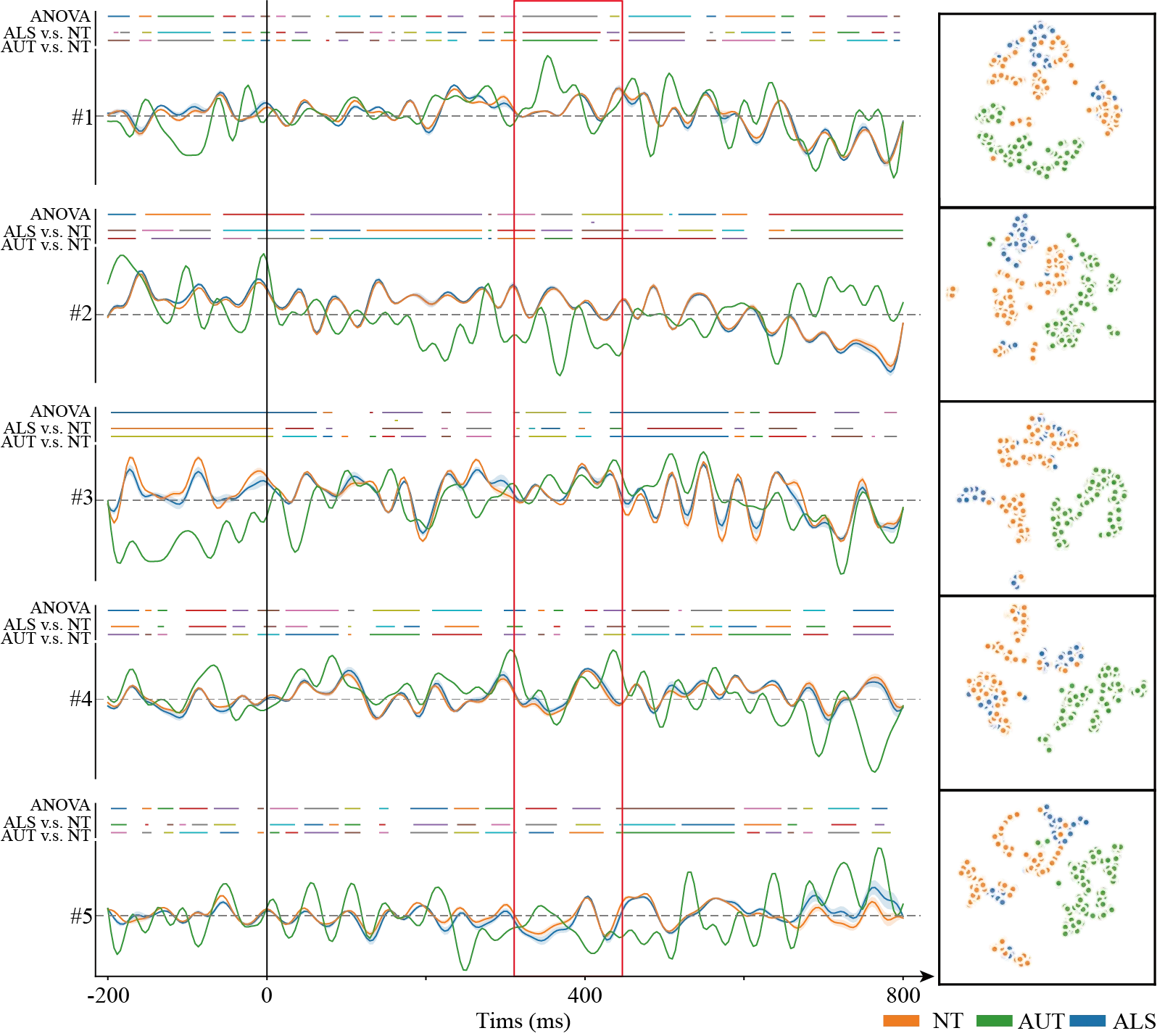
ينظر الشخص إلى حروف تومض على الشاشة، ويخمّن الحاسوب أيًّا منها اختار بناءً على دفعة في نشاط الدماغ. يشبه هذا مترجمًا يلتقط ليس الكلمات بل الإشارات الكهربائية للدماغ. لكن أدمغة مختلف الناس «تتحدث» بلكنات مختلفة: لدى أحدهم تكون الإشارة ساطعة وواضحة، ولدى آخر هادئة ومشوشة. قرر العلماء معرفة الفروق الدقيقة بين هذه اللهجات.
جمعوا تسجيلات لموجات الدماغ من ثلاث مجموعات من الأشخاص: مصابون بالتصلب الجانبي الضموري (مرض تضعف فيه العضلات)، ومصابون بالتوحد، وأشخاص لا يعانون من هذه الخصائص. وللتحليل، ابتكروا برنامجًا لا يكتشف الإشارة فحسب، بل يُظهر أيضًا «صورتها» — كيف تبدو الموجة النموذجية لكل مجموعة. واتضح أن الصور مختلفة فعلًا: لدى مجموعة تكون الموجة أكثر حدة، ولدى أخرى أعرض، ولدى ثالثة منزاحة زمنيًا.
هذا الاكتشاف مهم للأشخاص الذين لا يستطيعون الكلام أو الحركة. بالنسبة لهم، واجهات الدماغ هي الوسيلة الوحيدة للتواصل. إذا عرف البرنامج كيف تبدو إشارة هذا الشخص تحديدًا، فسيقل خطؤه. في المستقبل، ستتمكن هذه الأنظمة من التكيف مع كل شخص منذ الدقائق الأولى للاستخدام، مثل مترجم جيد يعتاد بسرعة على صوت محدثه.
الملخص الأصلي
كما كتبه المؤلفون، بالإنجليزية arXiv:2604.24765
P300-based brain-computer interfaces (BCIs) are widely used for communication, but population heterogeneity may alter the neural patterns available for decoding. Prior work has mainly examined such differences at the signal or performance level, while the representation structure learned by the decoder remains underexplored. In this study, we propose an interpretable fuzzy spatiotemporal framework for P300 classification and use it to analyze population-level differences across amyotrophic lateral sclerosis (ALS), autism (AUT), and neurotypical (NT) cohorts. The model employs spatial and temporal fuzzy filters with learnable prototypes, enabling both classification and reconstruction of cohort-specific fuzzy centers. Experiments were conducted on ALS and NT subsets from bigP3BCI and on the BCIAUT-P300 benchmark in a within-subject setting. The proposed model achieved competitive performance against multiple deep learning baselines. More importantly, the reconstructed fuzzy centers revealed systematic cohort-dependent differences in waveform morphology and representation geometry. Point-wise statistical analysis identified significant temporal differences between cohorts, including intervals overlapping with the canonical P300 window, and low-dimensional embeddings showed partially separated cohort-specific prototype organizations. These results suggest that population heterogeneity in P300-BCI is reflected not only in decoding performance but also in the discriminative structure learned by the model. The proposed framework provides an interpretable route toward population-aware P300-BCI analysis and design.
تظهر إشارة P300 في الدماغ بعد حوالي 300 مللي ثانية من ملاحظة الشخص شيئًا مهمًا — إنها مثل «آها!» لحظية داخل الرأس.