كيف تبني الجهاز العصبي نفسه يومًا بيوم سريع
يشبه بناء الجهاز العصبي تشييد مدينة، حيث يجب أن يتصل كل منزل جديد — وهو العصبون — بالطرق والوصلات في الوقت المناسب. في الدودة الصغيرة C. elegans يمكن رؤية هذه العملية بالتفصيل: فهي تمتلك 302 عصبونًا فقط، وقد تمكن العلماء من إعادة بناء وصلاتها في مراحل نمو مختلفة.
ابتكر مؤلفو الدراسة أداة DevoTG — وهي شبكة عصبية زمنية تتعلم من نوعين من البيانات. الأول هو شجرة الأنساب الخلوية: أي خلية انحدرت من أي خلية أخرى، ومتى. والثاني هو ثماني صور للدماغ للدودة، التُقطت بواسطة المجهر الإلكتروني في أيام مختلفة من حياتها. لا يكتفي DevoTG برؤية صورة ثابتة، بل يتذكر تسلسل الأحداث — مثل مهندس موقع يشرف على البناء من حفر الأساس حتى اكتمال المبنى.
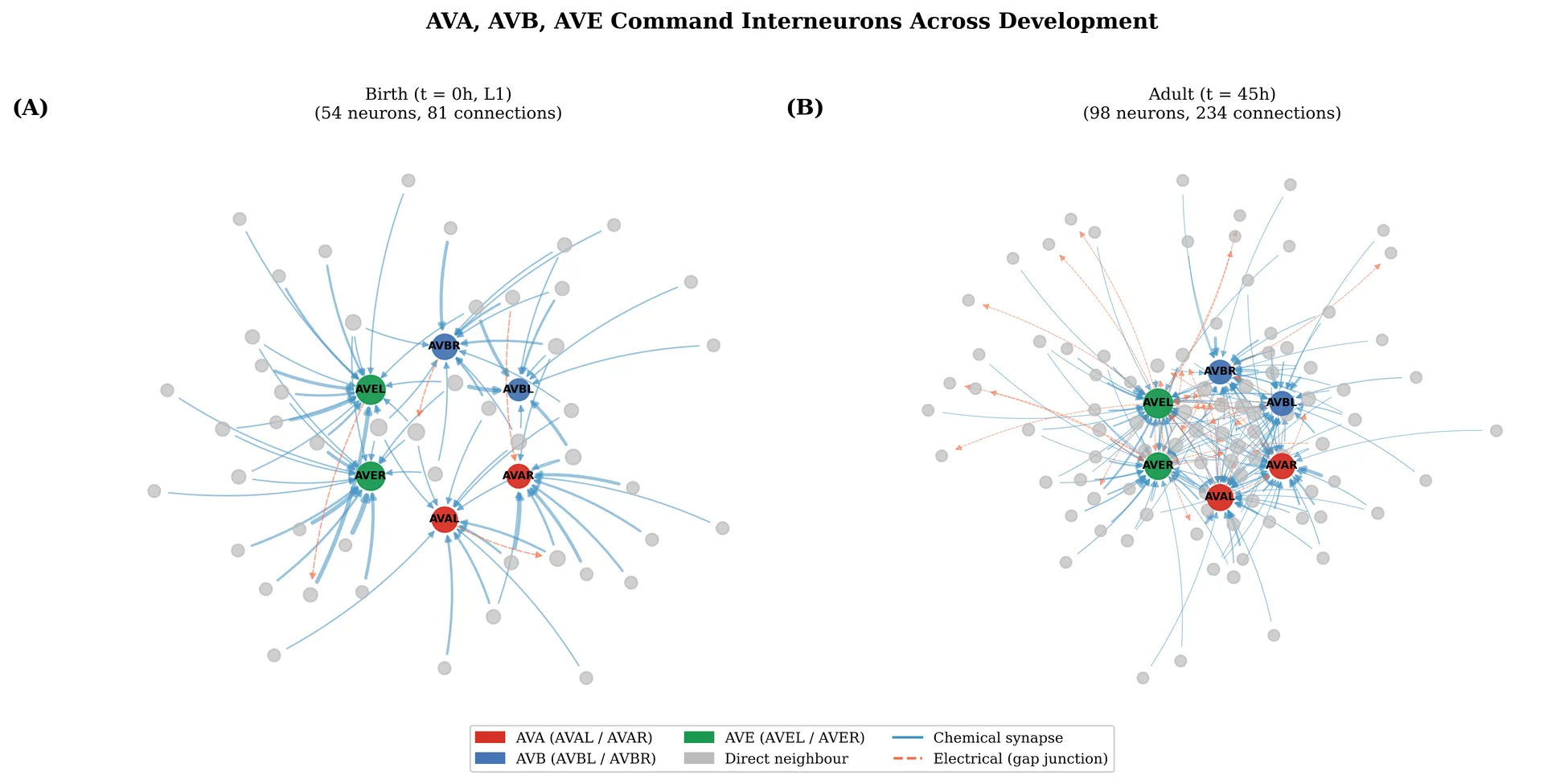
على خريطة الوصلات، ميّز DevoTG ثلاثة أنواع من الاتصالات. بعضها — المستقر — يظهر مبكرًا ويبقى إلى الأبد، مثل الطرق الرئيسية. وبعضها — المؤقت — لا يحتاجه الجسم إلا أثناء النمو، مثل السقالات في البناء. أما النوع الثالث — المتغير — فيظهر ويختفي باستمرار، مثل الأزقة التي يُعاد رصفها لتلبية احتياجات جديدة. ومما يثير الاهتمام بشكل خاص الخلايا العصبية القيادية AVA وAVB وAVE: فهي تحتل موقعًا مركزيًا مبكرًا، ومع مرور الوقت تزداد أهميتها وتتكاثر حولها الوصلات.
هذا النهج ليس مجرد أطلس، بل فيلم يوضح كيف يبني الدماغ نفسه بنفسه. كود DevoTG مفتوح المصدر، ويمكن تطبيقه على حيوانات أخرى لاكتشاف القواعد العامة لبناء الأعصاب.
الملخص الأصلي
كما كتبه المؤلفون، بالإنجليزية arXiv:2606.21940
Understanding how a nervous system wires itself from birth to adulthood is a fundamental challenge in developmental neuroscience. We present DevoTG, a temporal graph framework that applies Temporal Graph Neural Networks (TGNs) to two complementary representations of C. elegans neural development: a Continuous-Time Dynamic Graph (CTDG) of cell division events derived from cell lineage data, and a Discrete-Time Dynamic Graph (DTDG) of the developing synaptic connectome spanning eight reconstructed electron-microscopy datasets. On the lineage prediction task, our TGN achieves a mean test AUC of 0.839 +/- 0.007 (5 seeds; validation AUC 0.937 +/- 0.001), outperforming a static GNN with the identical architecture by 26 AUC points (0.577 +/- 0.080), demonstrating that temporal memory is the decisive factor. Applied to the connectome DTDG, DevoTG identifies three connection stability classes (stable, developmental, and variable) across 225 neurons and 858 to 2,496 connections over development (L1 birth to adult), providing a temporal-graph-theoretic complement to the individual-variability classification of Witvliet et al. Analysis of hub command interneurons AVA, AVB, and AVE reveals their persistent centrality and how their integration roles are progressively reinforced across larval stages. Accompanying interactive visualizations (3D animated networks, centrality heatmaps, and a spatiotemporal lineage graph) make developmental dynamics accessible for biological hypothesis generation. DevoTG is open-source and designed for extension to other developing nervous systems. Code is publicly available at https://github.com/DevoLearn/DevoGraph/tree/main/DevoTG.
تمتلك الدودة C. elegans 302 عصبونًا، ويعرف العلماء الخريطة الكاملة لوصلاتها — وهي المخلوق الوحيد الذي أُعدت له مثل هذه الخريطة.