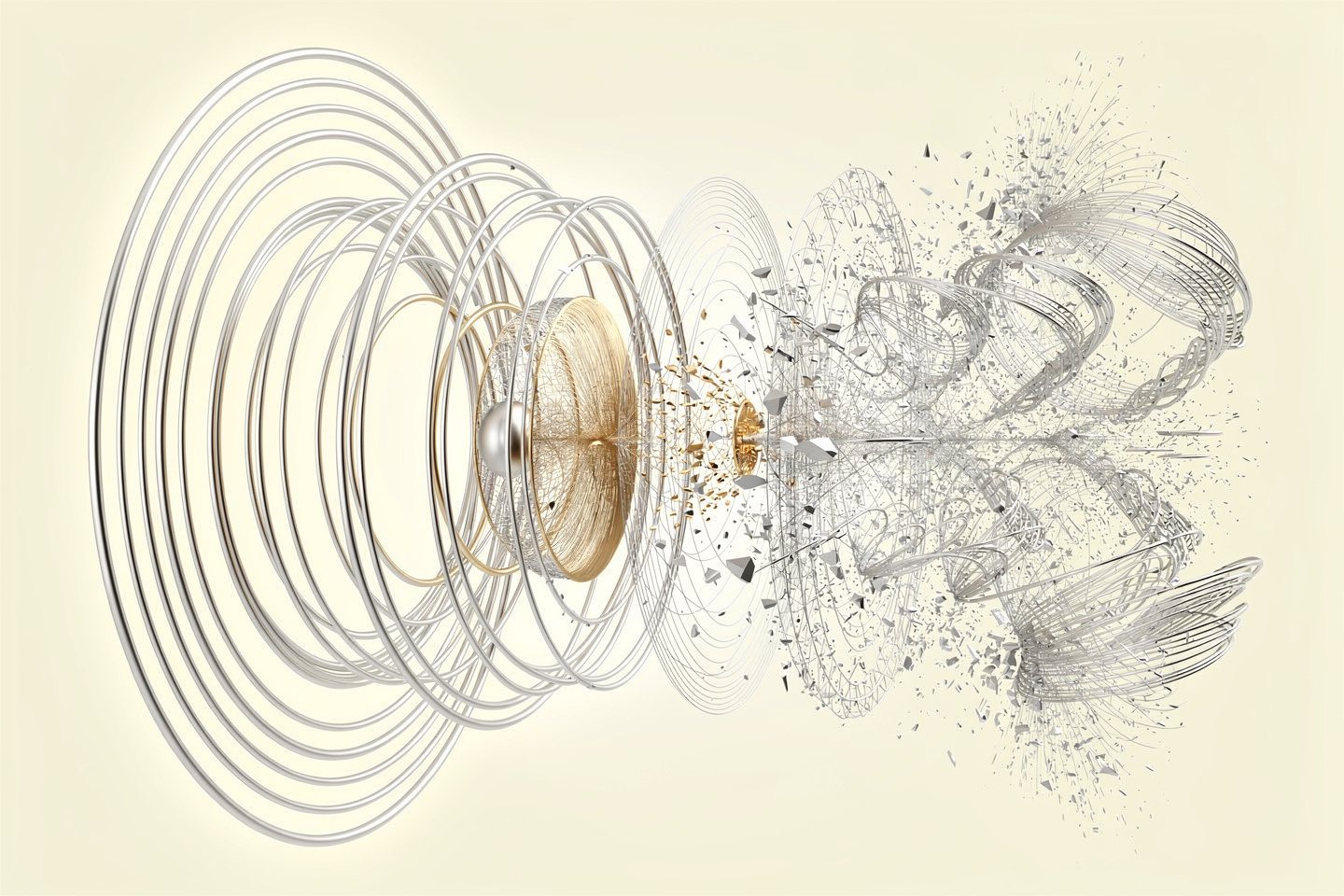
A system like a pendulum does not completely fall into chaos if the jolts are small: some ordered motions persist, like islands of stability among waves.
In practice: Prediction of the stability of planetary orbits in the Solar System over billions of years and design of particle accelerators.
In 1954, Andrey Kolmogorov proposed the idea, and Vladimir Arnold and Jürgen Moser rigorously proved in the 1960s that in Hamiltonian systems (where energy is conserved), under small perturbations, so-called invariant tori — multidimensional surfaces on which motion remains regular — are preserved. This is like a layer cake: some layers (tori) can withstand a light shaking, while others crumble into chaos. The theorem established a boundary between order and chaos.
How it works
Thanks to this theorem, engineers can be confident that particles in ring accelerators will not crash into the walls due to minor magnetic field errors, and astronomers understand that exoplanet orbits can exist for long periods.
💡 It is precisely the KAM theorem that explains why Saturn's rings have sharply defined gaps — resonant perturbations from moons destroy the regular orbits of particles in these zones.
Imagine a swinging pendulum: if you add a small perturbation, its motion remains almost regular. The theorem says that in complex systems (e.g., planets around the Sun), most closed orbits do not break down but only slightly deform under the weak influence of other bodies. This explains why the Solar System is stable even though the planets attract each other.
How it works
Thanks to this theorem, engineers can be confident that particles in ring accelerators will not crash into the walls due to minor magnetic field errors, and astronomers understand that exoplanet orbits can exist for long periods.
💡 To prove it, Arnold had to introduce a special fast convergence method, reminiscent of Newton's iterations, which allowed him to show that the Solar System is likely stable on cosmological time scales.
The theorem states that for an integrable Hamiltonian system described by action-angle variables (I, θ), under a sufficiently small and smooth perturbation H(I, θ) = H₀(I) + ε H₁(I, θ), invariant tori with frequencies ω = ∂H₀/∂I are preserved if the frequencies satisfy the Diophantine condition |k·ω| ≥ γ/|k|^τ for all integer vectors k ≠ 0. Thus, the measure of destroyed tori tends to zero with ε, and regular dynamics coexist with chaotic.
Discovery
In 1954, Soviet mathematician Andrey Kolmogorov formulated the theorem on the preservation of conditionally periodic motions under small perturbations. His student Vladimir Arnold gave a rigorous proof for analytic systems (1963), and Jürgen Moser simultaneously and independently extended it to smooth mappings (1962), using smoothing techniques. These works laid the foundation of the modern theory of dynamical systems and chaos.
How it works
The theorem is widely applied in celestial mechanics, plasma physics, and accelerator technology for long-term stability analysis. Limits: requires a sufficiently small perturbation and smoothness, as well as frequencies satisfying Diophantine conditions. Under strong perturbations, tori break down, opening the way to global chaos (Arnold diffusion).
Caveats
Exact estimation of the critical value ε at which torus destruction occurs; Generalization to infinite-dimensional systems (e.g., in hydrodynamics); Behavior near resonances and the emergence of 'sticky' regions in phase space
k is an integer vector with components k₁,...,kₙ, ω is the frequency vector, γ > 0 is a small constant depending on the perturbation, τ > n−1 is a parameter defining the Diophantine property; the symbol |k| denotes the sum of absolute values |k₁|+...+|kₙ|.