Rutherford scattering formulalaw
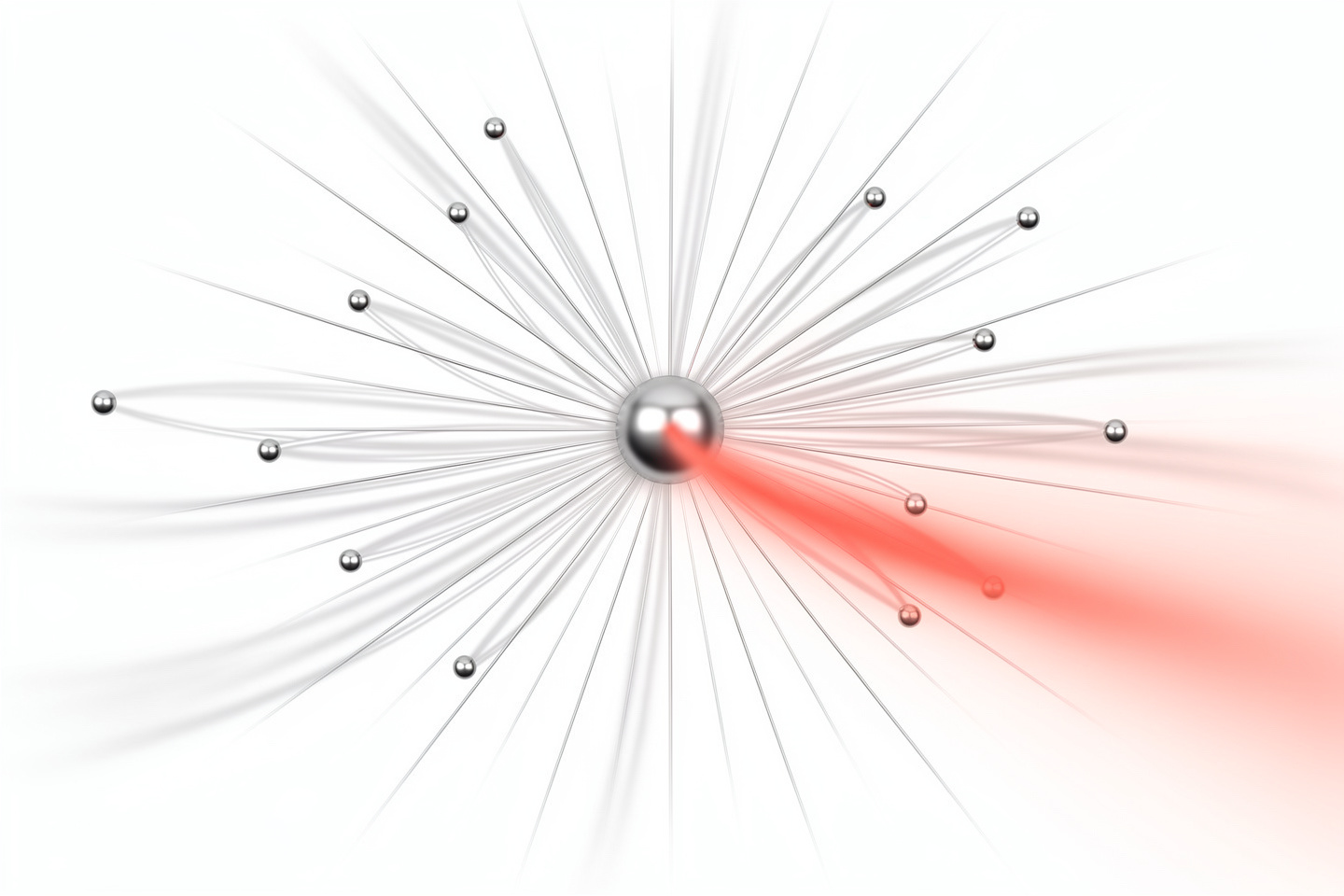
Ernest Rutherford, skeptical of the complex structure of the atom, tasked Hans Geiger and Ernest Marsden with bombarding gold foil with alpha particles. Everyone expected the particles to pass through, only slightly scattering. But Marsden noticed: about one in 8000 particles bounced back! Rutherford was amazed and later compared it to a 15-inch shell ricocheting off tissue paper. He realized that almost all the mass of the atom is concentrated in a tiny nucleus. In 1911, he derived a formula relating the number of scattered particles to angle, energy, and nuclear charge. This was a purely classical result, perfectly explaining the experiment; only later were quantum corrections needed for light nuclei.
How it works
The formula applies to any charged particles in a Coulomb field. It is the basis of Rutherford backscattering spectrometry (RBS), which is used to non-destructively determine the composition and thickness of coatings, check the quality of films in microelectronics, and calculate doses in radiation therapy.
💡 Rutherford recalled: 'I did not believe in backscattering until Geiger showed me the counter. Then I realized we had hit upon the nucleus.'
\frac{d\sigma}{d\Omega} = \left(\frac{Z_1 Z_2 e^2}{16\pi\varepsilon_0 E}\right)^2 \frac{1}{\sin^4(\theta/2)}
dσ/dΩ — differential scattering cross-section (probability of scattering into solid angle dΩ), Z₁ and Z₂ — charge numbers (number of protons) of the incident particle and target nucleus, e — elementary charge (≈1.602×10⁻¹⁹ C), ε₀ — electric constant (≈8.854×10⁻¹² F/m), E — kinetic energy of the incident particle, θ — scattering angle from the original direction