invention of the transistorinvention
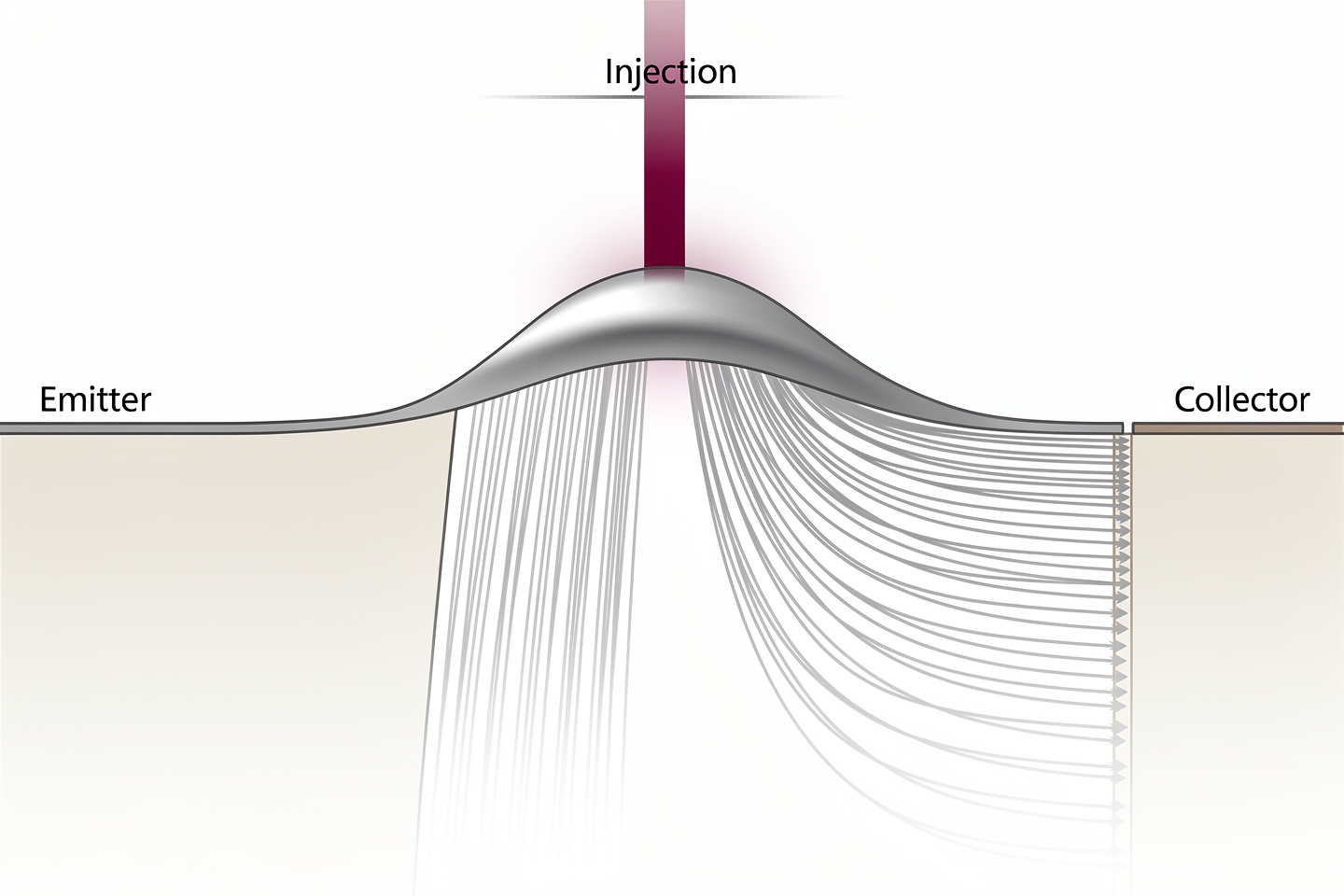
At the end of 1947 at Bell Labs, a team led by William Shockley, along with John Bardeen and Walter Brattain, created the first working point-contact transistor. For this discovery, they received the 1956 Nobel Prize. The operating principle is based on the properties of semiconductor p-n junctions: the current through the junction can be controlled by the injection of minority charge carriers.
How it works
Transistors are used in audio amplifiers, in power switches, and most importantly, as elementary cells of digital logic. Their miniaturization down to nanometer sizes led to modern microelectronics: your phone's processor contains over 10 billion transistors.
💡 The first transistor was assembled on a piece of germanium with gold contacts pressed by a spring, and looked like a jumble of metal plates and paper clips. It was the size of a large coin, whereas today transistors in processors are smaller than a virus.
I_C = \beta I_B
I_C — collector current (output current); I_B — base current (controlling current); β — current gain (typical values from 20 to 1000). The relation shows how a small base current controls a large collector current.