Des métaux froids sortis de la machine express
Le transistor de votre téléphone fonctionne comme un robinet : ouvert, les électrons coulent ; fermé, ils s'arrêtent. Mais un robinet métallique ordinaire fuit toujours un peu : même fermé, un courant s'en échappe. Cela épuise la batterie et chauffe la puce.
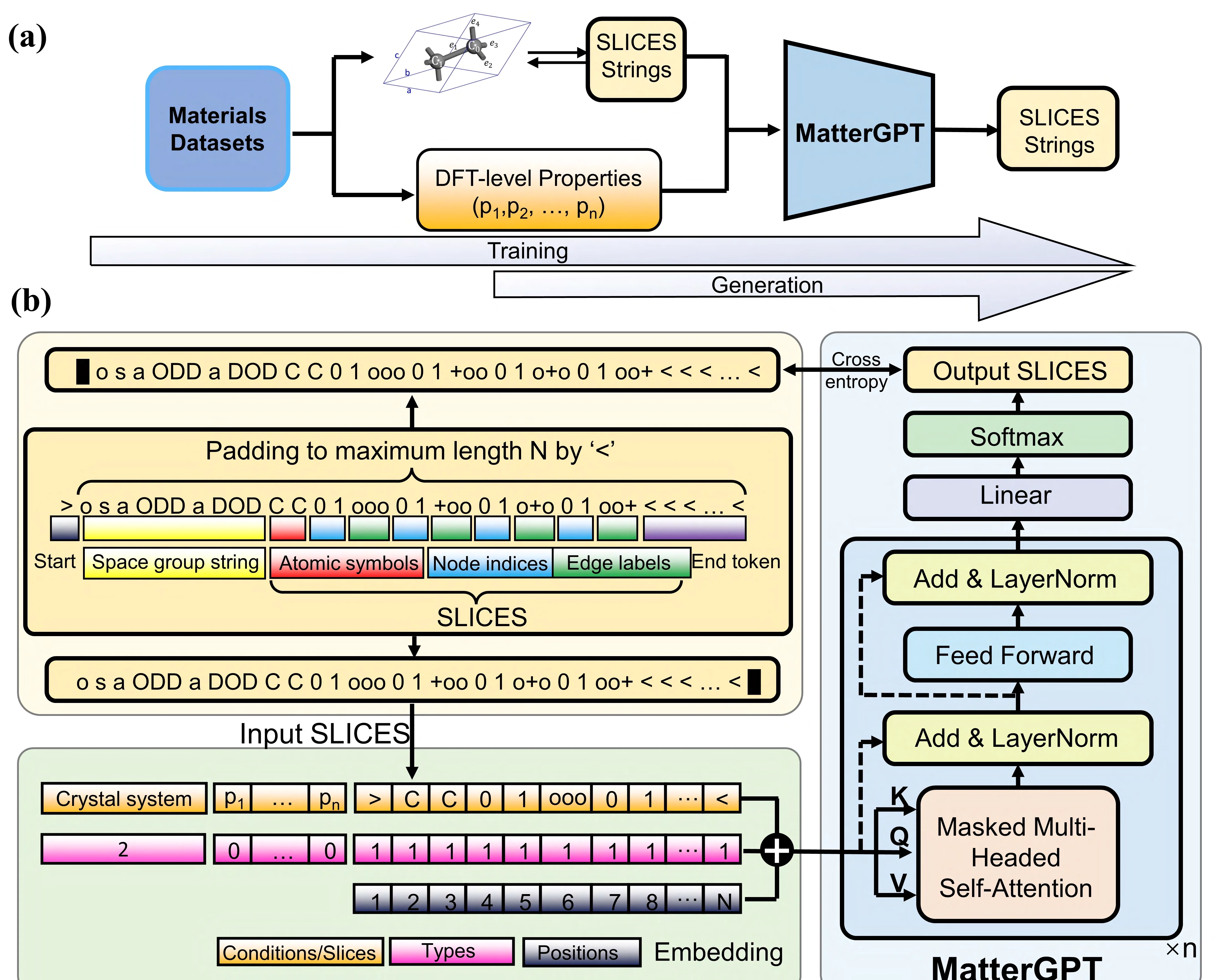
Longtemps, on a cherché ces matériaux à la main, en passant en revue les composés connus. On en a trouvé 252. Mais une base de données ne contient que ce qui est déjà découvert. Le réseau de neurones MatterGPT a appris à assembler de nouveaux cristaux à partir de « lettres » — des chaînes spéciales décrivant la disposition des atomes. On lui a montré 26 309 exemples et on lui a fixé un objectif : stabilité et bande interdite de 50 à 500 milliélectronvolts (soit des centaines de fois moins que l'énergie d'un seul photon de lumière visible).
La machine a produit 148 506 variantes. Presque toutes ont pu être assemblées en structures tridimensionnelles. Après filtrage sur la symétrie et la nouveauté, il reste 257 candidats qui n'existent dans aucune base. Pour plusieurs, on a vérifié les vibrations des atomes — le matériau ne se désagrège pas. Ces métaux sont donc synthétisables.
Ainsi, le réseau de neurones a étendu la carte des métaux froids au-delà du catalogue. Désormais, les ingénieurs disposent d'un véritable entrepôt de « robinets sans fuite » — il ne reste plus qu'à choisir lesquels couler dans l'atelier.
Résumé original
tel que rédigé par les auteurs, en anglais arXiv:2603.13920
Cold metals are a class of metals with an intrinsic energy gap located close to the Fermi level, which enables cold-carrier injection for steep-slope transistors and is therefore promising for low-power electronic applications. High-throughput screening has revealed 252 three-dimensional (3D) cold metals in the Materials Project database, but database searches are inherently limited to known compounds. Here we present an inverse-design workflow that generates 3D cold metals using MatterGPT, a conditional autoregressive Transformer trained on SLICES, an invertible and symmetry-invariant crystal string representation. We curate a training set of 26,309 metallic structures labeled with energy above hull and a unified band-edge distance descriptor that merges p-type and n-type cold-metal characteristics to address severe label imbalance. Property-conditioned generation targeting thermodynamic stability and 50-500 meV band-edge distances produces 148,506 unique candidates; 92.1% are successfully reconstructed to 3D structures and down-selected by symmetry, uniqueness and novelty filters, followed by high-throughput DFT validation. We identify 257 cold metals verified as novel with respect to the Materials Project database, with gaps around the Fermi level spanning 50-500 meV. First-principles phonon, electronic-structure, and work-function calculations for representative candidates confirm dynamical stability and contact-relevant work functions. Our results demonstrate that SLICES-enabled generative transformers can expand the chemical space of cold metals beyond high-throughput screening, providing a route to low-power electronic materials discovery.
Une bande interdite de 50 milliélectronvolts, c'est l'énergie qu'un électron reçoit d'une tension de seulement 0.05 volt. Pour comparaison, une pile bouton délivre 1.5 volt.