Шёлк и сера заряжают телефон экспресс
Трение расчёски о шерсть рождает искру. Похожий принцип работает в трибоэлектрических наногенераторах — устройствах, которые превращают механические прикосновения в электричество. Проблема в том, что обычные материалы дают слабый заряд.
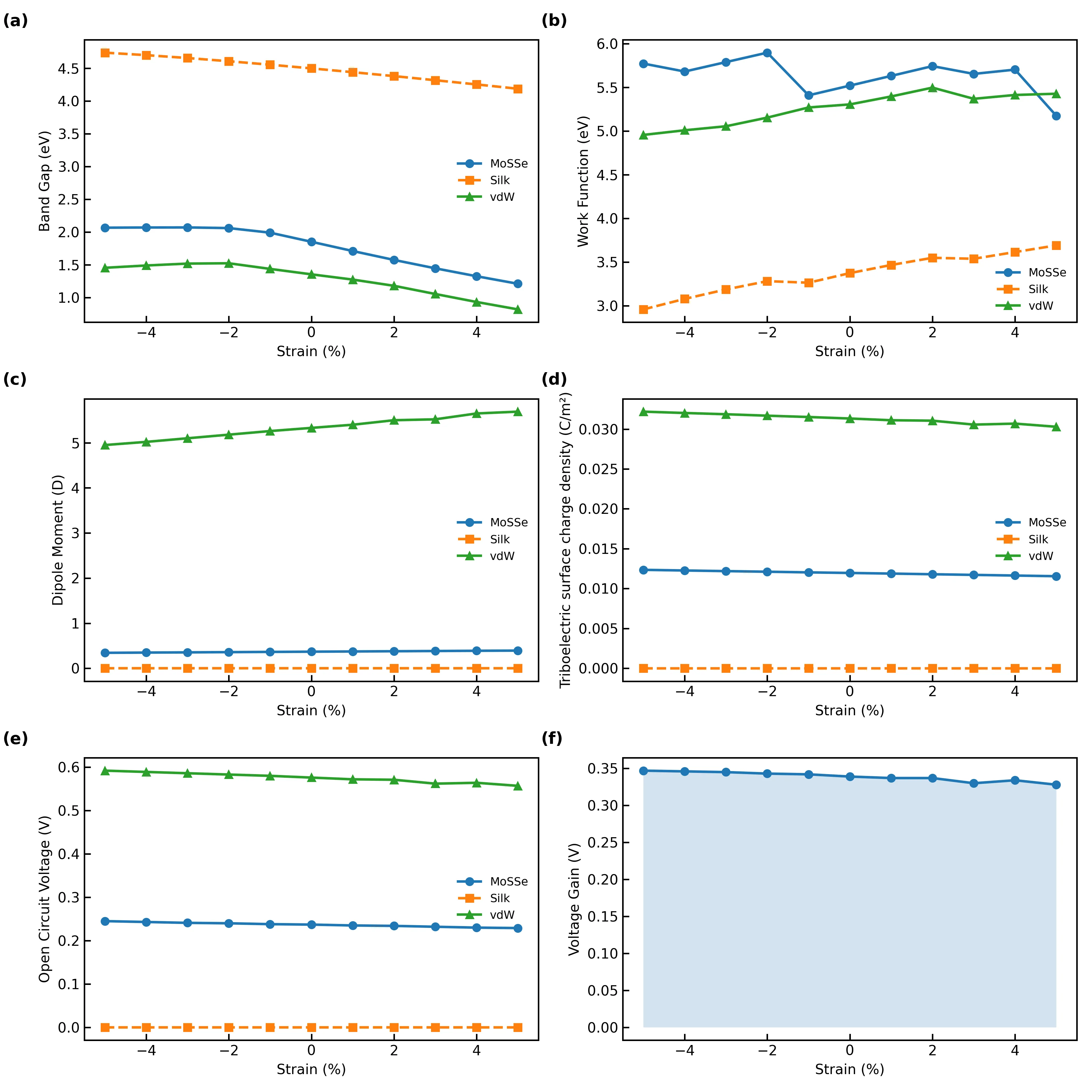
Группа исследователей изучила слоистый материал Janus MoSSe — его лист с одной стороны покрыт серой, с другой селеном, как бутерброд с разными начинками. К нему добавили шёлк, белок из коконов тутового шелкопряда. Расчёты показали: если такой композит растянуть, полоса запрещённых энергий для электронов сужается сильнее, чем у каждого материала по отдельности. Это значит, электронам легче перескакивать между слоями.
В результате выходное напряжение растёт на всех уровнях деформации. Тонкая плёнка из шёлка и MoSSe может стать основой для носимых датчиков или зарядки гаджетов от движения тела.
Оригинальная аннотация
как её написали авторы, на английском arXiv:2604.10581
Understanding and engineering interfacial electrostatics in hybrid two-dimensional (2D) and biomolecular material systems is essential for advancing high-performance triboelectric nanogenerators (TENGs). In this work, we systematically investigate the strain-dependent electronic structure and triboelectric response of Janus MoSSe, silk fibroin, and their van der Waals (vdW) heterostructure using first-principles calculations. Tensile strain induces a pronounced band-gap reduction in the MoSSe/silk interface, exceeding that of the isolated constituents and indicating enhanced interlayer electronic coupling. The vdW heterostructure exhibits a significant work-function shift and a substantially larger dipole moment compared to MoSSe and silk alone, revealing strong interfacial charge redistribution driven by Fermi-level alignment and asymmetric polarization. This enhanced polarization directly amplifies the triboelectric surface charge density, producing values more than double those of pristine MoSSe and several orders of magnitude higher than silk. Consequently, the open-circuit voltage and overall triboelectric output are markedly improved across all strain levels. These results demonstrate that synergistic interfacial polarization and strain engineering can effectively elevate charge separation, storage, and transfer efficiencies, establishing the MoSSe/silk vdW heterostructure as a promising material for next-generation high-efficiency TENGs.
Шёлк — природный пьезоэлектрик: при сжатии или растяжении он сам вырабатывает небольшое напряжение, поэтому его добавляют в умную одежду.