ألياف تمتص الدم سريع
تسقط قطرة دم على ضمادة مصنوعة من ألياف بوليمرية فائقة الدقة. عادةً ما تبقى على السطح مثل قطرة ندى على ورق مشمع. المادة تطرد الماء، ولا يتم امتصاص الدم — وبالتالي لا تلتصق الضمادة بالجرح.
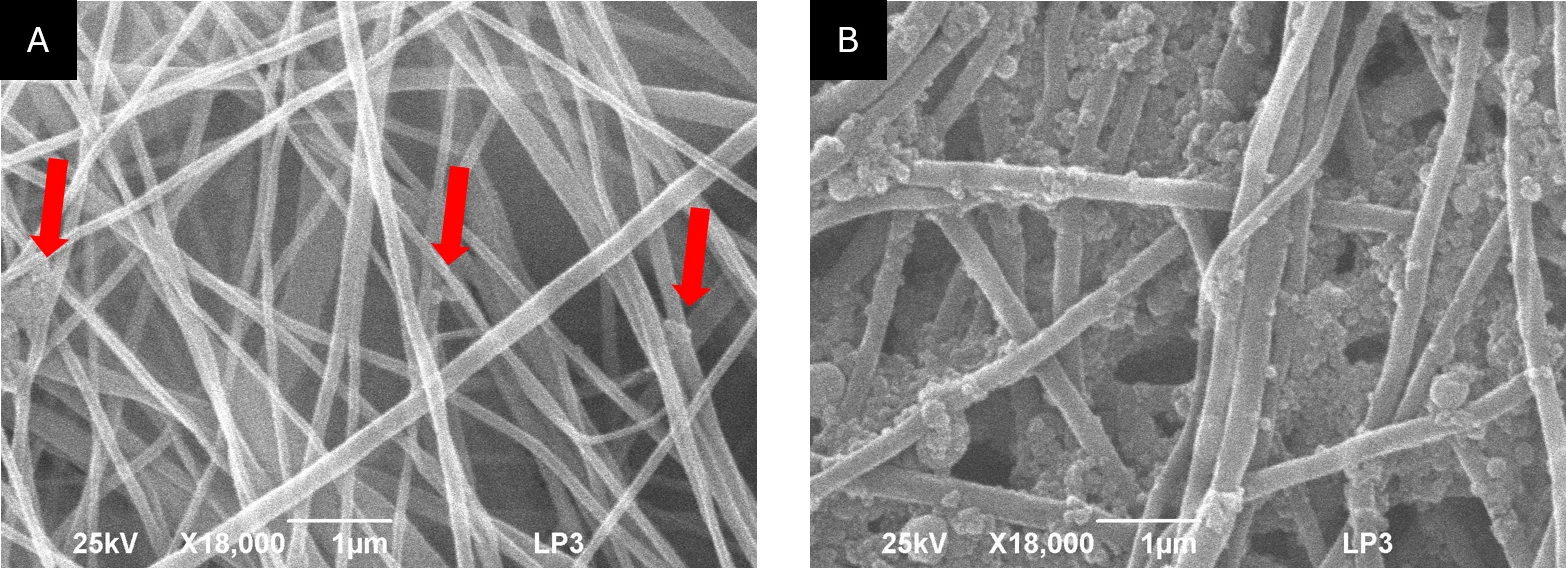
غيّر العلماء سطح الألياف. أضافوا إلى البوليمر جسيمات سيليكون صغيرة جدًا — أنحف بألف مرة من شعرة الإنسان. حصلوا على الجسيمات باستخدام الليزر في سائل، دون إضافات لاصقة، لذلك بقيت "عارية" ونشطة. في أحد النسختين، أخفوا الجسيمات داخل الألياف، وفي الأخرى أخرجوها إلى السطح، مثل حبات السمسم على الخبز.
كانت النتيجة مختلفة. الألياف ذات الجسيمات الداخلية تبللت بشكل أفضل قليلًا فقط: قطرة الدم انتشرت أوسع قليلًا، لكنها بقيت متماسكة. أما عندما كانت الجسيمات بارزة في الخارج، انتشرت القطرة لتصبح قرصًا رقيقًا. انخفضت زاوية التبول إلى أقل من 20 درجة — تقريبًا مثل الزجاج المبلل. وتحت المجهر كان واضحًا: حول النواة الحمراء من خلايا الدم انتشرت منطقة فاتحة من البلازما. الألياف، مثل الإسفنج، امتصت الجزء السائل من الدم، بينما بقيت الخلايا في الأعلى.
هذه المادة يمكن أن تكون أساسًا لضمادات ذكية: فهي تتشبع بالدم بسرعة، وتلتصق بإحكام بالجرح، بل وتفصل الدم إلى مكوناته. هذه خطوة نحو وسائل تضميد لا تغطي الجرح فحسب، بل تتفاعل معه بنشاط.
الملخص الأصلي
كما كتبه المؤلفون، بالإنجليزية arXiv:2601.05809
Electrospun poly(\epsilon-caprolactone) (PCL)nanofibrous mats are widely considered for blood-contacting wound dressings and small-diameter vascular applications; however, their intrinsic hydrophobicity limits rapid wetting and controlled interaction with blood. In this work, we modulate the interfacial response of PCL nanofibers by incorporating oxide-shelled silicon nanoparticles (SiNPs) synthesized by pulsed laser ablation in liquid, a ligand-free approach that avoids organic stabilizers and preserves surface reactivity. Two composite architectures were designed: SiNPs embedded within the fiber bulk (PAC1,4,16) and SiNPs preferentially exposed at the fiber surface (SPAC1,4,16), with systematically increasing nanoparticle loadings. Structural characterization confirmed the retention of a homogeneous fibrous morphology and the targeted nanoparticle distribution. The dynamic interaction with whole blood was quantified using time-resolved contact-angle measurements, complemented by top-view optical microscopy and three-dimensional profilometry of dried droplets. Pristine PCL remained strongly hydrophobic whereas a hydrophilic PCL functionalized with APTES showed rapid spreading. Incorporation of SiNPs within the fiber volume led to only a moderate enhancement of wettability, and dried droplets retained compact morphologies with limited spreading. In contrast, surface-decorated mats displayed a sharp, concentration-dependent transition toward highly wettable behavior: for SPAC16, the contact angle fell below 20, droplet profiles became markedly flattened, and microscopy revealed extended plasma-rich regions surrounding a red-cell-rich core, indicative of pronounced phase separation within the nanofibrous network.
زاوية التبول أقل من 20 درجة تعني أن قطرة الدم تنتشر تقريبًا مثل الماء على زجاج نظيف — تصبح مسطحة وليست محدبة.