أغشية الأكاسيد تتعلم التذكر سريع
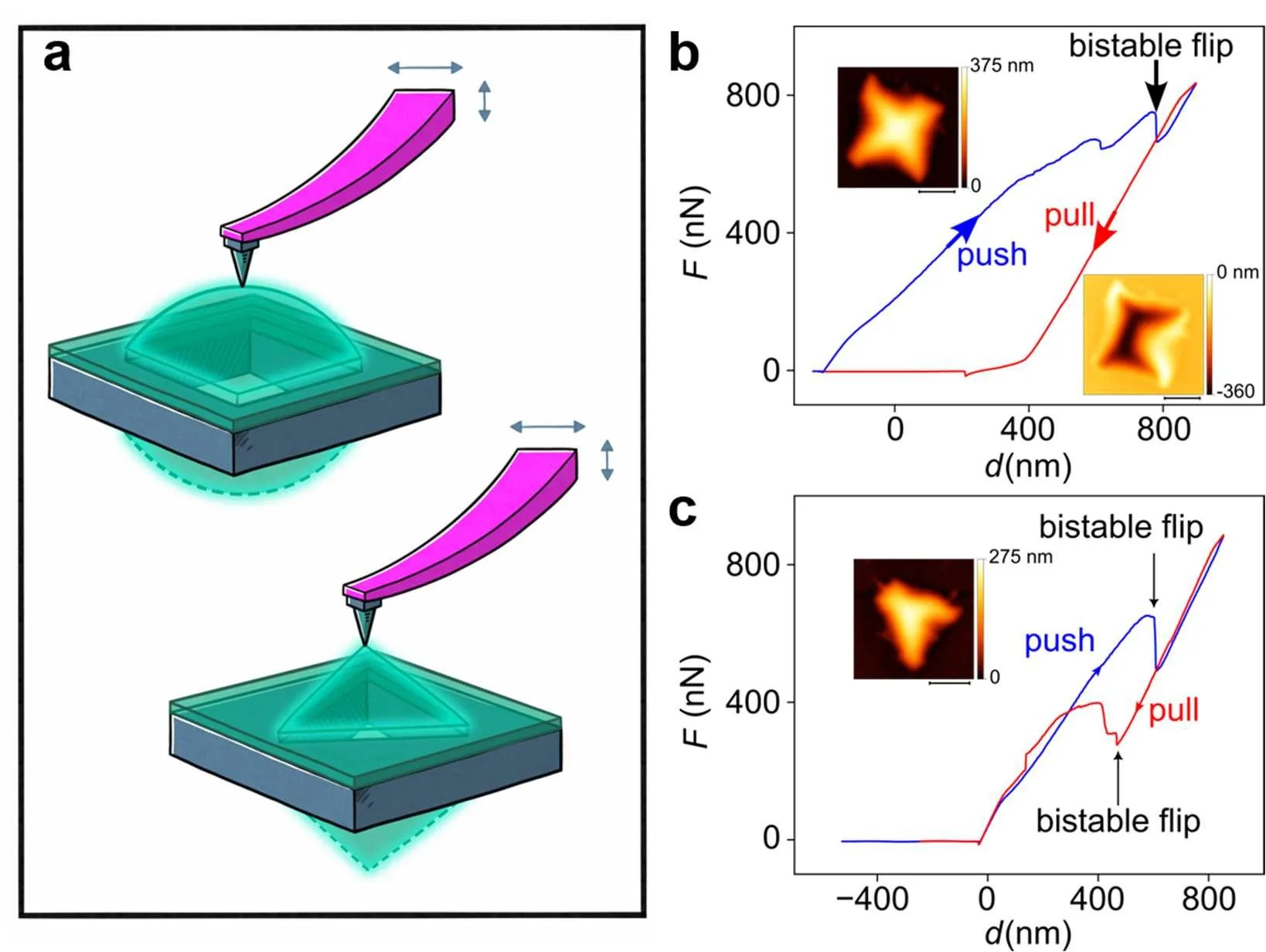
غشاء رقيق من أكسيد معدني يستقر على سطح يحتوي على حفرة صغيرة جدًا. إذا تم ضغط الغشاء قليلاً من الجانبين، فإنه لا يتجعد، بل ينحني إلى الأسفل داخل الحفرة أو إلى الأعلى على شكل حدبة. كلا الوضعين مستقران، مثل غطاء علبة طعام معدنية، الذي يكون إما مقعرًا أو محدبًا، ولا يقفز من تلقاء نفسه بينهما. هذا السلوك يُسمى بالاستقرار المزدوج (bistability)، وهو ما تم تحقيقه بنجاح في أغشية بلورية فائقة الرقة من أكسيد السترونشيوم-تيتانيوم وأكسيد الباريوم-تيتانيوم.
تمت زراعة الغشاء على طبقة تضحية، ثم نُقل إلى ركيزة تحتوي على حفر محفورة مسبقًا. الإجهاد المتبقي في البلورة جعل الغشاء ينحني. اتجاه الانحناء يعتمد على هندسة الحفرة وصلابة الغشاء نفسه. قام الباحثون بقياس التضاريس باستخدام مجهر القوة الذرية (AFM)، والجهد الكهربائي باستخدام مسبار كلفن (Kelvin probe). اتضح أن توزيع المجال الكهربائي داخل الغشاء يختلف بين الوضعين المستقرين، خاصة في تيتانات الباريوم ذات الخواص الكهروإجهادية (ferroelectric). بضغطة خفيفة من المسبار، يمكن قلب الغشاء من وضع إلى آخر وبالعكس.
هذا المفتاح الميكانيكي لا يحتاج إلى تيار مستمر، ولا يتآكل مع الدورات، ويعمل في درجة حرارة الغرفة. من خلال تجميع العديد من هذه الخلايا، يمكن بناء ذاكرة حيث يُخزن البت (bit) عبر انحناء الغشاء، ويُقرأ عن طريق تغير المجال الكهربائي. هذه خطوة نحو الميكانيكا النانوية (nanomechanics)، حيث تعيش المعلومات ليس في الشحنة، بل في الشكل.
الملخص الأصلي
كما كتبه المؤلفون، بالإنجليزية arXiv:2601.17959
Mechanical instabilities in thin solids offer a powerful route to engineer nonlinear responses, yet their controlled use in functional crystalline oxides has remained largely unexplored. Notably, by changing the aspect ratio of solids, the energy landscape around equilibrium can be modified to induce non-linearities under lateral stresses through non-lateral deformations. These nonlinear systems can develop multiple local energy minima where the system can settle and switch between states through the application of a driving force. Crucially, recent advances in oxide thin film growth have enabled the fabrication of freestanding oxide membranes, paving a viable path for their use in bistable architecture, particularly at the nanoscale. Here, we demonstrate that freestanding oxide membranes, such as SrTiO3 (STO) and BaTiO3 (BTO), relax into well-defined metastable buckling states when transferred onto lithographically defined cavities. The membrane deformation is determined by the interplay between built-in residual strain, bending stiffness, and cavity geometry, resulting in reproducible bistable states with distinct strain distributions. Using a combination of atomic force microscopy, in-contact Kelvin probe measurements, and finite-element modelling, we reveal that these mechanically locked states directly shape the electromechanical potential landscape of ferroelectric BaTiO3. We further demonstrate reversible snapthrough transitions between mechanically degenerate states, establishing complex oxides as deterministic, geometry-tunable building blocks for nonlinear nanoelectromechanical architectures. Our results illustrate a general strategy for exploiting mechanical instabilities to encode and manipulate functional responses in ultrathin crystalline membranes.
أكسيد السترونشيوم-تيتانيوم هو نفس المادة التي تُصنع منها الماسات الاصطناعية المستخدمة في المجوهرات، ولكن بدون شوائب.