تموجات الشحنة التي نجت من النظام سريع
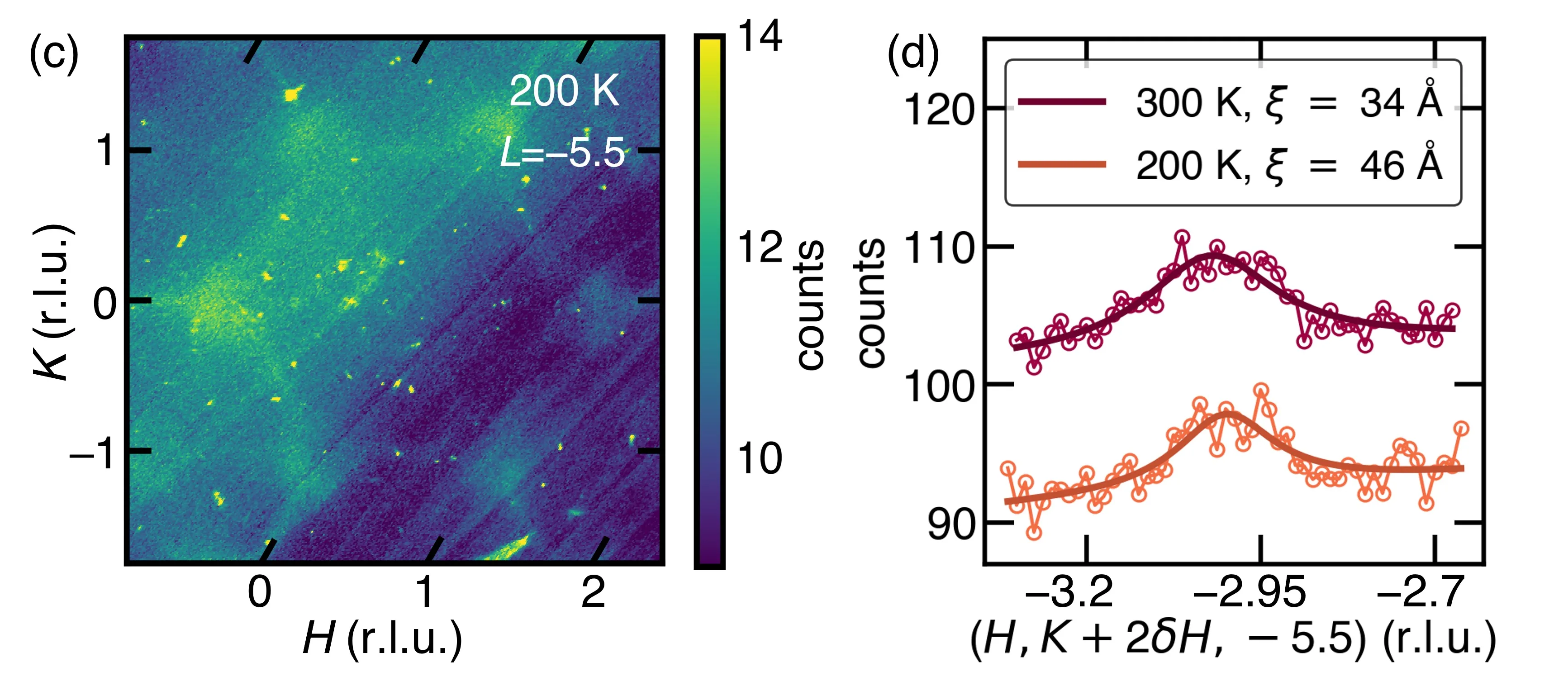
في بعض البلورات، ترتب الإلكترونات نفسها في موجة — مثل تموجات على سطح الماء، لكن من الشحنة. عادةً، توجد هذه الموجة فقط في البرد الشديد. لكن في هذه التجربة، رأى العلماء أن آثار الموجة تبقى حتى في درجة حرارة الغرفة.
أخذ الباحثون بلورة CsV$_3$Sb$_5$، وأضافوا إليها قصديرًا، ثم تابعوا انعكاس نبضات ليزر فائقة القصر. من اهتزازات ذرات الشبكة البلورية، فهموا أن «تموجات» الشحنة لم تختفِ تمامًا — بل أصبحت غير منتظمة ومتجمدة. تعمل شائبة القصدير مثل حبيبات رمل تمنع الموجة من التحرك بحرية، فتتجمد في مكانها.
إذًا، في هذه البلورات، تعيش «ذاكرة» موجة الشحنة لفترة أطول بكثير مما كان يُعتقد. وهذا ليس استثناءً، بل خاصية عامة لعائلة كاملة من المواد.
الملخص الأصلي
كما كتبه المؤلفون، بالإنجليزية arXiv:2602.17915
In this work, we perform ultrafast time-resolved reflectivity measurements to track the evolution of charge density wave (CDW) correlations in Sn-doped Kagome superconductor CsV$$_3$$Sb$$_{5-x}$$Sn$$_x$$. By extracting the coherent phonon spectrum, we evidence robust signatures of CDW correlations at temperature and doping ranges far beyond the phase boundary of long-range CDW order. Remarkably, we unveil short-range CDW correlations survive up to room temperature in $$x = 0.32$$ Sn-doped CsV$$_3$$Sb$$_5$$, supported by synchrotron X-ray diffraction measurements. We point out the introduction of quenched disorder by Sn doping can pin the CDW and form static short-range CDW, which can explain the observed persistent CDW signatures. Our results thus corroborate the ubiquity and robustness of CDW correlations in Sn-doped CsV$$_3$$Sb$$_5$$ and provide new insights on the role of disorders on the CDW correlations in AV$$_3$$Sb$$_5$$ family.
نبضة الليزر في هذه التجربة تدوم بضع فيمتو ثوانٍ فقط — أي أقل من جزء من مليون من جزء من مليار من الثانية. في هذا الوقت، يقطع الضوء مسافة أقل من سمك شعرة الإنسان.