الفأر يجري — والدماغ يروي القصة سريع
فأر يجري على المضمار — ليس لأن محركًا يدفعه، بل لأنه هو من أراد ذلك. على جمجمته شبكة من 32 حساسًا صغيرًا، تشبه قبعة السباحة لكن بأسلاك. تلتقط الحساسات الموجات الكهربائية الضعيفة التي يصدرها الدماغ. سابقًا، لفهم السرعة التي يجري بها الحيوان، كان لا بد من زرع أقطاب كهربائية مباشرة في الدماغ. الآن اتضح أن مجرد وضع الحساسات على الرأس يكفي — وكل شيء يصبح واضحًا.
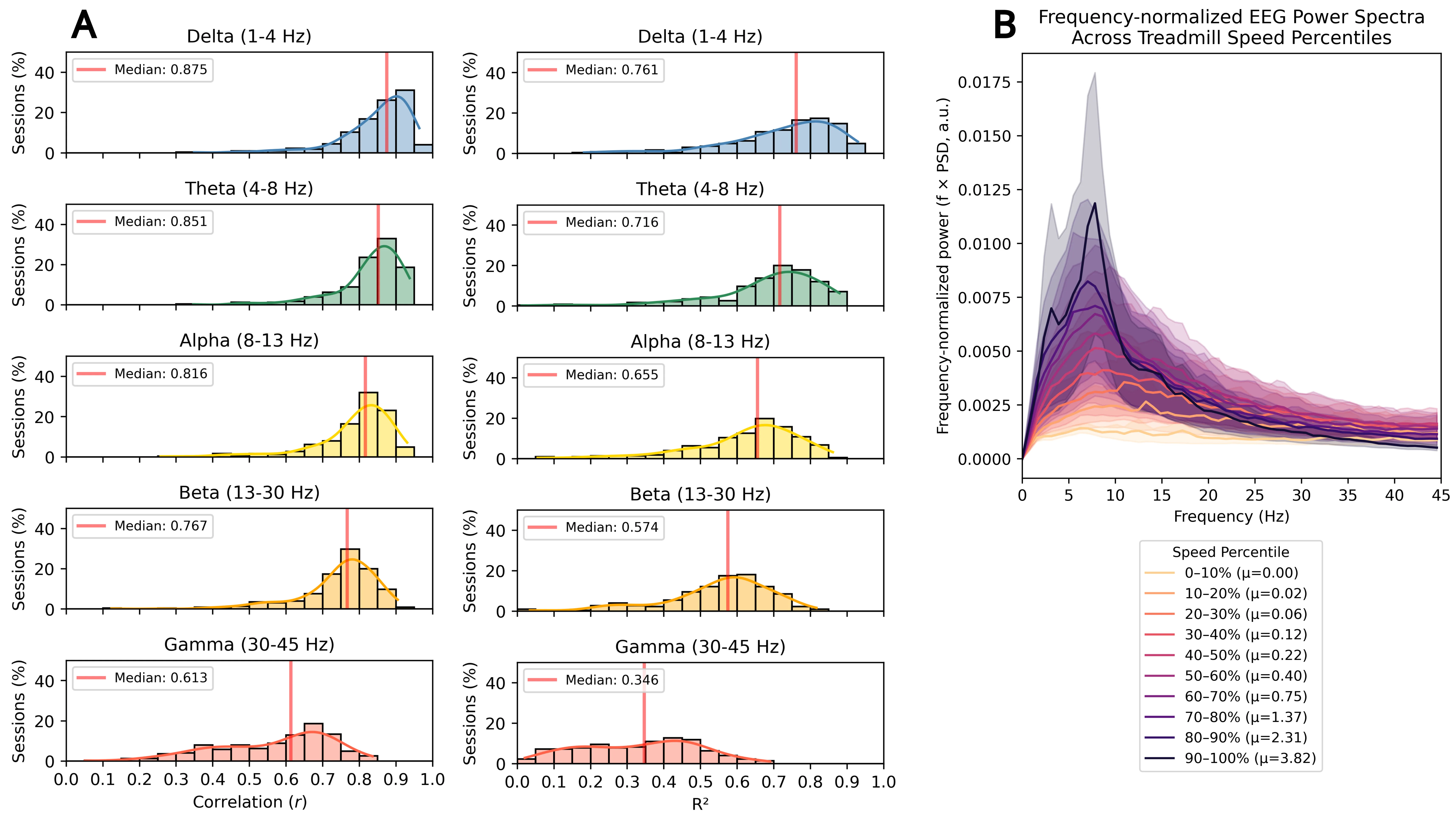
دُرّبت الشبكة العصبية على 133 ساعة من التسجيلات. كانت تنظر إلى نمط الموجات الدماغية وتخمّن سرعة المضمار. كانت النتيجة دقيقة جدًا: معامل الارتباط 0.88 — وكأنك تصيب الهدف في كل مرة تقريبًا. الدور الرئيسي تلعبه موجات الإيقاع البطيء — أقل من ثماني ذبذبات في الثانية. تُنتجها القشرة البصرية، ذلك الجزء من الدماغ الذي يعالج الصورة. يبدو أن الدماغ لا يكتفي بإصدار الأوامر للأرجل، بل يقارن الجري باستمرار بما تراه العينان.
إذا درّبت الشبكة العصبية على فأر واحد، فلن تعمل على فأر آخر — لكل حيوان "بصمة دماغية" خاصة. لكن على الفأر نفسه في يوم آخر، تعمل بشكل ممتاز. إذن، النمط مستقر، ويمكن صنع جهاز تضبطه مرة واحدة — فيطيعك كل يوم.
يتوقف الفأر، وتخفت الموجات في دماغه. لكن نمط هذه الموجات قد أخبرنا بالفعل أين جرى وبأي سرعة. بقي أن نتعلم قراءته دون أسلاك — وعندها يصبح الفكر حرًا كالجري.
الملخص الأصلي
كما كتبه المؤلفون، بالإنجليزية arXiv:2602.18637
$$\textit{Objective.}$$ Accurate neural decoding of locomotion holds promise for advancing rehabilitation, prosthetic control, and understanding neural correlates of action. Recent studies have demonstrated decoding of locomotion kinematics across species on motorized treadmills. However, efforts to decode locomotion speed in more natural contexts$$-$$where pace is self-selected rather than externally imposed$$-$$are scarce, generally achieve only modest accuracy, and require intracranial implants. Here, we aim to decode self-paced locomotion speed non-invasively and continuously using cortex-wide EEG recordings from rats. $$\textit{Approach.}$$ We introduce an asynchronous brain$$-$$computer interface (BCI) that processes a stream of 32-electrode skull-surface EEG (0.01$$-$$45 Hz) to decode instantaneous speed from a non-motorized treadmill during self-paced locomotion in head-fixed rats. Using recurrent neural networks and a dataset of over 133 h of recordings, we trained decoders to map ongoing EEG activity to treadmill speed. $$\textit{Main results.}$$ Our decoding achieves a correlation of 0.88 ($$R^2$$ = 0.78) for speed, primarily driven by visual cortex electrodes and low-frequency ($$< 8$$ Hz) oscillations. Moreover, pre-training on a single session permitted decoding on other sessions from the same rat, suggesting uniform neural signatures that generalize across sessions but fail to transfer across animals. Finally, we found that cortical states not only carry information about current speed, but also about future and past dynamics, extending up to 1000 ms. $$\textit{Significance.}$$ These findings demonstrate that self-paced locomotion speed can be decoded accurately and continuously from non-invasive, cortex-wide EEG. Our approach provides a framework for developing high-performing, non-invasive BCI systems and contributes to understanding distributed neural representations of action dynamics.
القشرة البصرية هي منطقة الدماغ التي تعالج ما تراه العينان. عند الفئران، تشغل معظم الدماغ، لأن الرؤية هي الطريقة الرئيسية التي تتعرف بها على العالم.
في فيلم "أفاتار"، يتحكم البشر في الصور الرمزية عبر واجهة عصبية، لكن الإشارات تُقرأ هناك بواسطة كبسولة معقدة. هنا، يكفي قبعة مزودة بحساسات — تقريبًا كالخيال العلمي، لكن دون جراحة.