لهب الهيدروجين: كيف نقيس قوته الخفية سريع
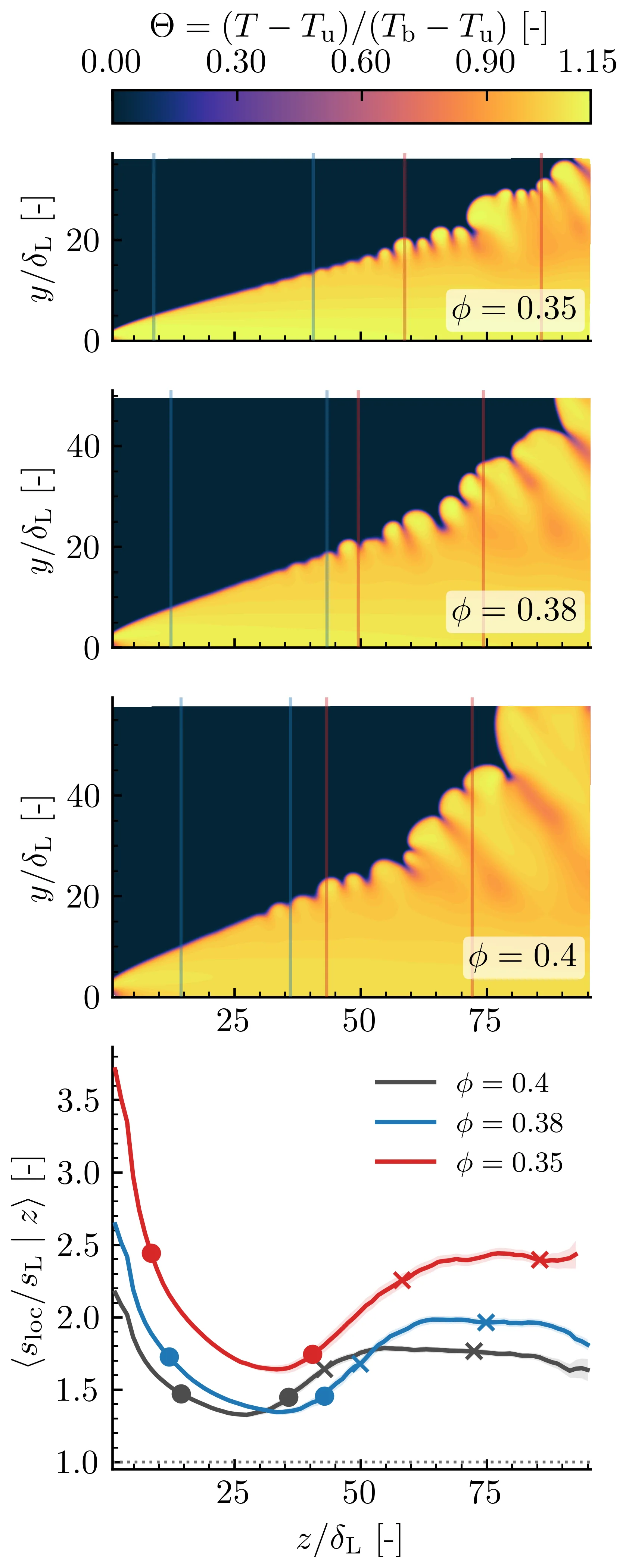
ورقة مستوية بدأ أحدهم بتجعيدها. في البداية تظهر عليها ثنيات متفرقة، ثم تغطي السطح كله — فتصبح الورقة غير مستوية وخشنة. هذا تقريبًا ما يفعله لهب الهيدروجين: في تدفق الغاز الهادئ يكون أملس ومائلًا بزاوية واحدة، لكن بمجرد تغيير تركيب الخليط، يغطى السطح بالخلايا والتجاعيد. تُعرف هذه الظاهرة باسم عدم الاستقرار الحراري-الانتشاري: فالهيدروجين الخفيف يغادر منطقة الاحتراق بسرعة، بينما تنتشر الحرارة بشكل مختلف عن جزيئات الوقود، فتبدأ الجبهة المستوية بالانحناء تلقائيًا.
ثبّت العلماء اللهب على قضيب رفيع حتى لا يطير، ووجّهوا إليه تيارًا من الهيدروجين والهواء المخلوطين مسبقًا. ما دام الخليط فقيرًا (هيدروجين قليل)، يبقى اللهب أملس مثل قماش مشدود. لكن إذا أضيف القليل من الهيدروجين، يتحول فجأة في اتجاه مجرى التدفق إلى حالة مجعدة — تمامًا مثل ورقة كُرمشت من أحد أطرافها. ومن ميل اللهب يمكن حساب مدى سرعة احتراقه: الزاوية مع التدفق تزداد، وهذا واضح في الصور.
لفهم كم مرة زادت سرعة الاحتراق، لا يكفي قياس الميل — بل يجب أيضًا مراعاة مقدار زيادة مساحة سطح اللهب بسبب التجاعيد. لذلك استُخدمت ثلاث طرق مختلفة لتقدير المساحة، وأعطت جميعها نتائج متشابهة. وتبين أنه في الخليط الفقير جدًا (نسبة الوقود إلى الهواء 0.35) تزداد السرعة بمقدار 1.1–1.3 مرة، بينما في الخليط الأغنى قليلًا (0.40) تنخفض إلى 0.8–0.9 من القيمة الأصلية. وهذا يتوافق مع التوقعات النظرية والحسابات الحاسوبية.
هذا القياس الدقيق مهم لمحركات المستقبل: فالهيدروجين يحترق دون سناج أو ثاني أكسيد الكربون، لكن لهبه عرضة لعدم الاستقرار. إذا تعلمنا التحكم في هذا التجعيد، يمكننا جعل الشعلات أكثر كفاءة وأمانًا. وفي الوقت الحالي، اللهب على القضيب يشبه ورقة مخبرية نرى عليها كل ثنية.
الملخص الأصلي
كما كتبه المؤلفون، بالإنجليزية arXiv:2603.18852
This study introduces a novel experimental configuration using OH-PLIF imaging to directly determine the stretch factor ($$I_0$$) in laminar premixed hydrogen flames transitioning from a quasi-stable to a thermodiffusively unstable regime. A rod-anchored V-flame is stabilised in a laminar premixed reactant flow. Near the anchoring rod, the mildly strained flame remains quasi-stable, exhibiting a smooth surface and a well-defined inclination angle ($$\theta_{\mathrm{s}}$$) to the main flow. This stable branch is associated with a burning rate $$S_{\mathrm{s}}$$. Farther downstream, the flame abruptly transitions to a regime dominated by thermodiffusive (TD) instabilities, characterised by cellular structures and a wrinkled surface. The distance between this transition and the anchor decreases with increasing equivalence ratio. This TD-unstable branch exhibits a larger mean flame-surface angle ($$\theta_{\mathrm{u}}$$), enabling direct determination of the flame-speed increase, $$S_{\mathrm{u}}/S_{\mathrm{s}}$$. It is assumed that this ratio represents the normalised flame consumption speed, $$S_{\mathrm{c}}/S_{\mathrm{L}}$$. Determination of $$I_0$$ additionally requires the increase in flame-surface area caused by the thermodiffusive instabilities. Three complementary methods are therefore used to evaluate the surface area of the TD-unstable branch ($$A$$) relative to a smooth reference area ($$A_0$$), yielding consistent trends in $$A/A_0$$ over the investigated equivalence-ratio range. The resulting $$I_0$$ values, with the main uncertainty arising from $$A$$, decrease monotonically with increasing equivalence ratio, from about 1.1--1.3 at $$\phi=0.35$$ to 0.8--0.9 at $$\phi=0.40$$, consistent with theoretical predictions. Additional numerical simulations in a reduced two-dimensional representation reproduce the same transition behaviour and yield qualitatively consistent results.
الهيدروجين هو أخف الغازات، ولهبه شبه غير مرئي في النهار: فهو أزرق وشفاف. لذلك تستخدم مصانع الهيدروجين أجهزة استشعار خاصة لاكتشاف التسرب في الوقت المناسب.
في رواية «المريخي» لأندي وير، يحصل البطل على الماء من وقود الهيدروجين بحرقه مع الأكسجين — لكن اللهب هناك يظل هادئًا، بينما في الواقع قد يغطى فجأة بالخلايا.