إعادة توزيع الضوء تكشف ما لا يُرى سريع
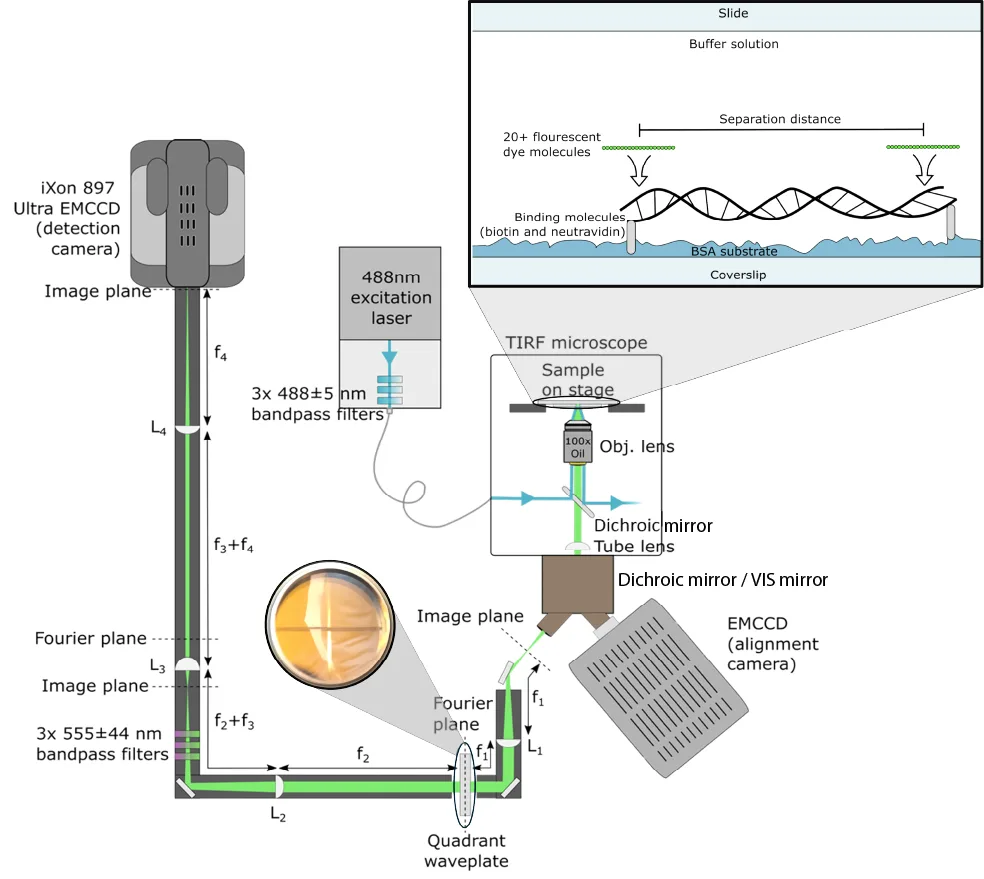
المجهر الضوئي العادي يصطدم بحد: فهو لا يميّز نقطتين إذا كانت المسافة بينهما أقل من 200 نانومتر — أي ما يعادل سمك فقاعة صابون مقسومًا على مئة. للنظر أعمق، كان العلماء يجبرون الجزيئات في العينة على الوميض أو البهتان، لكن هذه الحيل بطيئة وتضر بالخلايا الحية. الجهاز الجديد — مجهر الكشف المهيكل (Structured Detection Microscope) — يفعل الأمر بشكل مختلف.
إنه لا يلمس العينة نفسها، بل يغيّر شكل بقعة الضوء التي تلتقطها الكاميرا. الضوء القادم من جزيئات متجاورة كان سيندمج في بقعة ضبابية واحدة، يتم توزيعه الآن على مناطق مختلفة من المستشعر. الأمر أشبه بتسجيل صوتين في غرفة صاخبة ليس بميكروفون واحد، بل بميكروفونين موزعين في الزوايا: كل منهما يلتقط جزءًا منه. ونتيجة لذلك، يميّز الجهاز علامات على مساطر الحمض النووي (DNA) متباعدة بمقدار 50 نانومترًا، ويوفّر وضوحًا يصل إلى 40 نانومترًا — أي أفضل بخمس مرات من الحد.
هذا النهج يفتح الطريق لمراقبة الخلايا الحية دون سمية ضوئية — التسمم الضوئي الذي يجعل الخلية تتلف تحت المجهر. الآن سيتمكن علماء الأحياء من تتبع عمل البروتينات والحمض النووي في الوقت الفعلي، دون خوف من قتل الخلية بشعاع ساطع.
الملخص الأصلي
كما كتبه المؤلفون، بالإنجليزية arXiv:2604.00413
Super-resolution microscopy is crucial for imaging sub-wavelength biological structures. However, most techniques rely on nonlinear saturation or stochastic switching of emitters, limiting imaging speed and increasing phototoxicity. Here, we achieve deep super-resolution without employing saturation or stochastic dynamics, instead using a form of spatial mode demultiplexing. By shaping the point-spread function of the emitted light, our Structured Detection Microscope (SDM) redistributes information away from high shot-noise regions of the image, enhancing sensitivity to sub-diffraction emitter separations in two-dimensions and without mode-sorting optics. Implementing SDM within a high-numerical aperture total internal reflection fluorescence microscope, we demonstrate imaging of fluorophores attached to DNA nanorulers with separations as small as 50 nm at resolutions surpassing 40 nm - fivefold below the diffraction limit. This shows that spatial mode demultiplexing can achieve far sub-wavelength resolution and is applicable to biologically relevant samples. By enabling super-resolution biomolecular imaging without emitter saturation and stochasticity, our work opens the door to better understanding biological structure, function and dynamics.
حد الدقة البصرية الذي تجاوزه المؤلفون وُصف في عام 1873 على يد إرنست أبّه (Ernst Abbe). وقد اعتُبر حدًا لا يمكن تجاوزه لما يقرب من قرن ونصف.
في مسلسل «الفضاء» (The Expanse)، تتيح المستشعرات فائقة الدقة للسفن الرؤية عبر الكويكبات. المجهر الجديد هو خطوة نحو الرؤية عبر الأغشية الخلوية دون تدميرها.