الحرارة تنحرف جانبياً تحت تأثير المجال المغناطيسي سريع
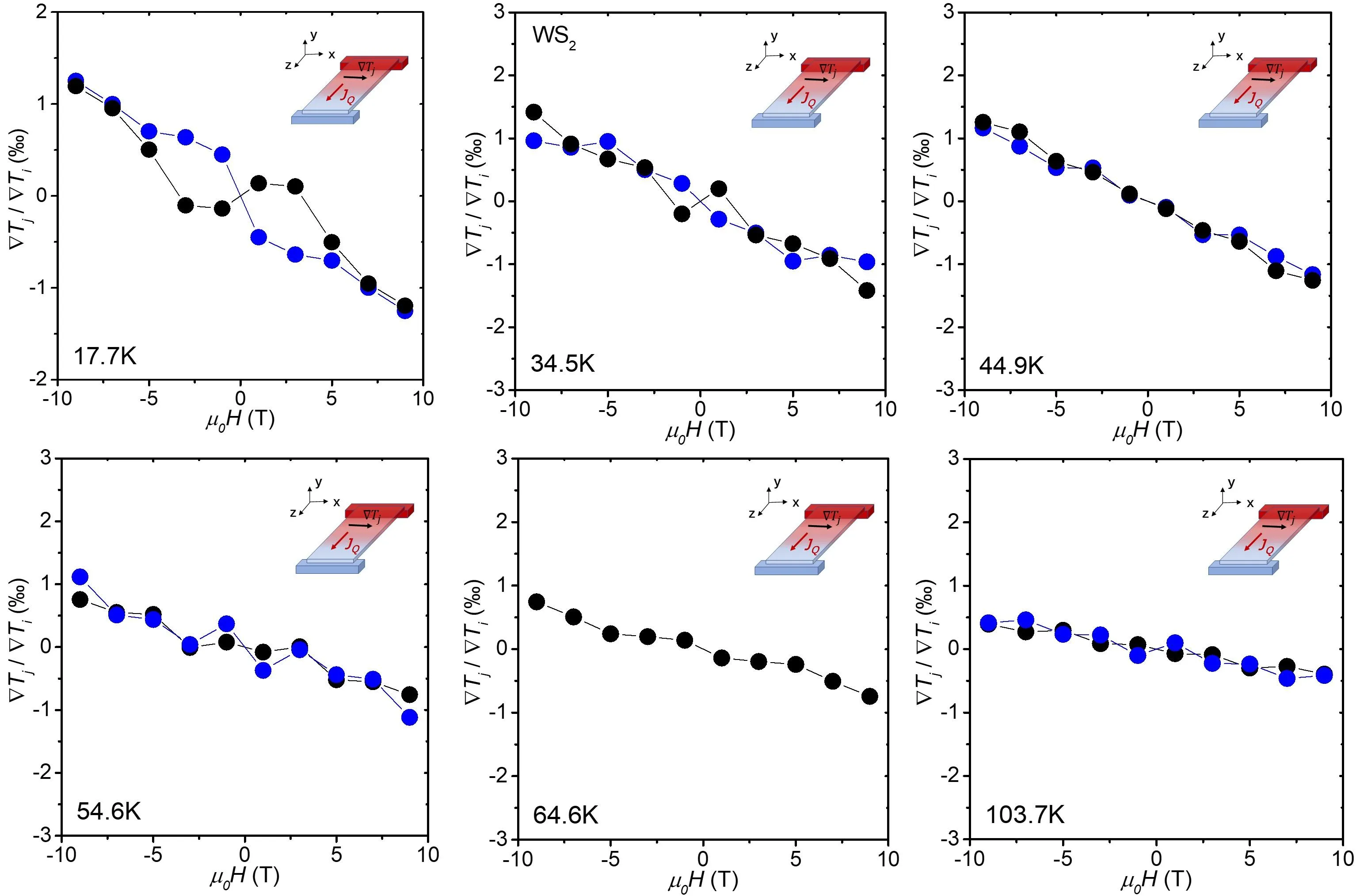
في البلورة العازلة، تنتشر الحرارة عادة من الطرف الساخن إلى الطرف البارد. ولكن عند تشغيل المجال المغناطيسي، ينحرف جزء من تدفق الحرارة إلى الجانب — مثل الماء الذي ينحرف قليلاً عن مساره عندما تدفعه الرياح أثناء تدفقه من التل. يُعرف هذا السلوك بالتأثير الحراري هول (thermal Hall effect).
أخذ الباحثون بلورة WS2 ذات الطبقات (ثنائي كبريتيد التنجستن — مادة تشبه الجرافيت ولكنها مكونة من ذرات التنجستن والكبريت) وقاسوا كيفية انتقال الحرارة على طول الطبقات وعبرها. وتبين أن كلا التدفقين يبلغان أقصى قوة لهما عند نفس درجة الحرارة تقريباً. ونسبتهما لا تتجاوز حداً معيناً، كما هو الحال في العوازل الأخرى.
قارن المؤلفون هذا بسلوك غاز من الجزيئات غير الكروية. هناك، يؤثر المجال المغناطيسي على دوران الجزيئات، وبسبب التصادمات ينشأ تدفق حراري عرضي. وعلى نحو مماثل، في البلورة يؤثر المجال على الفونونات من خلال تفاعلها مع بعضها البعض. تقدير بسيط يأخذ في الاعتبار قوة بيري (Berry force) (تأثير مرتبط بهندسة حركة الذرات) يصف القياسات بشكل جيد لسبعة عوازل بلورية مختلفة.
الملخص الأصلي
كما كتبه المؤلفون، بالإنجليزية arXiv:2604.03644
The amplitude of the Hall response of electrons can be understood without invoking interactions. Most theories of the phonon thermal Hall effect have likewise opted for a non-interacting picture. Here, we challenge this approach. Our study of WS$$_2$$, a transition metal dichalcogenide (TMD) insulator, finds that longitudinal, $$\kappa_{xx}$$, and transverse, $$\kappa_{xy}$$, thermal conductivities peak at almost the same temperature. Their ratio obeys an upper bound, as in other insulators. We then compare transverse thermal transport in a phonon gas and in a molecular gas. In the latter, the Senftleben-Beenakker effect is driven by the competition between molecular collisions and applied magnetic field in setting the distribution of molecular angular momenta. An off-diagonal transport response arises thanks to interactions between non-spherical particles, which do not need to be chiral. By analogy, we argue that in a phonon gas, magnetic field will influence phonon-phonon interactions, and generates a transverse thermal \emph{resistivity}, whose order of magnitude can be accounted for by invoking a Berry force on the drift velocity of the nuclei in the presence of a finite heat. This simple picture gives a reasonable account of the experimentally measured transverse thermal resistivity of seven different crystalline insulators.
تم اكتشاف التأثير الحراري هول في العوازل لأول مرة في عام 2005 في غارنيت تيربيوم-غادولينيوم، ومنذ ذلك الحين لوحظ في العديد من البلورات.