كيف تبني الخلايا الحارسة فخًّا للسرطان سريع
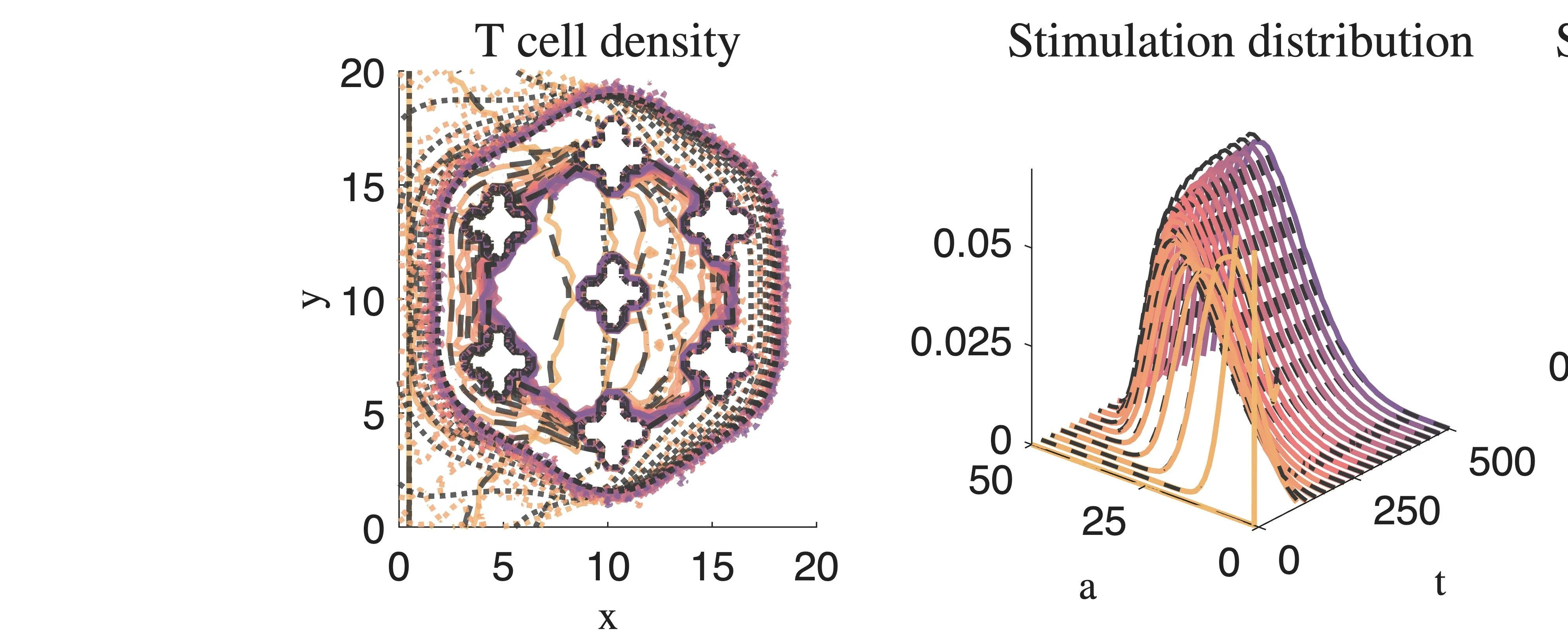
تشبه العقدة اللمفاوية مركز قيادة مزدحمًا بالحركة. هنا، الخلايا التغصنية — الكشافة التي تجمع حطام الأعداء — تعرض على الخلايا التائية (الجنود) أجزاءً من الغزاة. إذا وقف الكشافة منفردين، يمر الجنود دون أن يلاحظوا الإشارة تقريبًا. ولكن عندما يتجمع الكشافة في مجموعات متراصة، فكأنما يشعلون نيرانًا: تصبح الإشارة أوضح وأكثر إلحاحًا.
بَنى مؤلفو الدراسة محاكاة حاسوبية لهذه العملية. في المحاكاة، تتصرف كل خلية تائية كعنصر مستقل له «شغفه» الخاص بالتحفيز. ومن المحاكاة اشتقوا معادلات تصف حركة الخلايا وتنشيطها اعتمادًا على كثافة العناقيد. واتضح أن الجنود متوسطي الحساسية هم الأكثر استفادة. بالنسبة لهم، يصبح العنقود دفعة حاسمة للاستيقاظ. أما الضعفاء فلا يستجيبون على أي حال، بينما شديدو الحساسية يستثارون حتى من إشارة منفردة.
الخلاصة الرئيسية: التنظيم المكاني للخلايا لا يغير قوة الاستجابة فحسب، بل ينوعها أيضًا. تخلق العناقيد طيفًا واسعًا من المحفزات، فتدخل إلى المعركة جنودٌ بعتبات حساسية مختلفة. وهذا يفسر بيانات الملاحظات السريرية. ففي مريضات سرطان الثدي، يرتبط ارتفاع كثافة العناقيد التغصنية في العقد اللمفاوية الحارسة بتحسن البقاء على قيد الحياة. الجهاز المناعي لا يتلقى تعزيزات فحسب — بل يتعلم تمييز العدو بمرونة أكبر.
الملخص الأصلي
كما كتبه المؤلفون، بالإنجليزية arXiv:2604.17786
The coordination of the immune system and its components is essential for the body to maintain a healthy status. Recent clinical studies show that breast cancer patients with high Dendritic cell clustering in tumour draining lymph nodes have improved survival outcomes, compared to those with a lower degree of clustering. These results suggest that a specific form of Dendritic cell clustering promotes T cell activation. However, the mechanistic effects of this spatial organisation is unclear. We develop a spatially dynamic model of T cells interacting with Dendritic cells within the lymph node. We present a novel probabilistic agent-based model (ABM) of T cells, and use it to derive the deterministic, phenotypically structured partial differential equation (PS-PDE) of T cell activation and motion. Using the PS-PDE, we derive analytic approximations of the expected T cell stimulation distribution, based on the topology and level of clustering of a given Dendritic cell population. Our analytic approximation enables us to identify T cell characteristics that benefit most from Dendritic cell clustering, to result in an enhanced stimulation distribution. We also perform a sensitivity analysis with our models to identify T cell characteristics that result in desirable T cell activation characteristics, such as rapid T cell activation, and robust heterogeneous T cell activation. Our key findings show that T cells with an intermediate level of stimulation uptake benefit most from higher levels of Dendritic cell clustering, activating with a comparable or greater abundance, and greater heterogeneity, when compared to T cells of a similar characteristic but with a lower level of Dendritic cell clustering.
تحتوي عقدة لمفاوية واحدة بحجم حبة الفول على نحو مليار خلية لمفاوية تتحرك باستمرار بسرعة حوالي 10 ميكرومترات في الدقيقة — كما لو كان الإنسان يطوف حول ملعب كرة قدم خلال ساعة.