تركيبة غير متوقعة لغلاف تابع لكوكب نبتون الصغير الدافئ سريع
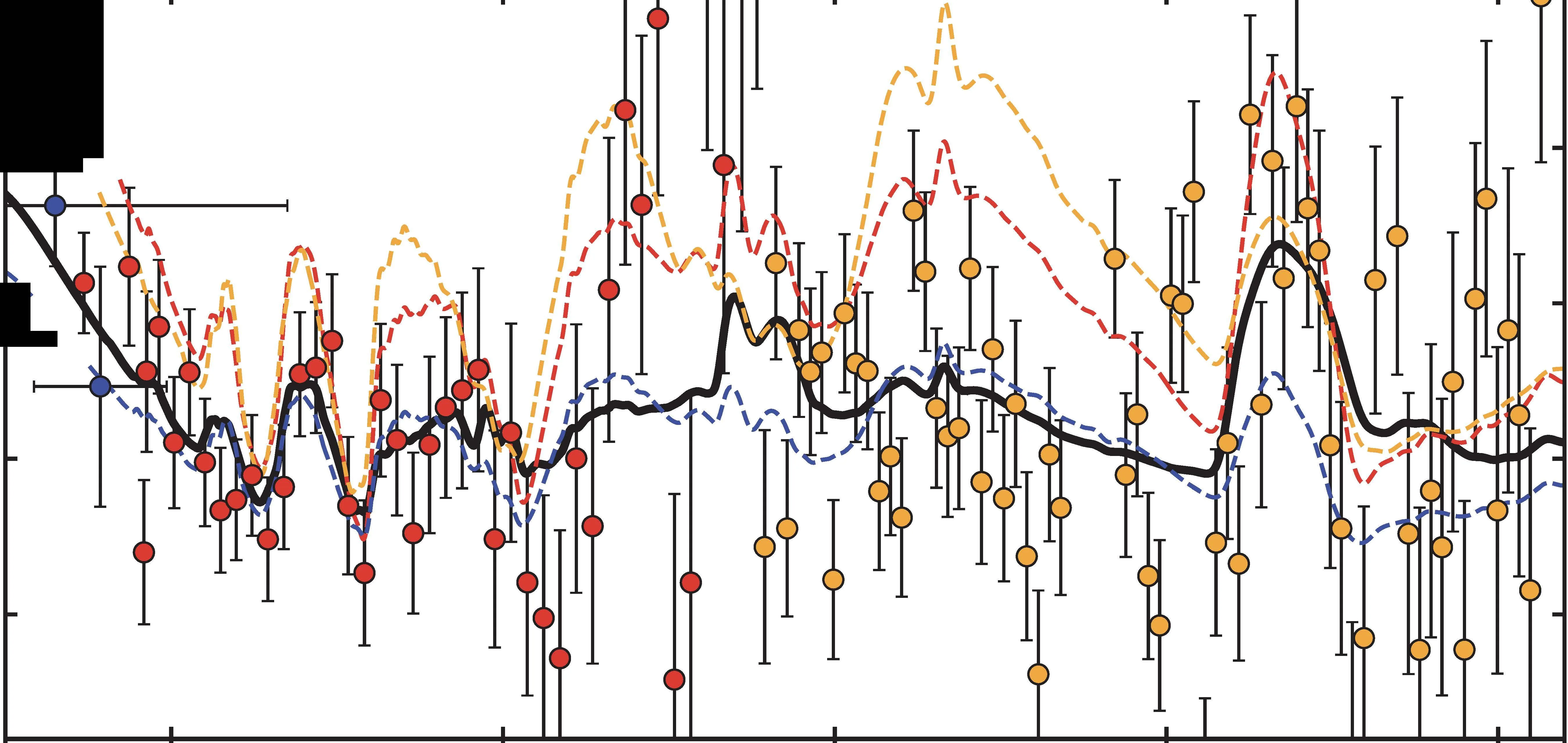
البخار المتصاعد من قدر يغلي يلوّن ضوء مصباح يدوي قليلًا: يوقف بعض الألوان ويسمح بمرور البعض الآخر. هكذا تقريبًا يدرس العلماء هواء الكواكب البعيدة. عندما يمر كوكب أمام نجمه، يخترق جزء ضئيل من ضوء النجم غلافه الجوي، وتترك الجزيئات خطوطًا داكنة في الطيف — "بصمات أصابعها" الخاصة.
تلسكوب جيمس ويب الفضائي جيمس ويب فعل ذلك مع الكوكب TOI-1130b — وهو نبتون صغير دافئ (أوسع من الأرض بحوالي 3.7 مرة وأثقل منها بـ 20 مرة). تبين أن غلافه الجوي عبارة عن مزيج كيميائي حقيقي. تظهر بوضوح الماء (H₂O) وثاني أكسيد الكربون (CO₂) وحتى ثاني أكسيد الكبريت (SO₂) — وهذا الأخير نادرًا ما يُعثر عليه في مثل هذه الكواكب. وهناك تلميحات أيضًا إلى الميثان (CH₄)، لكنها ليست واضحة تمامًا بعد.
التركيبة تكشف أصل الكوكب. الغلاف الجوي غني بالعناصر الثقيلة (المعدنية أعلى بحوالي 60 مرة من الشمس)، ونسبة الكربون إلى الأكسجين منخفضة. هذا المزيج نموذجي للعوالم التي وُلدت بعيدًا عن النجم، خلف "خط الجليد" — الحدود التي يتجمد عندها الماء إلى جليد. على الأرجح، تشكل TOI-1130b في المناطق الخارجية الباردة للنظام، ثم انتقل إلى أقرب من النجم. ربما تحت تأثير جاره الأضخم — المشتري الحار في مدار خارجي. ذلك الجار، مثل مكنسة كهربائية عملاقة، ربما "صفّى" الحصى والجليد، موجّهًا جزءًا من المواد إلى الداخل.
هذا الاكتشاف يضيف لمسة مهمة إلى صورة النبتونات الصغيرة — النوع الأكثر انتشارًا من الكواكب في المجرة، والتي لا توجد في نظامنا الشمسي. يبدو أنه لا توجد وصفة واحدة لتكوينها: بعضها ينمو في مكانه، والبعض الآخر يأتي من بعيد حاملًا معه مواد متطايرة. بدراسة هوائها، نحن وكأننا ننظر إلى قدر تُطهى فيه تنوعات الكواكب.
الملخص الأصلي
كما كتبه المؤلفون، بالإنجليزية arXiv:2605.02036
We present the combined JWST/NIRSpec G395H and NIRISS SOSS transmission spectrum of a warm mini-Neptune, TOI-1130b (3.66 R$$_{\oplus}$$, 19.8 M$$_{\oplus}$$, $$T_{eq}\sim825$$ K). It is part of a rare and unique multi-planet system TOI-1130, which hosts an inner mini-Neptune and an outer hot Jupiter locked in a 2:1 mean motion resonance. From the transmission spectrum of TOI-1130b we detect multiple molecules -- H$$_2$$O (7.5$$\sigma$$), CO$$_2$$ (3.3$$\sigma$$), and SO$$_2$$ (3.6$$\sigma$$), as well as a tentative detection of CH$$_4$$ ($$\sim$$2$$\sigma$$). We find a strong optical slope in the NIRISS/SOSS spectrum, which is consistent with TESS and CHEOPS transit depth measurements. From equilibrium chemistry retrievals we measure the atmospheric metallicity ($$\log{Z/Z_{\odot}}=1.8^{+0.4}_{-0.3}$$) and C/O ratio ($$<$$0.75 at 3$$\sigma$$ level confidence) and constrain the atmospheric mean molecular weight, $$\mu$$ = 5.5$$^{+1.3}_{-0.8}$$ amu. These constraints are consistent with self-consistent forward model grids. We detect no significant He I 1.083$$\mu$$m absorption signal and put a mass-loss rate upper limit of $$10^{11}$$g\s$$^{-1}$$. The volatile-rich high mean molecular weight atmosphere of TOI-1130b along with the `pebble-filtering' effect of the outer hot Jupiter supports the ex-situ formation scenario beyond the water ice line and subsequent migration, coherent with its present orbital architecture. A volatile-rich formation scenario could also potentially explain the location of TOI-1130b at the edge of the `radius cliff'. This result hints that the mini-Neptune population may not a homogeneous formation history; rather, volatile-rich ex-situ formation also contributes to its population.
درجة حرارة التوازن لـ TOI-1130b تبلغ حوالي 825 كلفن (نحو 550 درجة مئوية). هذا أسخن من سطح الزهرة، لكنه أبرد من لهب موقد الغاز.