Andrew Vanderburg

10 articles · 30 co-authors · latest: 2026-08-25
9,891 citations · h-index 49 · 398 papersData: Semantic Scholar

We have retold 10 papers by this author. 1 of them with a full read. most often about: exomoon, transit method, JWST. 30 co-authors across our retellings.

Links in the knowledge graph
Exoplanets2025-10-281 minarXiv:2510.24575express
The Hunt for Moons of Rogue Planets
In the vast darkness of interstellar space, the rogue planet WISE 0855 flickers with a barely perceptible heat glow, like a cooling ember. Its temperature is only a few dozen degrees above freezing — if life existed there, it would see a sunless sky, in an eternal icy haze.
Exoplanets2026-01-151 minarXiv:2601.10598express
Four Teenage Planets Around a Young Star
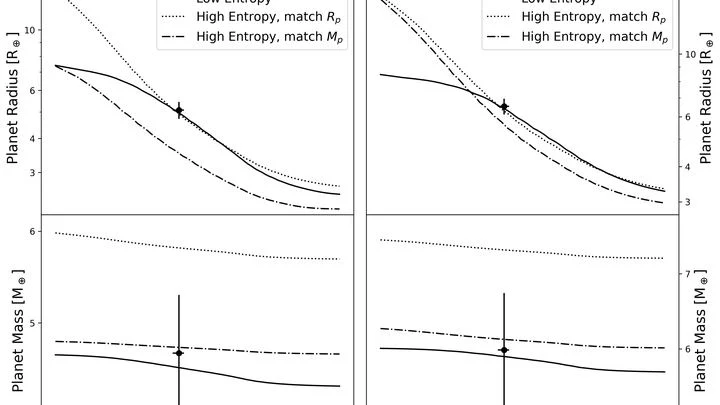
350 light-years away, four planets orbit the star V1298 Tau. They are 5–10 times larger than Earth but lighter than they appear. For nine years, astronomers tracked their motion to understand what they are made of and how they lived in the past. The planets are lined up in a chain: their orbital periods are nearly in 3:2, 2:1, and 3:1 ratios.
Exoplanets2026-01-271 minarXiv:2601.19870express
One Transit, One Year
For ten hours, the star HD 137010 dimmed a little, like a lamp with a speck of dust on it. The K2 telescope caught this in 2017, and in all the observing time, it happened only once. Astronomers realized: a planet had passed in front of the star. This way of finding worlds is called the transit method. When a planet crosses the star's disk, the star briefly fades.
Exoplanets2026-02-191 minarXiv:2602.17760express
Neural Network Cleans Stellar Noise from the Search for Distant Worlds
For six straight years, the HARPS-N telescope on La Palma island stared at the Sun as if it were a distant star — taking spectra, tracking brightness, and recording every quiver of spectral lines. All this was to understand how to distinguish a star's subtle sway from a genuine planetary signal. A star doesn't sit still: its surface boils like a pot of soup.
Stellar2026-03-172 minarXiv:2603.17039express
A Star Slowly Devours Its Companion
A sugar cube sits on a saucer next to a cup of hot tea. Drop it in, and it dissolves within minutes. But if you lower it slowly, the sugar melts gradually, releasing its sweetness into the drink. Something similar is happening in two newly discovered stellar pairs, except the sugar is a brown dwarf and the tea is a star.
Exoplanets2026-03-191 minarXiv:2603.19402express
A Quiet Star: How They Searched for a Planet and Found Nothing
The Gaia space telescope measures star positions with an accuracy of a microarcsecond, like spotting a coin on the Moon from Earth. In 2022, it noticed that the bright star HD 12800 was wobbling slightly, as if tugged by an invisible companion. Astronomers hypothesized that a planet orbits the star. But a wobble can be deceiving.
Exoplanets2026-04-062 minarXiv:2604.05235express
Moons of Distant Planets: What's Keeping Us from Seeing Them
The light from a distant star is never steady. It shimmers like heat over hot asphalt. When astronomers pointed JWST at the star TOI 700, they saw this shimmer especially clearly: every 16 minutes, the brightness changed by a tiny fraction, just 46 parts per million.For comparison: if you placed a light bulb a kilometer away, this change would be…
Exoplanets2026-04-251 minarXiv:2604.23448express
Giant Planet or Twin World?
Astronomers pointed JWST at a planet near the star Epsilon Indi — a giant gas ball resembling Jupiter, just 12 light-years away. In thermal images, the planet shone like a lantern. But nearby they noticed a faint dot — like a firefly. Calculations showed that two objects describe the picture better than one. However, it's most likely a lens flare — like a ghost of a lamp.
Exoplanets2026-05-032 minarXiv:2605.02036express
The Neighbor Who Wasn't Kicked Out
On a sunny street, there's a house with a big family: a giant father who always sits by the window and a small child running around the yard. That's the TOI-4468 system: a gas giant hot Jupiter hugs the star, while a bit farther out circles a sub-Neptune — a planet smaller than Neptune but larger than Earth.