كيف تنتفخ موجة الصدمة في الهواء المخلخل سريع
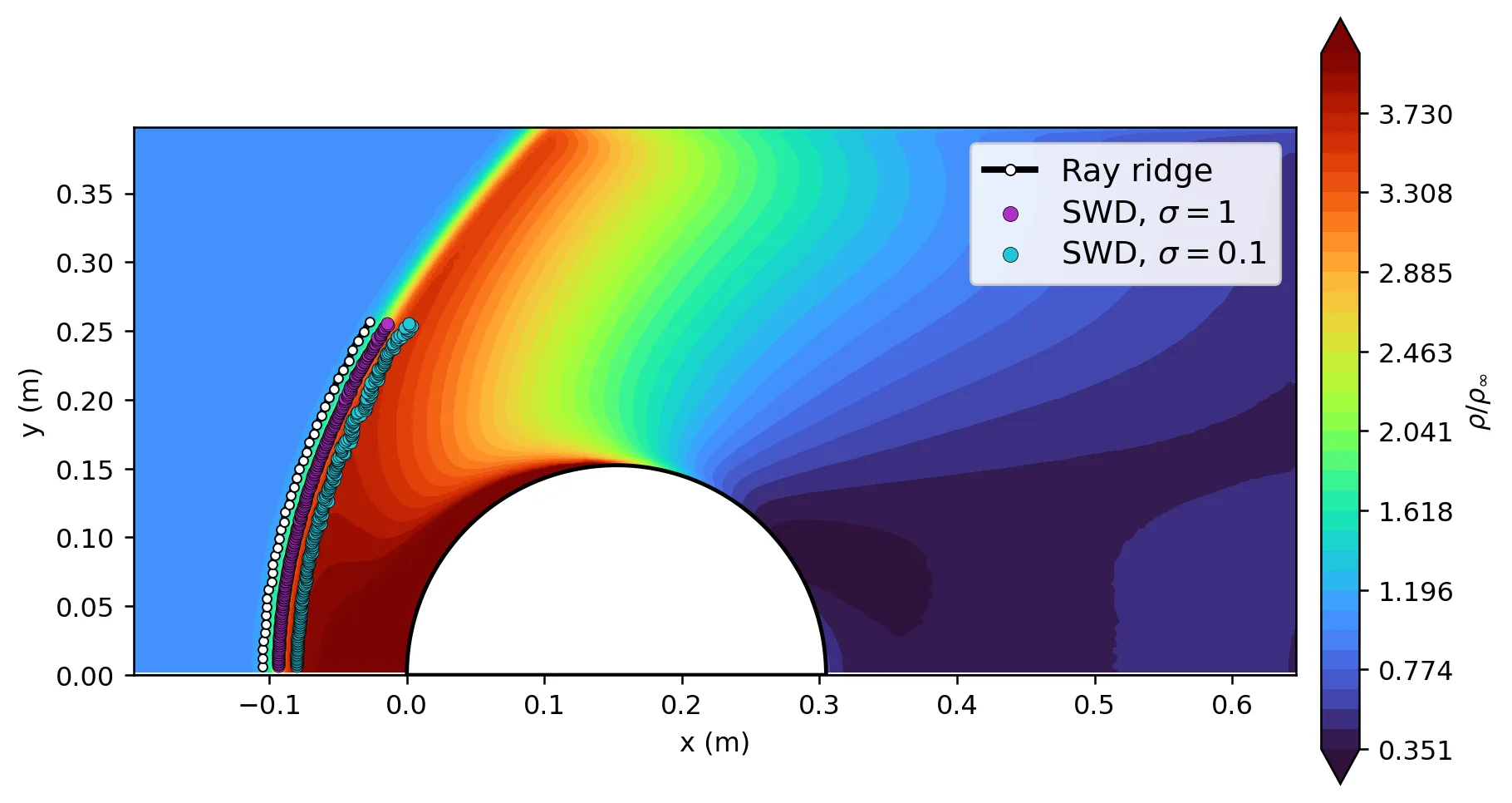
أسطوانة بسرعة هائلة تخترق الهواء، فيتولد حولها موجة صدمة — حد حاد ينضغط فيه الهواء ويسخن فجأة. إرنست ماخ كان أول من صور هذه القفزات، ومنذ ذلك الحين اعتدنا على تصورها كجدران رقيقة شبه غير مرئية.
لكن إذا كان الهواء مخلخلًا جدًا، كما هو الحال على ارتفاع 80 كيلومترًا، فإن الجزيئات هناك تطير منفردة، ولا تصطدم ببعضها تقريبًا. في العمل الجديد، قام العلماء بحساب هذا الانسياب على الكمبيوتر، متتبعين خطوة بخطوة مصير ملايين الجسيمات. واتضح أنه عند التخلخل الشديد يختفي الحد الحاد. فبدلاً من قفزة حادة، ينشأ غاز طبقة انتقالية "منتفخة" عريضة ينضغط فيها الغاز تدريجيًا. هذا ليس مجرد تضخيم للصورة المألوفة، بل تغير في آلية الانضغاط نفسها.
يلعب متوسط المسار الحر دورًا رئيسيًا هنا — المسافة التي يقطعها الجزيء بين الاصطدامات. في الوسط الكثيف، تكون هذه المسافة مجهرية، وتكون الموجة رقيقة. في الوسط المخلخل، يصبح متوسط المسار الحر مشابهًا لحجم الجسم نفسه، فينتشر الانضغاط على مدى عشرات السنتيمترات. أظهر مؤلفو العمل أن نمو سماكة طبقة الانضغاط يتحدد بهذه المعلمة تحديدًا، وليس فقط بدرجة انضغاط الغاز.
هذه النتيجة مهمة لتصميم المركبات الهابطة والطائرات فرط الصوتية. عندما تدخل مركبة الغلاف الجوي بسرعة 10 ماخ، فإن الخطأ في حساب موجة الصدمة قد يؤدي إلى ارتفاع حرارة زائد أو مسار غير صحيح. فهم كيفية "انتفاخ" الموجة في الهواء المخلخل يساعد في جعل الدروع الحرارية أكثر أمانًا.
الملخص الأصلي
كما كتبه المؤلفون، بالإنجليزية arXiv:2605.17099
Rarefied hypersonic bow shocks over blunt bodies inflate as the Knudsen number increases, but it remains unclear whether this inflation is a simple shift and broadening of one common shock layer or a multi-scale change of the macroscopic and internal-energy fields. We address this question using direct simulation Monte Carlo (DSMC) data for Mach-10 flow over a circular cylinder in argon and nitrogen over \(Kn_\infty \approx 0.01\)--\(1\), together with a Mach-number sweep at \(Kn_\infty=0.01\). At low rarefaction, a ray-based density-gradient ridge gives a reproducible bow-shock location and agrees with an independent schlieren-based shock-wave-detection method. As \(Kn_\infty\) increases, this ridge is replaced by a broad kinetic compression layer, so the high-Knudsen cases are analysed using profile-based standoff and thickness metrics rather than by imposing a visual shock line. The Knudsen- and Mach-number sweeps separate two mechanisms. At fixed \(M_\infty\), the continuum normal-shock density ratio provides a useful low-rarefaction reference compression scale, whereas the measured standoff growth is governed primarily by the kinetic mean free path; the effective density thickness shows an intermediate minimum before increasing in the diffuse regime. At fixed low \(Kn_\infty\), changing \(M_\infty\) mainly changes compression strength and curvature, preserving a coherent attached-layer structure. Density-registered profiles and shock-attached proper orthogonal decomposition (POD) show that, within the present maximum-density-gradient registration, density becomes nearly rank one, whereas Mach number and thermal variables retain independent modal content. Rarefied bow-shock inflation is therefore a coupled compression--relaxation process, not a single-scale rescaling of a continuum-like shock.
على ارتفاع 100 كم، عدد الجزيئات قليل جدًا لدرجة أن الصوت لا ينتشر هناك عمليًا — لا يمكن لموجة الصدمة أن تتشكل بالطريقة المألوفة.
في رواية «المريخي» لأندي وير، يستخدم البطل الغلاف الجوي المخلخل للمريخ للتباطؤ — لكن بدون حساب دقيق لموجة الصدمة "المنتفخة" لكان قد تحطم في السماء.