بوصلة مغناطيسية للدماغ دون تشويش سريع
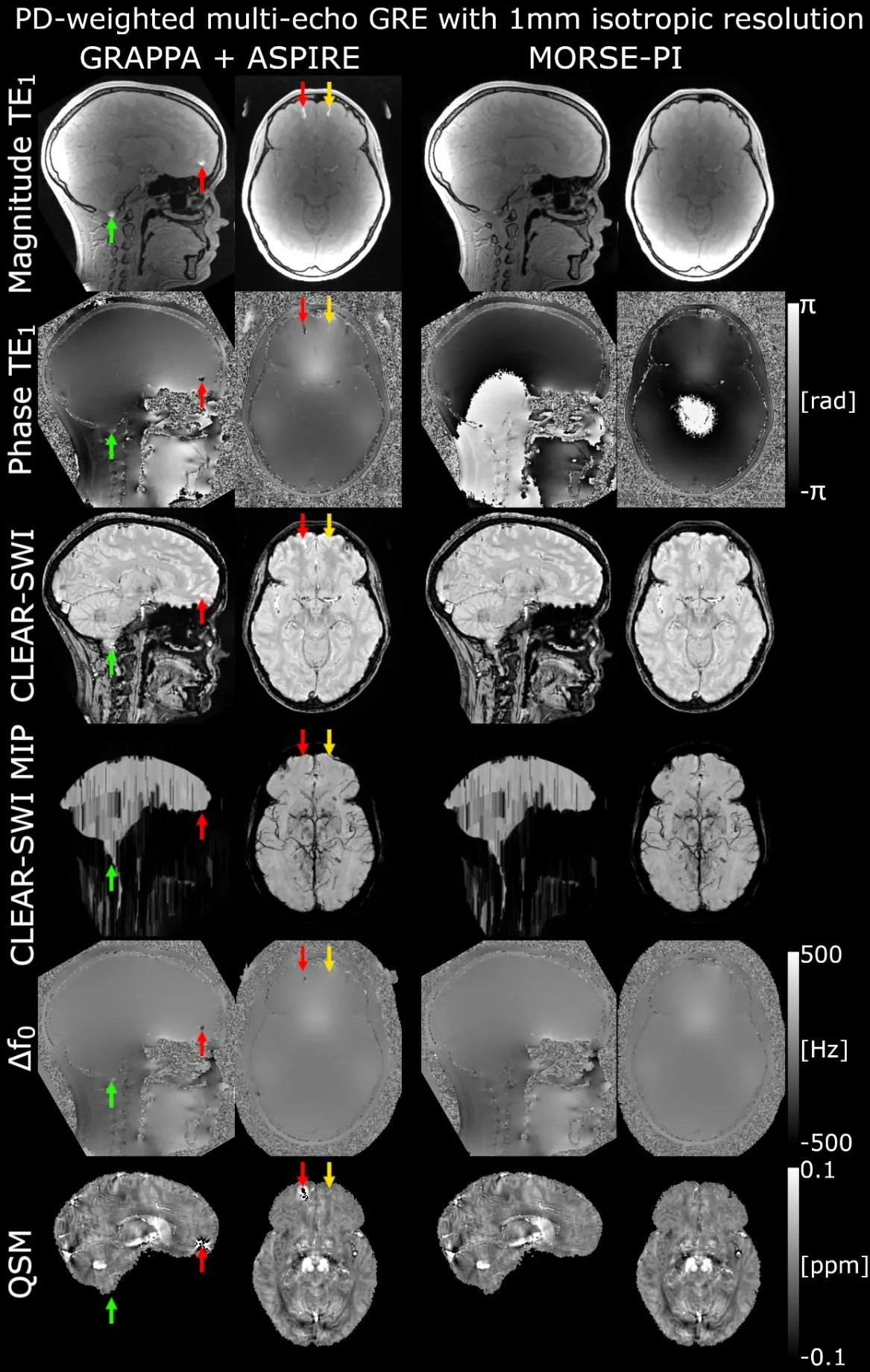
المغناطيس القوي لجهاز التصوير يحفز تيارات كهربائية ضعيفة في الأنسجة. طور هذه التيارات يتصرف مثل إبرة البوصلة التي تهتز مع كل هبة ريح — فأدنى تداخل يحول الخريطة إلى تموجات لا يُرى فيها سوى الضوضاء بدلاً من الأوعية الدقيقة أو رواسب الحديد.
تعمل MORSE-PI مثل قائد أوركسترا ذكي لمجموعة من ملفات الاستقبال. فهو ينشئ ملفًا مرجعيًا افتراضيًا يسمع الإشارة من الدماغ كله بشكل متساوٍ، وبمساعدته تتم موازنة أطوار جميع الملفات في إيقاع نظيف واحد.
الطريقة لا تزيل الضوضاء فحسب، بل تمنعها من التحول إلى دوامات زائفة على الخريطة. لم تعد إبرة البوصلة تدور في دوامة التداخلات. الآن يمكن قياس القابلية المغناطيسية (QSM) بشكل موثوق — وهو المؤشر الرئيسي للكشف عن النزيف الدقيق أو تغيرات باركنسون. كل هذا يعمل في أي مجال: من 3 تسلا المعتادة إلى 7 تسلا التجريبية.
الملخص الأصلي
كما كتبه المؤلفون، بالإنجليزية arXiv:2606.21336
Phase imaging applications such as QSM are highly sensitive to noise amplifications, phase singularities, and other artefacts, particularly in challenging scenarios such as ultra-high field (7T), under-sampled or single-echo acquisitions. We present a novel image reconstruction method, MORSE-PI, designed to produce high-SNR, artefact-free, and singularity-free phase images for both structural and functional phase-based brain imaging. MORSE-PI extends our previous approach, MORSE, by introducing a Virtual Reference Coil (VRC). The VRC is constructed as a linear combination of coil sensitivity maps, with correlations enhanced between coil elements using the noise covariance matrix. Such a VRC ensures robust signal support across the entire brain and is used to correct phase offsets in the MORSE-derived coil sensitivity estimates, resulting in artefact-free, high SNR phase. Compared to GRAPPA with ASPIRE phase correction, MORSE-PI demonstrates greater robustness to artefacts such as noise amplification and aliasing, and shows improved reproducibility in structural imaging at both 3T and 7T. Unlike ESPIRiT and GRAPPA combined with adaptive coil combination methods, MORSE-PI yields singularity-free phase maps. MORSE-PI enables high-SNR reconstructions even for the most challenging scenarios, such as single-echo EPI at 7T. Its efficient, containerised implementation using the Gadgetron framework supports deployment on the MRI scanner console during measurements. MORSE-PI offers a flexible and computationally efficient solution for generating high-SNR, artefact- and singularity-free phase images in both single- and multi-echo GRE and EPI acquisitions. This makes it particularly well-suited for structural and functional QSM, as well as other phase-based MRI applications. Its robustness and rapid computational time facilitate efficient deployment on scanners across field strengths.
جهاز التصوير فائق الارتفاع بقوة 7 تسلا ينتج مجالًا مغناطيسيًا أقوى بـ 140 000 مرة من المجال الأرضي — وهو قادر على انتزاع مشبك ورق من الجيب عبر الغرفة بأكملها.
في رواية «تقرير الأقلية»، كان يتم البحث عن المتنبئين بالجرائم من خلال اضطرابات في الخرائط المغناطيسية للدماغ — كانت MORSE-PI ستجعل البحث عنهم أكثر دقة.