خطأ صامت في البحث عن الكواكب سريع
في مرصد هادئ، يلتقط المطياف ضوء نجم بعيد. الجهاز يحلله إلى قوس قزح — الطيف. الخطوط في الطيف تنزاح قليلًا ذهابًا وإيابًا: كوكب غير مرئي يهز النجم. لملاحظة هذا الانزياح، يقارن علماء الفلك الطيف بنموذج مرجعي — «صورة» للنجم مُجمَّعة من رصدات عديدة.
إحدى طرق المقارنة هي طريقة المشتقة. تنظر إلى مدى سرعة تغير السطوع على طول الطيف، ومن هذا الميل تحسب الانزياح. لكن إذا كانت الصورة المرجعية مُجمَّعة من إطارات خافتة (بنسبة إشارة إلى ضوضاء منخفضة)، فإن الميل يصبح غير دقيق. المترجم يشتت انتباهه كل حفيف في القاعة — فتتحول ساعة الاجتماع إلى ساعتين. اختبر المؤلفون ذلك على خطوط اصطناعية وبيانات حقيقية.
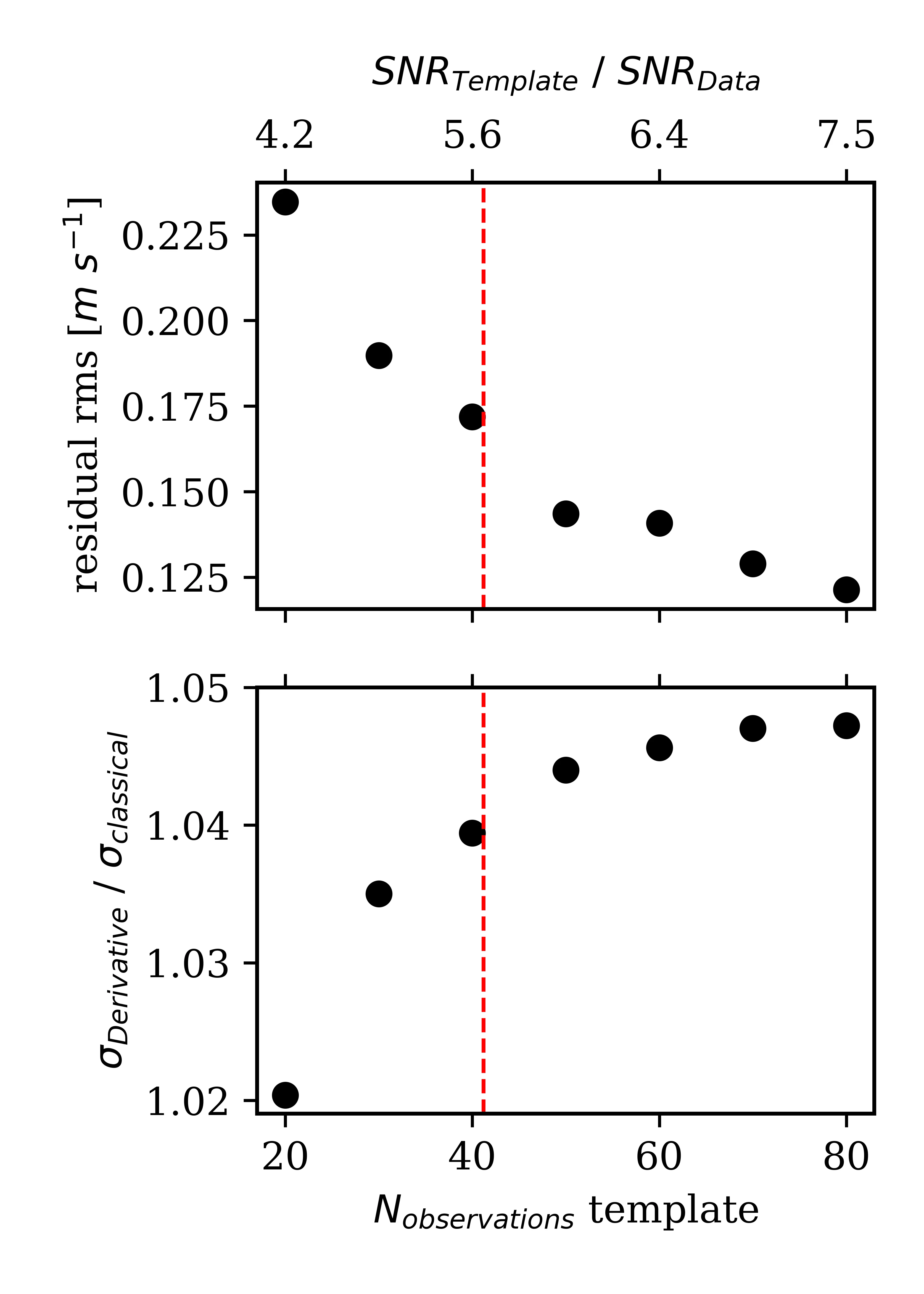
عندما تصبح الإشارة أكثر سطوعًا (نسبة إشارة إلى ضوضاء أكبر من 1000)، ينخفض الخطأ إلى ما دون عتبة حساسية أفضل المطيافات الحديثة. وإذا تم حساب متوسط خطوط عديدة، يقل الخطأ مهما كانت الجودة. في الرصدات الحقيقية، كان الفرق بين الطريقتين 12,5 سنتيمترًا في الثانية فقط لنموذج من 78 إطارًا — أقل من سرعة نمو الخيزران.
هذا العمل تذكير: في السعي وراء كواكب بحجم الأرض، حتى خلل مجهري في الحسابات قد يضللنا. خطأ صامت في الطريقة، شبه غير ملحوظ، يمكن أن يخفي إشارة حقيقية. وعندها سيظل المطياف في المرصد الهادئ يلتقط الضوء، غير مدرك للكوكب المختبئ.
الملخص الأصلي
كما كتبه المؤلفون، بالإنجليزية arXiv:2606.30377
The radial velocity (RV) method is a widely used technique to infer planetary masses and orbital parameters. One of the most widely used methods to compute RVs is based on the alignment of a high-SNR, data driven, stellar model with individual observations, commonly referred to as template matching. Typically, the alignment is performed through a $$\chi^2$$ minimization, but some approaches rely on the derivative of the stellar template to do so, which is often the case in line-by-line methods. In this paper we aim to explore the limitation of derivative-based methods for RV extraction in the case of using low-SNR stellar models. We use simulated Gaussian profiles to investigate the effect of computing a numerical derivative of the stellar template, in comparison with the usage of an analytical profile. The impact on RV and associated uncertainty is then analyzed as a function of the signal-to-noise ratio (SNR) of the line. Then, using real observations we compare the residuals between a derivative-based RV extraction and a classical template matching implementation, as function of the SNR of the stellar template. We find that on simulated Gaussian profiles the usage of the numerical approach leads to a RV residual at the level of the meter per second, at a per-pixel SNR regime of 100. An increase of the SNR leads to a decrease of this impact, falling under the current noise-floor of state-of-the-art spectrographs at SNR>1000 for a single spectral line. The inclusion of multiple spectral lines in the simulations lead to an overall decrease of the contamination, across all SNR regimes. The application to a real dataset presents a decrease of the RV impact with the increase of the template's SNR, albeit still presenting a 12.5 cm/s difference when including 78 observations in the stellar template.
ساعدت طريقة السرعات الشعاعية لأول مرة في العثور على كوكب خارجي حول نجم 51 بيغاسوس في عام 1995. ومنذ ذلك الحين، زادت الدقة لدرجة أننا نميز ارتجاف النجم بالسنتيمترات في الثانية — أبطأ من زحف الحلزون.