من ينشر العدوى ومن يصاب بها: الحياة الخفية للوباء سريع
الأوركسترا تعزف بدون قائد. نحن نعرف مستوى الصوت العام — وهو المؤشر الأساسي للعدوى R0، نصف القطر الطيفي للوباء. لكن النوتة الموسيقية نفسها — مصفوفة الاتصالات بين الناس من مختلف الأعمار — تحمل في طياتها اللحن: من ينشر العدوى ومن يتلقى الضربة الرئيسية.
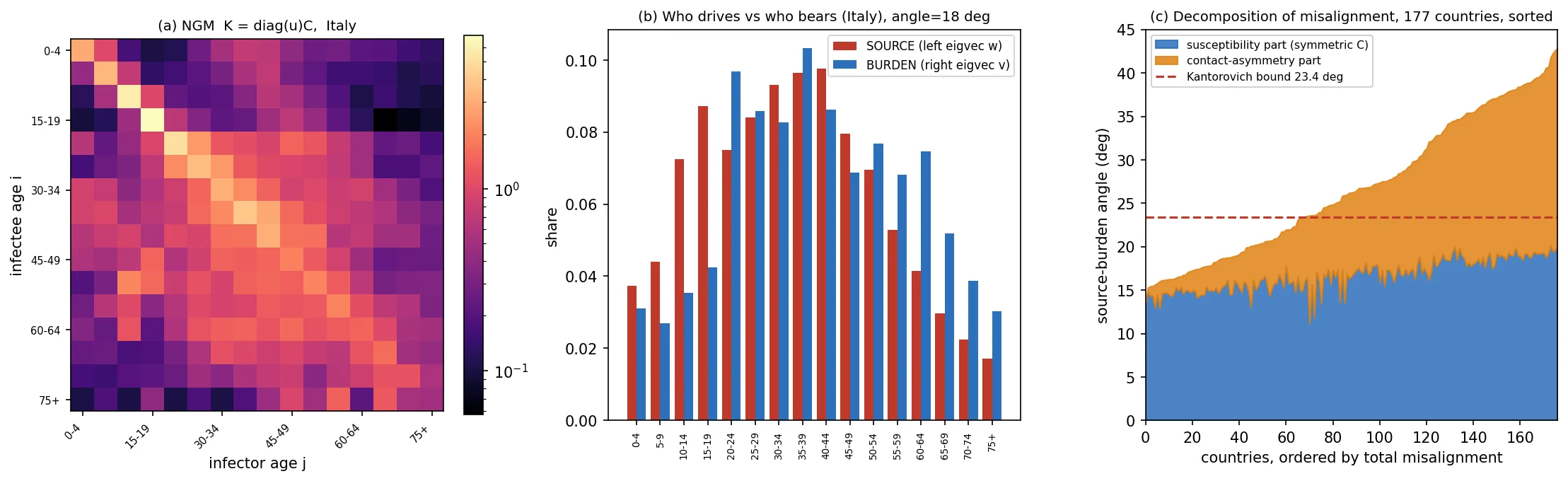
درس العلماء بيانات الاتصالات من 177 دولة، التي جمعتها دراسة Prem et al.، ورأوا صورة مثيرة للاهتمام. في العالم المثالي، تتطابق «المصادر» و«الضحايا» في الوباء: أولئك الذين ينشرون العدوى أكثر هم أنفسهم من يمرضون. لكن في الواقع، افترقت هذه المجموعات. في المتوسط حول العالم، بلغت الزاوية بينهما 26 درجة، وفي بعض البلدان أكثر من 40 درجة. يشبه الأمر رجال الإطفاء الذين يطفئون النار ويبقون سالمين بينما اللهب يشتعل في الحي المجاور.
أثبت المؤلفون نظرية: عندما تكون الاتصالات متبادلة (بقدر ما قابلتكم، بقدر ما قابلتموني)، تكون هذه الفجوة محدودة بنسبة بسيطة بين أعلى قابلية وأدناها. لكن في الواقع، الاتصالات ليست متبادلة — وتصبح الفجوة أكبر. والأكثر إثارة للقلق أن الاستراتيجية التي تستهدف فقط خفض R0 قد تضرب هدفاً خاطئاً: فهي تحمي من ينشر العدوى، وليس من يموت بسببها. ونتيجة لذلك، قد يرتفع متوسط الوفيات الناجمة عن العدوى.
الملخص الأصلي
كما كتبه المؤلفون، بالإنجليزية arXiv:2607.03979
The basic reproduction number is the spectral radius of a matrix, $$R_0=\rho(K)$$. Taking that definition literally, we ask what $$K\mapsto\rho(K)$$ discards. A matrix carries three kinds of information: its dominant eigenvalue, its dominant eigenvectors, and its departure from normality. $$R_0$$ keeps only the first; the other two are where the epidemic's social structure lives. The right eigenvector is the burden distribution, the left the source distribution; they coincide when the system is normal and diverge under heterogeneity. Across the $$177$$ national contact matrices of Prem et al., the operator is \emph{never} normal, and once age-specific susceptibility is included, its source and burden eigenvectors are misaligned by a median of $$26^{\circ}$$, exceeding $$40^{\circ}$$ in some countries: the groups that drive transmission are systematically not those that bear it. We prove that under reciprocal contact this misalignment obeys a Kantorovich bound set by the susceptibility contrast $$q_{\max}/q_{\min}$$ alone, and zero when susceptibility is uniform, with the excess in real, non-reciprocal matrices contributed by contact asymmetry. Transient amplification, by contrast, stays small, so the operative social content is the misalignment, not transient blow-up. The omission also has teeth: because minimizing $$R_0$$ protects those who \emph{spread} infection, while minimizing deaths protects those who \emph{die} from it, the two target different age groups; the former sometimes raises average infection fatality even as it lowers the scalar. When contact is strongly structured and susceptibility is heterogeneous, we suggest reporting $$R_0$$ along with its eigenvectors rather than reporting it alone.
في بعض البلدان، تتجاوز الفجوة بين من ينشرون العدوى ومن يعانون منها 40 درجة — كما لو أن إبرة البوصلة تشير ليس إلى الشمال بل إلى الشمال الشرقي.