لماذا لا يتوهج الورم لدى الجميع؟ سريع
تخيل ورشة يتم فيها تحضير طلاء متوهج. يأخذ العامل قطعة أولية، يضيف الصبغة المطلوبة، فيصبح الطلاء جاهزاً. وبجانبه يراقب مراقب، يقوم بتحويل جزء من الطلاء فوراً إلى مخزن آخر، ويرمي الباقي في النفايات. هكذا تقوم خلايا ورم الدماغ نفسها بإنتاج المادة التي تجعلها تتوهج تحت الضوء الأزرق لمصباح الجراح. لكن عند بعض المرضى يتوهج الورم بشكل ساطع، وعند آخرين يكاد لا يتوهج.
لوقت طويل كان يُعتقد أن السبب هو «المراقبون»: البروتين الناقل ABCB1 (يطرد المادة المتوهجة خارج الخلية) والإنزيم FECH (يحولها إلى مركب آخر). لكن عندما فحص العلماء عينات من أورام حقيقية لأكثر من مئتي مريض، لم تتأكد هذه الفرضية. لم يُعثر على أي علاقة بين نشاط مسار الإشارات MAPK (سلسلة الأوامر الداخلية للخلية) وعمل الناقل أو الإنزيم المحول.
لكن ظهرت صورة مختلفة تماماً. كلما كان نشاط سلسلة الأوامر MAPK أعلى، قل إنتاج الخلية للإنزيم PPOX — وهو «العامل» الذي يحول القطعة الأولية إلى الشكل المتوهج. العلاقة كانت عكسية: إشارة قوية تعني إنتاجاً ضعيفاً، والعكس صحيح. هذا يشبه موقفاً يكون فيه رئيس الورشة، بدلاً من مراقبة التسريبات، يأمر العامل ببساطة بإبطاء العمل.
إذا كانت هذه العلاقة سببية حقاً، فإن ضبط التوهج يحدث في مرحلة التخليق، وليس في مرحلة الإزالة. هذا يعني أنه لمساعدة الجراح على رؤية حدود الورم بشكل أوضح، يجب التأثير ليس على الناقلات ولا على التحولات الجانبية، بل على عملية تجميع المادة المتوهجة نفسها. تصبح سلسلة الأوامر MAPK هي المقبض الذي يمكن من خلاله إضافة سطوع.
الملخص الأصلي
كما كتبه المؤلفون، بالإنجليزية arXiv:2608.07865v1
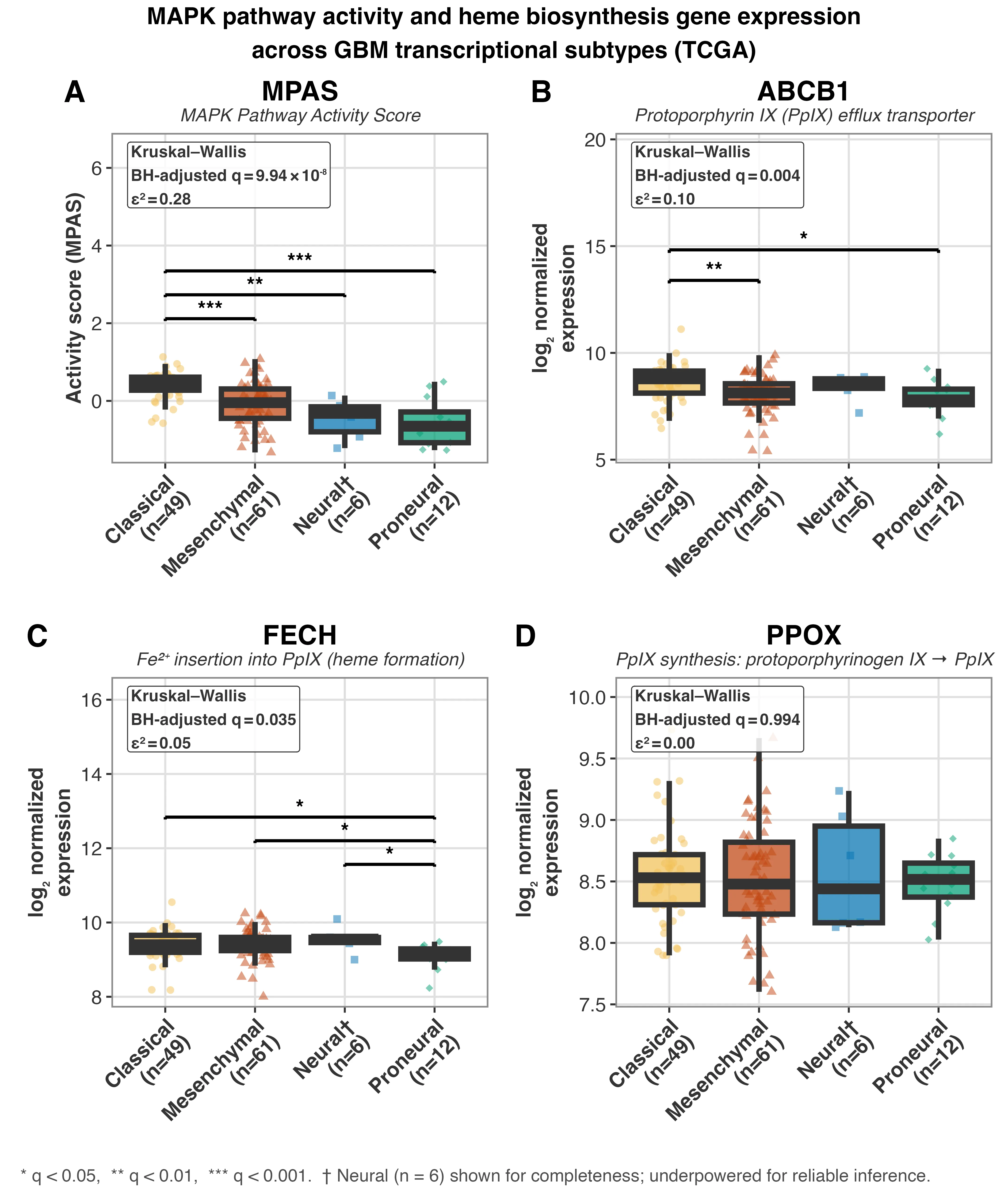
5-aminolevulinic acid (5-ALA) promotes fluorescence-based resection of glioblastoma via protoporphyrin IX (PpIX); however, there is considerable heterogeneity in fluorescence intensity, limiting margin distinction. Cell-line studies show that stimulation of the MAPK pathway results in decreased PpIX levels through increased elimination by ABCB1, an efflux transporter, and ferrochelatase (FECH), the enzyme that converts PpIX to heme. However, the mechanism has yet to be studied in human tissue. Using two independent, purity-adjusted sets of primary IDH-wildtype glioblastoma specimens (TCGA-GBM, n=140, discovery; CGGA, n=87, validation), no reproducible correlation between MAPK signaling and its proposed downstream effectors (ABCB1 and FECH) could be detected. Instead, MAPK activity displayed a reproducibly negative relationship with PPOX, the enzyme that converts protoporphyrinogen IX to protoporphyrin IX: TCGA-GBM (n=133 with purity estimates; rho = -0.40, 95% bootstrap CI [-0.54, -0.25], adjusted p < 0.001), CGGA (rho = -0.28, 95% bootstrap CI [-0.47, -0.07], adjusted p = 0.0342). The finding was robust to permutation testing and to alternative approaches to purity adjustment. Here we report, for the first time, replicated human-tissue evidence for this association. If this correlation reflects causality, MAPK regulation of PpIX would act at the point of synthesis rather than at the clearance steps implied by previous cell-culture studies. We observed differential activation of the MAPK pathway with increased activation in the classical subtype and decreased activation in the proneural subtype. There was no correlation between MAPK pathway activation and overall survival (log-rank p = 0.73). The association between PPOX expression and MAPK pathway activation is biological rather than prognostic, identifying the MAPK pathway as a candidate handle for increasing 5-ALA fluorescence.
العقار 5-ALA الذي يجعل الورم يتوهج هو في الواقع «لبنة بناء» تقوم الخلية بتجميع الجزيء المتوهج منها بنفسها. وهو في حد ذاته شفاف.