الكبد عند الترددات المنخفضة سريع
وعاء من الجيلي يهتز لكنه يحافظ على شكله إذا هززته بلطف. أما الشراب الكثيف، فيتموج وينتشر عند نفس الحركة. الكبد السليم يشبه الجيلي، بينما الكبد الملتهب عند الترددات المنخفضة يصبح أشبه بالشراب.
بنى العلماء جهازًا يهز الكبد عند اثني عشر ترددًا مختلفًا — من خمس إلى ثمانين اهتزازة في الثانية. كل اهتزازة تشبه دفعة لطيفة براحة اليد. يتتبع الجهاز كيفية مرور الموجة عبر العضو، ويحدد من سرعتها وتلاشيها مدى مرونة النسيج أو لزوجته.
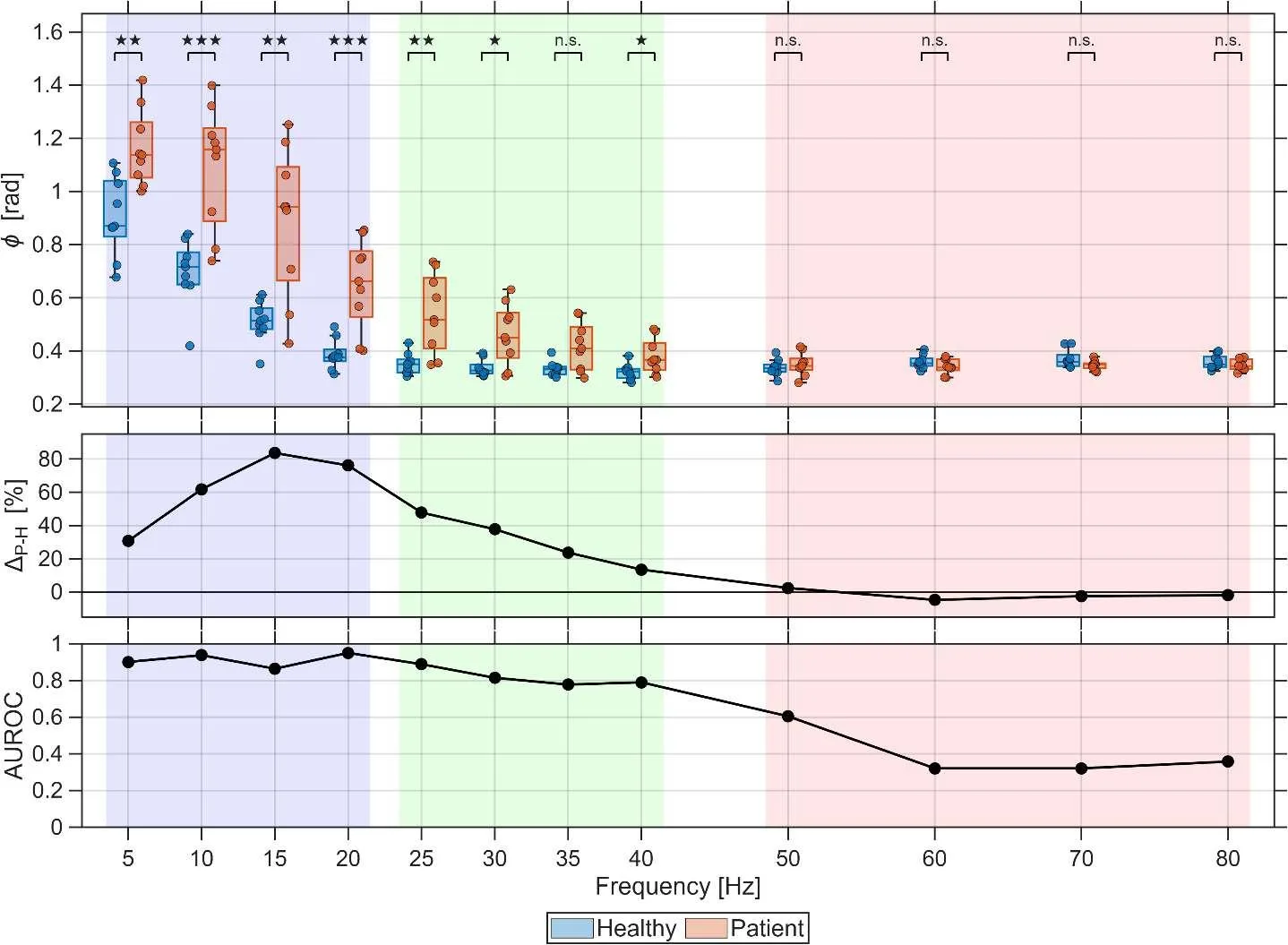
اتضح أنه عند الالتهاب، وعند ترددات أقل من 20 هرتز، يفقد الكبد مرونته ويبدأ في تبديد الطاقة مثل السائل. عند المرضى، زاد فقدان الطاقة بنسبة 63%، بينما زادت سرعة الموجة بنسبة 8% فقط. هذا يعني أن ما يتغير ليس صلابة العضو بقدر ما يتغير قدرته على تخميد الاهتزازات.
تم اختبار الطريقة بالفعل على تسعة متطوعين أصحاء وتسعة مرضى يعانون من أمراض الكبد الالتهابية. الفرق واضح تمامًا. الآن يمكن للأطباء النظر إلى الكبد دون ثقب — فقط هزه بلطف والاستماع إلى استجابته.
الملخص الأصلي
كما كتبه المؤلفون، بالإنجليزية arXiv:2608.18867v1
Magnetic resonance elastography (MRE) is established for noninvasive assessment of liver fibrosis. Conventional abdominal MRE is typically limited to 40-60 Hz. Lower frequencies remain largely unexplored, particularly with regard to hepatic inflammation. We developed ultra-wideband MRE covering 5-80 Hz to investigate frequency-resolved viscoelastic dispersion of the liver and spleen and to identify biomechanical markers of hepatic inflammation. Following phantom validation, nine healthy volunteers and nine patients with inflammatory liver disease were examined at 12 frequencies. Spatiotemporal phase unwrapping and frequency-adaptive wavefield preprocessing enabled reconstruction of shear wave speed (SWS), penetration rate (PR), and loss angle ($$\phi$$). Six rheological models were evaluated. The largest inflammation-associated changes were observed at frequencies below 20 Hz: $$\phi$$ increased by 63% (p<0.001), PR decreased by 37% (p=0.003), and SWS increased by 8% (p=0.008), indicating predominantly dissipative, rather than stiffness-related, changes and a shift toward fluid-like behavior with minor stiffness changes in the lower frequency regime. The rheological springpot model with serial dashpot provided the best fit and revealed distinct dispersion functions for liver and spleen. In patients, springpot elastic modulus increased (101%, p=0.001), while viscosity and springpot power-law exponent decreased (52%, p=0.002 and 58%, p<0.001) suggesting a shift from soft-fluid to stiff-solid liver properties. Ultra-wideband MRE revealed that inflammatory liver disease is associated with property shifts toward stronger dissipation and fluid-like behavior at low frequencies while displaying solid-like behavior at higher frequencies. Ultra-low frequency MRE may provide a diagnostic window into inflammation-associated liver viscoelasticity without full rheological modeling.
الكبد هو العضو الداخلي الوحيد الذي يمكنه التعافي حتى يعود إلى حجمه الأصلي تقريبًا حتى بعد فقدان ثلثي أنسجته.