Lumière et atomes : comment l'anisotropie contrôle la chaleur express
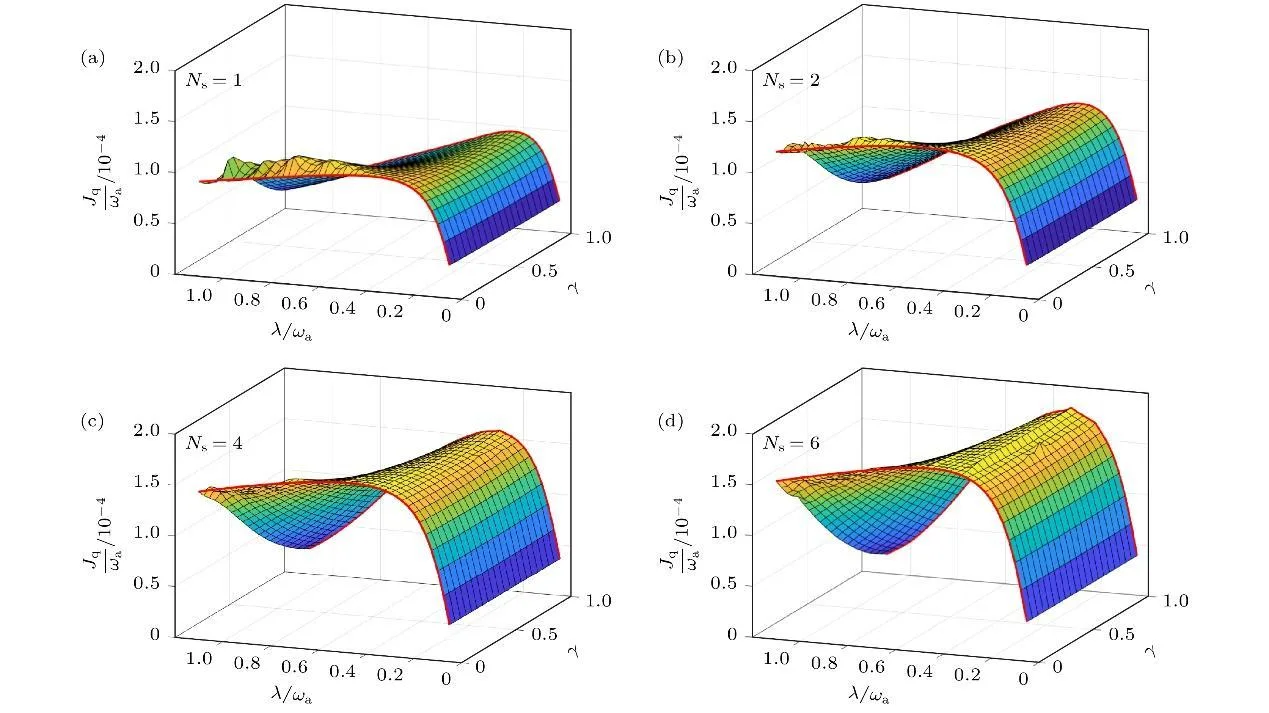
La lumière et les atomes, comme des danseurs, peuvent se mouvoir à l'unisson ou en désordre. Lorsque leur interaction est anisotrope — c'est-à-dire qu'elle dépend de la direction — la danse se complique. Dans ce nouveau travail, les physiciens ont examiné un modèle où de nombreux atomes (qubits) interagissent collectivement avec un champ lumineux anisotrope, chaque composant étant relié à un réservoir thermique. Il s'avère que l'anisotropie peut modifier radicalement le flux de chaleur à travers le système.
Le nombre d'atomes joue un rôle d'amplificateur : à mesure qu'il augmente, les pics du flux de chaleur deviennent plus hauts et les creux plus profonds. Dans la limite d'un nombre infini d'atomes (limite thermodynamique), il a été possible de dériver des formules simples qui fixent une borne supérieure au flux de chaleur pour les systèmes finis. Ces formules décrivent un processus analogue au co-tunneling, où la chaleur est transportée non pas individuellement, mais par paquets coordonnés.
La diode thermique — un dispositif qui laisse passer la chaleur dans un sens mieux que dans l'autre — dépend également de l'anisotropie. Ajuster l'interaction entre la lumière et les atomes ouvre la voie à un contrôle de la chaleur à l'échelle quantique, ce qui pourrait être utile dans la microélectronique de demain.
Résumé original
tel que rédigé par les auteurs, en anglais arXiv:2603.29180
Nonequilibrium heat transport and quantum thermodynamics in light-matter interacting systems have received increasing attention. Quantum thermal devices, e.g., heat valve and head diode, have been realized. Recently, it has been discovered that the anisotropic light-matter interactions can greatly modify the eigenvalues and eigenvectors of hybrid quantum systems, leading to nontrivial quantum phase transitions, quantum metrology, and nonclassicality of photons. To explore the influences of anisotropic light-matter interactions on quantum transport, we investigate heat flow in the nonequilibrium anisotropic Dicke model. In this model, an ensemble of qubits collectively interacts with an anisotropic photon field. Each component interacts with bosonic thermal reservoirs. Quantum dressed master equation (DME) is included to properly study dissipative dynamics of the anisotropic Dicke model. Within the eigenbasis of the reduced anisotropic Dicke system, strong qubit-photon couplings can be properly handled. Our results demonstrate that anisotropic qubit-photon interactions are crucial for modulating steady-state heat flow. In particular, it is found that under strong coupling the heat flow is dramatically suppressed by a large anisotropic qubit-photon factor. While under moderate coupling, the anisotropic qubit-photon interactions enhance the heat flow. Moreover, the increase in the number of qubits amplifies the flow characteristics, with the peaks increasing and the valleys decreasing. Besides, we derive two analytical expressions of heat flows in thermodynamic limit approximation with limiting anisotropic factors. These heat currents exhibit the cotunneling heat transport pictures. They also serve as the upper boundaries for the heat flows in the finite-size anisotropic Dicke model. We also analyze the thermal rectification effect in the anisotropic Dicke model.
Dans le modèle de Dicke, l'anisotropie de l'interaction peut conduire à des transitions de phase quantiques inhabituelles, où les propriétés du système changent brusquement lors d'une variation douce des paramètres.