Как наклон трубки спасает мозг при операции на сердце экспресс
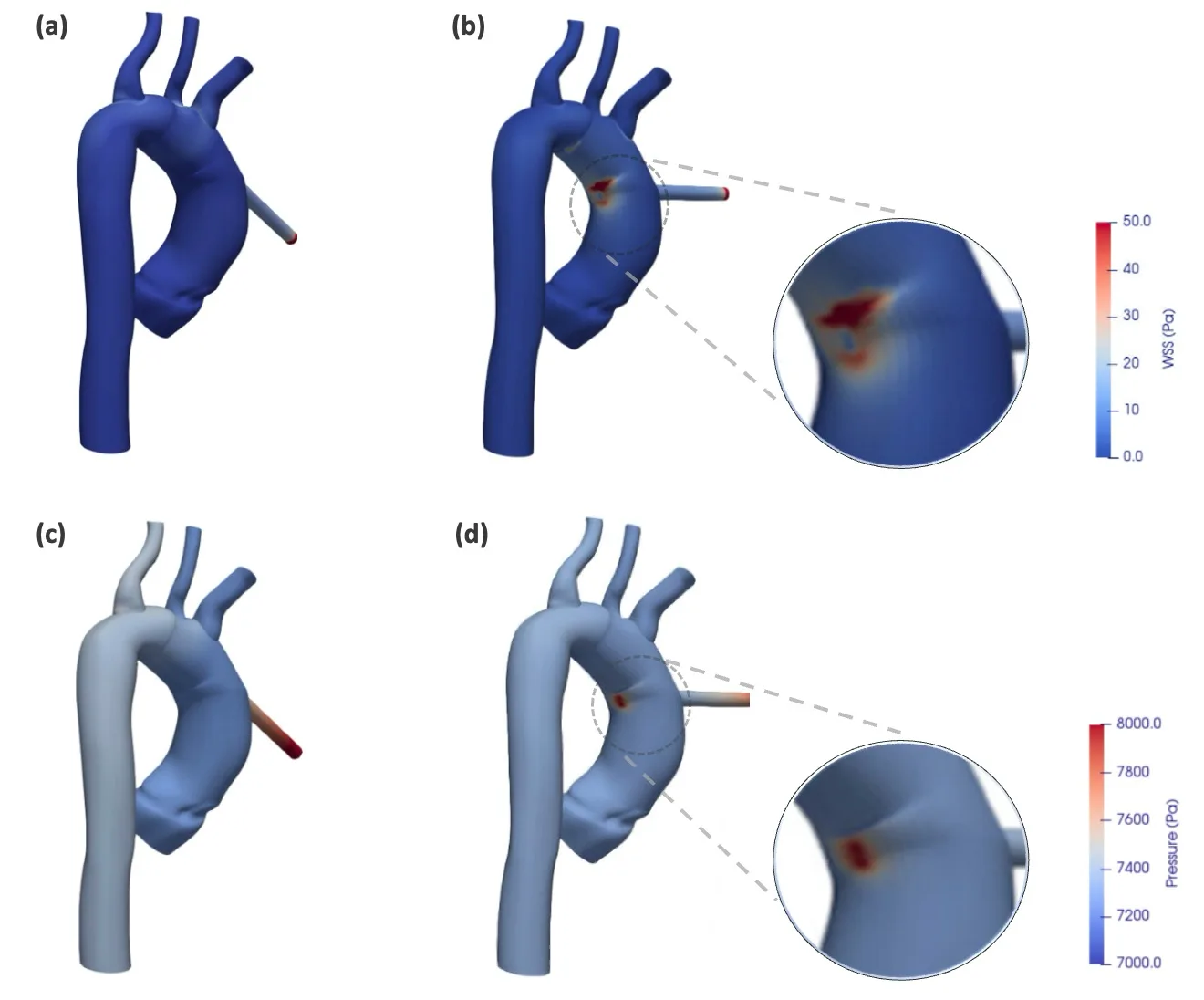
Хирург вводит в аорту трубку, чтобы кровь шла в обход сердца. Струя из трубки бьёт в стенку сосуда, как садовый шланг в клумбу, и размывает там частицы, которые могут улететь в мозг.
Учёные построили компьютерные модели аорт четырёх людей: ребёнка, подростка, взрослого и пожилого. Они меняли угол трубки — прямой (90 градусов) и наклонный (30 градусов), а ещё вязкость крови и размер частиц. Оказалось, что наклонная трубка отправляет в сосуды к мозгу на 18–50% меньше частиц, чем прямая. У пожилой аорты эффект самый сильный.
Детская аорта оказалась самой чувствительной: если кровь жиже, а частицы крупнее, то в мозг уходит заметно больше частиц. Наклон трубки — простой способ сделать операцию безопаснее, особенно для пожилых.
Оригинальная аннотация
как её написали авторы, на английском arXiv:2601.07881
Embolic stroke during cardiopulmonary bypass (CPB) is strongly influenced by cannula induced flow disturbances that govern emboli transport and aortic wall loading. This study quantifies how aortic cannula orientation affects embolic distribution and atherosclerotic plaque disruption risk across patient specific, age-dependent aortic anatomies under clinical CPB conditions. A validated computational fluid dynamics and Lagrangian particle tracking (CFD-LPT) framework was applied to four patient-specific aortic models representing pediatric, adolescent, adult, and geriatric anatomies. Two clinically relevant cannula orientations: perpendicular (90 deg) and angled (30 deg), were evaluated under varying blood viscosities (1.5 to 3.5 cP) and embolus sizes (0.5 to 2.5 mm). Aortic branch exit percentage, wall pressure, and wall shear stress (WSS) were quantified. The 30 deg angled cannula reduced embolic transport into the aortic branches by 18 to 50 percent compared with perpendicular cannulation, with the largest reduction observed in the geriatric model. Perpendicular cannulation produced concentrated jet impingement, resulting in significantly elevated posterior wall pressure (24 percent) and up to an 8 fold increase in local WSS. The pediatric anatomy exhibited the highest sensitivity, where decreasing viscosity and increasing embolus size increased branch exit by 8.4 percent and 25 to 44 percent, respectively, consistent with higher particle Stokes numbers and inertial decoupling from the core flow. Angled cannulation redistributes jet momentum along the aortic curvature, weakens jet impingement, reduces localized pressure and wall stress, and limits embolic delivery towards the cerebral circulation. These findings provide mechanistic, patient-specific evidence supporting angled cannula orientation to reduce CPB complications.
Самая большая разница между прямой и наклонной трубкой — у пожилых: наклон снижает уход частиц в мозг вдвое.