Мюонный сюрприз растаял экспресс
Мюон — тяжёлый брат электрона, который живёт всего две миллионные доли секунды. В магнитном поле он крутится, как волчок, но чуть быстрее, чем предсказывают формулы. Двадцать лет назад в Брукхейвене это «чуть быстрее» заметили, и с тех пор физики спорили: то ли приборы врут, то ли в пустоте прячутся неведомые частицы.
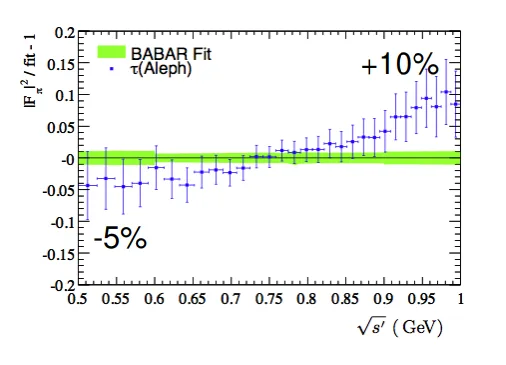
Теперь в Фермилабе измерили вращение мюона в четыре раза точнее — и оно снова оказалось «слишком быстрым». Но параллельно теоретики на суперкомпьютерах пересчитали вклад пустоты: оказалось, что вакуум не пуст, а кишит виртуальными частицами, которые слегка подкручивают мюон. Новые расчёты, учитывающие смешивание двух типов частиц, подняли теоретическое значение почти до экспериментального. Расхождение растаяло.
Стандартная модель снова выстояла. Она не объясняет тёмную материю и крошечные массы нейтрино, но для мюона её предсказания теперь совпадают с опытом. Это не провал, а триумф точности: мы научились лучше считать пустоту.
Оригинальная аннотация
как её написали авторы, на английском arXiv:2601.08101
Recently, the exciting new Fermilab (FNAL) Muon g-2 measurement impressively confirmed the final Brookhaven (BNL) result from 2004, and with a result four times more precise, has launched a new serious attack on the Standard Model (SM). On the theoretical side, ab initio lattice QCD (LQCD) calculations of hadronic vacuum polarization have made remarkable progress. They are now the new standard for studying the leading non-perturbative contributions, which have previously hindered matching with the precision required for full exploitation of the experimental results. The lattice results affected both leading hadronic contributions the hadronic vacuum polarization (HVP) and the hadronic light-by-light (HLbL) contributions by increasing the previously generally accepted $$e^+e^-$$ to hadrons based dispersion relation results. The shifts reduced the discrepancy between theory and experiment, leaving nothing missing. One of the most prominent signs of Beyond the Standard Model (BSM) physics has disappeared: the SM appears validated more than ever, in agreement with what other searches at the Large Hadron Collider (LHC) at CERN tell us! A triumph of the SM, even though the SM cannot explain known cosmological puzzles like dark matter or baryogenesis, and why neutrino masses are so tiny, the absence of strong CP violation, for example. I also argue that the discrepancy between the data-driven dispersive result and the lattice QCD results for the hadronic vacuum polarization can be largely explained by correcting the $$e^+e^-$$ data for 'rho-gamma' mixing effects.
Мюон настолько тяжёл, что в Большом адронном коллайдере его рождение фиксируют как «ливень» из десятков частиц — но живёт он меньше, чем нужно свету, чтобы пересечь песчинку.