Почему банановая болезнь не сдаётся экспресс
Банановая плантация покрывается ржавыми полосами. Это чёрная сигатока — грибок, чьи споры путешествуют по воздуху, как невидимая пыльца. Он бьёт по листьям, лишая растение сил. Фермер снижает заражённость, но болезнь вдруг возвращается — словно сорняк, который притворялся мёртвым.
Математическая модель показала ловушку: заражённость может упасть ниже единицы, а очаг всё равно тлеет. Поэтому одних карантинов мало. Расчёты указывают на два рычага — селекцию устойчивых сортов и защиту молодых листьев в сезон дождей. Случайные всплески инфекции (например, из-за погоды) модель тоже учла, проверив тысячи сценариев. Картина ясна: победить грибок можно, только ударив по нему с двух сторон сразу.
Оригинальная аннотация
как её написали авторы, на английском arXiv:2604.26060
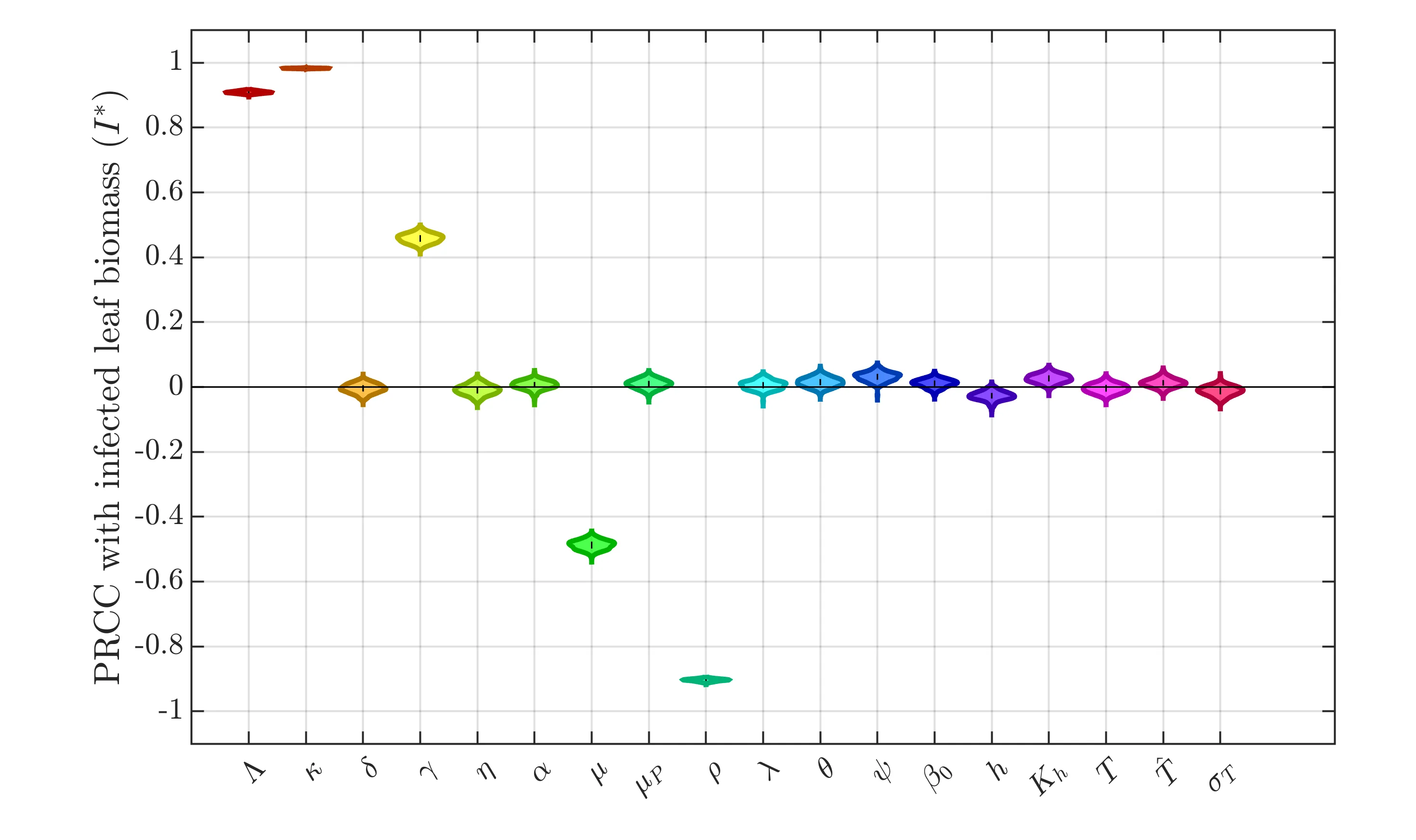
Black Sigatoka disease (BSD), also known as black leaf streak disease, is an airborne fungal infection caused by \textit{Pseudocercospora fijiensis} that severely impacts global banana and plantain production. Its persistence and resistance to eradication make it one of the most challenging plant diseases to manage. In this paper, we propose a deterministic pathogen-host model to describe BSD dynamics. Due to dual transmission pathways (ascospores and conidia) and mate limitation in sexual reproduction, the model exhibits a backward bifurcation: a stable endemic equilibrium coexists with the disease-free equilibrium for certain parameter values in which the basic reproduction number, $$\mathcal{R}_0$$, is less than 1. This phenomenon explains why control strategies that solely reduce $$\mathcal{R}_0$$ below one may fail. For the backward bifurcation regime, we perform sensitivity analysis of the endemic equilibrium using normalized forward sensitivity indices, Latin Hypercube Sampling, and Partial Rank Correlation Coefficients. Results indicate that effective control must extend beyond $$\mathcal{R}_0$$ reduction and prioritize (1) limiting production of new susceptible leaves during high-risk periods and (2) developing and deploying disease-resistant plant varieties. To incorporate transmission variability, we also formulate a stochastic version of the model using the Stochastic Simulation Algorithm (SSA). Extensive numerical simulations compare stochastic realizations with deterministic predictions and quantify variability in disease dynamics. To identify the principal drivers of persistence and variability, we analyze the endemic equilibrium using Sobol's variance-based sensitivity method, which highlights the role of nonlinear parameter interactions in shaping variability.
Один квадратный сантиметр больного листа банана способен выбросить в воздух до 20 тысяч спор за сутки — этого хватит, чтобы заразить целую плантацию.
В романе «Год чудес» Джеральдин Брукс изоляция деревни не спасает от чумы — так и с бананами: пока есть хоть один скрытый очаг, болезнь ждёт своего часа.