Гибкие щетинки в потоке: как вязкость заставляет их сгибаться вместе экспресс
Травинки в ручье колышутся поодиночке, но если их растёт несколько рядом, они могут сгибаться как одна. Примерно так вели себя гибкие пластинки в новом эксперименте с жидкостью, которая меняет свою густоту при течении.
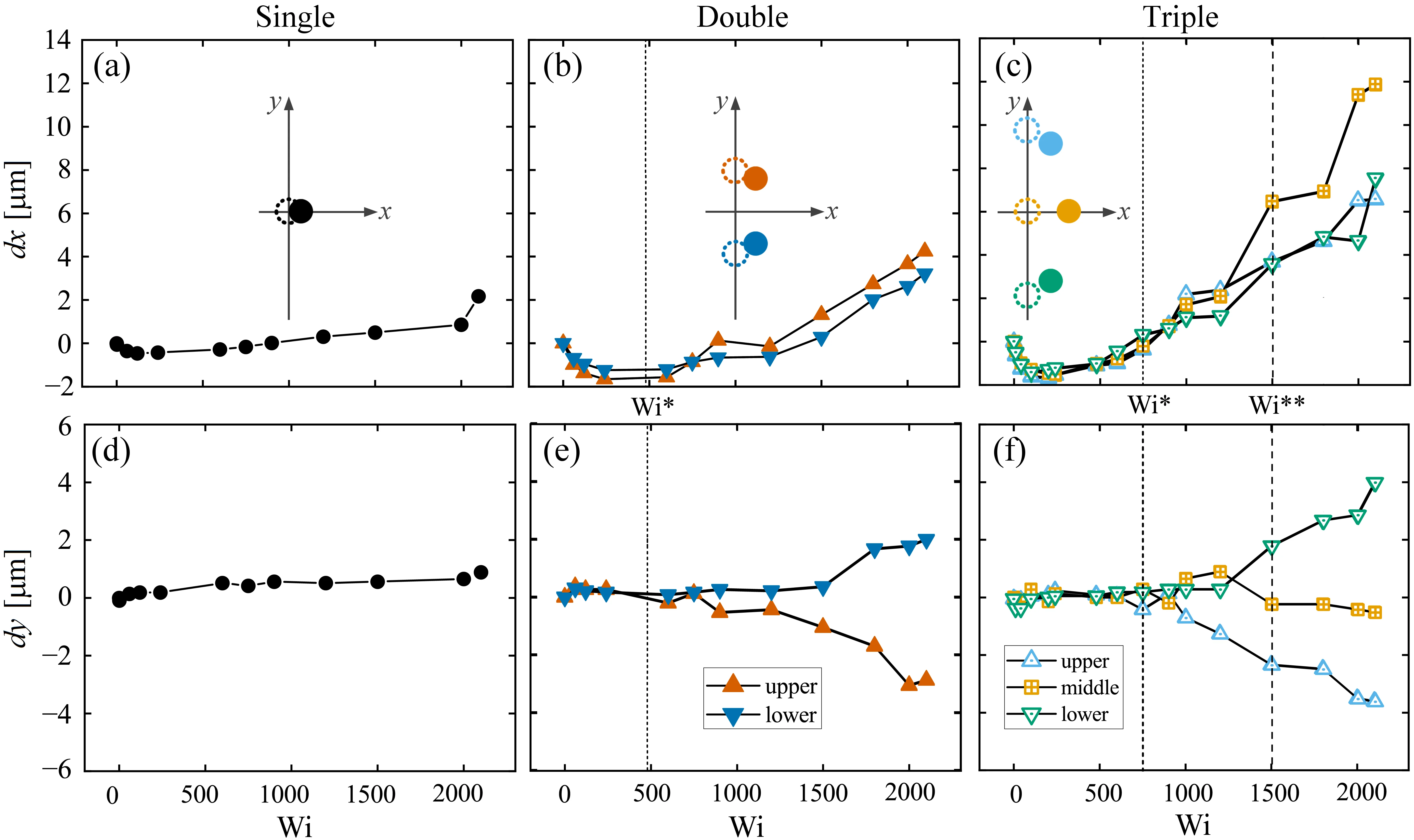
Учёные погружали в жидкость ряды гибких пластинок — от одной до трёх — и следили, как за ними тянется след, похожий на хвост. В жидкости, которая становится чуть более текучей при быстром движении, одиночная пластинка оставляла длинный хвост. Но когда пластинок было две или три, их хвосты сливались в один широкий поток, а сами пластинки наклонялись навстречу друг другу. При этом для трёх пластинок нужно было разогнать жидкость сильнее, чем для двух.
В другой жидкости, которая теряет густоту очень резко, хвосты появлялись, но не сливались, и пластинки не сближались. Значит, одного лишь появления хвоста недостаточно: нужны и особая текучесть жидкости, и соседство пластинок.
Это открытие поможет создавать крошечные устройства, где гибкие детали должны двигаться согласованно, например, микроскопические насосы без движущихся частей.
Оригинальная аннотация
как её написали авторы, на английском arXiv:2608.13908v1
Fluid-structure interaction (FSI) in viscoelastic flows past deformable structures at low Reynolds numbers remains poorly understood, despite its relevance to biological systems such as cilia and flagella, and to engineered microsystems. We investigate viscoelastic FSI in side-by-side flexible cantilever arrays using a bottom-up approach that systematically varies the number of cantilevers and the rheology of the test fluid, comparing weakly shear-thinning (WS) and highly shear-thinning (HS) polyethylene oxide solutions. For both fluids, with increasing Weissenberg number (Wi), an elongated elastic wake develops behind a single isolated cantilever. For multiple cantilevers, the WS fluid undergoes a transition at a critical Weissenberg number (Wi*) from separated to merged elastic wakes, accompanied by the emergence of a divergent flow field and coordinated inward spanwise cantilever deflection. The critical Wi* increases as the number of cantilevers in the array is increased from two to three, demonstrating a strong dependence of the onset on the array configuration. For the HS fluid, wake merger, flow divergence, and inward cantilever deflection are suppressed across the full range of Wi investigated, despite comparable elasticity and the formation of elastic wakes. This contrast shows that elasticity alone promotes wake formation but is insufficient to produce the collective instability, which instead requires both shear-thinning and interactions between neighboring cantilevers. These findings demonstrate that viscoelastic FSI in flexible arrays is governed by the combined effects of fluid elasticity, shear-thinning, and geometric configuration, with elastic wake interactions mediating the collective instability and linking local elastic wakes to array-scale structural response.
Реснички в наших лёгких бьются в жидкой слизи, которая тоже ведёт себя не как вода: при быстром движении она становится более текучей.
В фильме «Фантастическое путешествие» учёные уменьшают подлодку до размеров клетки — там поток жидкости ведёт себя совсем не так, как в нашем мире.