Печень на низких частотах экспресс
Миска с желе дрожит, но держит форму, если её слегка встряхнуть. Густой сироп в ответ на такое же движение колышется и растекается. Здоровая печень похожа на желе, а воспалённая на низких частотах становится больше похожа на сироп.
Учёные построили аппарат, который трясёт печень на двенадцати разных частотах — от пяти до восьмидесяти колебаний в секунду. Каждое колебание — как мягкий толчок ладонью. Прибор следит, как волна проходит сквозь орган, и по её скорости и затуханию определяет, насколько ткань упругая или вязкая.
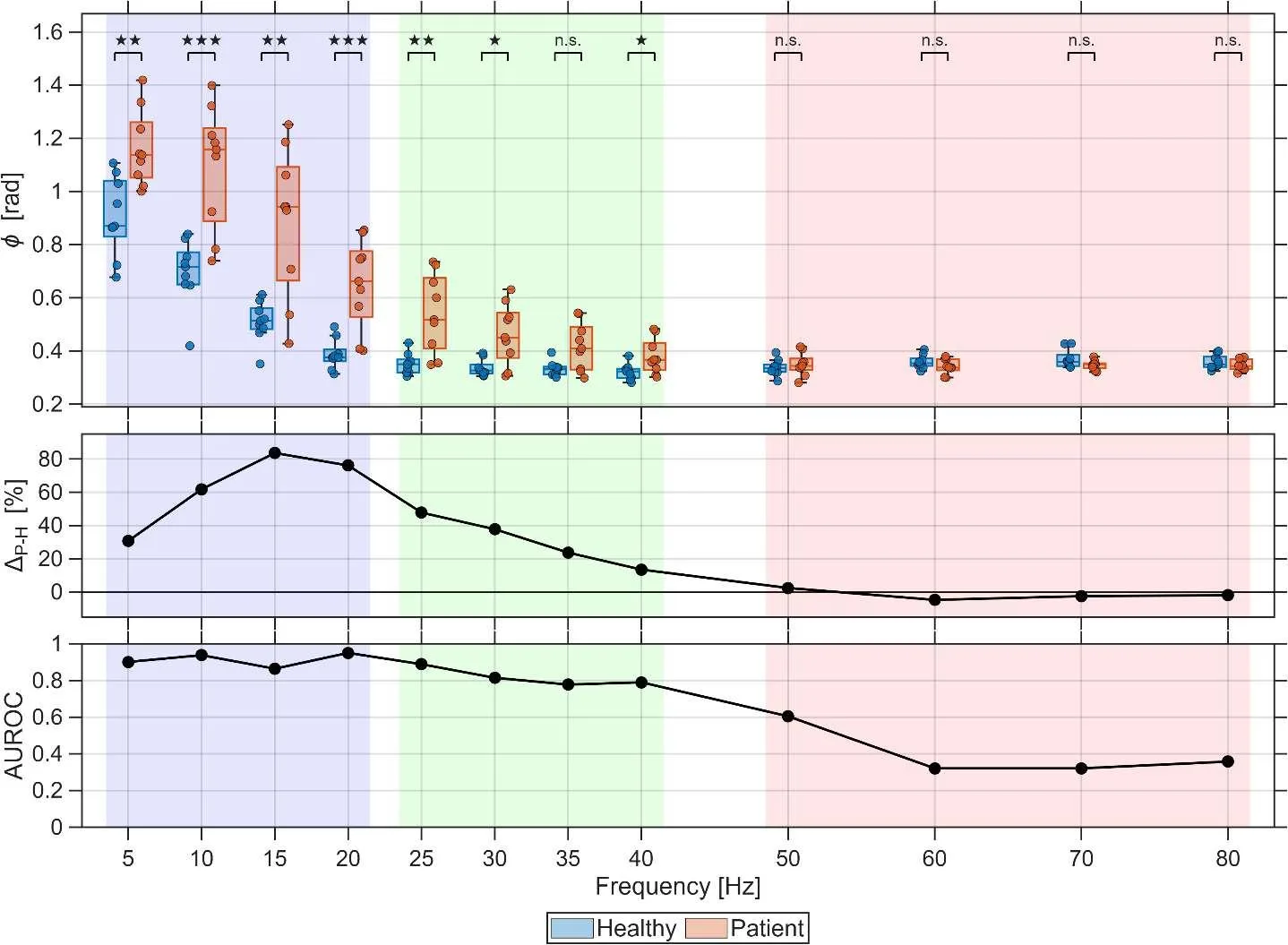
Оказалось, при воспалении на частотах ниже 20 герц печень теряет упругость и начинает рассеивать энергию, как жидкость. У больных потеря энергии выросла на 63%, а скорость волны увеличилась всего на 8%. Это значит, что меняется не столько жёсткость органа, сколько его способность гасить колебания.
Метод уже проверили на девяти здоровых добровольцах и девяти пациентах с воспалительными заболеваниями печени. Разница видна чётко. Теперь врачи смогут заглянуть в печень без прокола — просто мягко потрясти её и послушать, как она отзывается.
Оригинальная аннотация
как её написали авторы, на английском arXiv:2608.18867v1
Magnetic resonance elastography (MRE) is established for noninvasive assessment of liver fibrosis. Conventional abdominal MRE is typically limited to 40-60 Hz. Lower frequencies remain largely unexplored, particularly with regard to hepatic inflammation. We developed ultra-wideband MRE covering 5-80 Hz to investigate frequency-resolved viscoelastic dispersion of the liver and spleen and to identify biomechanical markers of hepatic inflammation. Following phantom validation, nine healthy volunteers and nine patients with inflammatory liver disease were examined at 12 frequencies. Spatiotemporal phase unwrapping and frequency-adaptive wavefield preprocessing enabled reconstruction of shear wave speed (SWS), penetration rate (PR), and loss angle ($$\phi$$). Six rheological models were evaluated. The largest inflammation-associated changes were observed at frequencies below 20 Hz: $$\phi$$ increased by 63% (p<0.001), PR decreased by 37% (p=0.003), and SWS increased by 8% (p=0.008), indicating predominantly dissipative, rather than stiffness-related, changes and a shift toward fluid-like behavior with minor stiffness changes in the lower frequency regime. The rheological springpot model with serial dashpot provided the best fit and revealed distinct dispersion functions for liver and spleen. In patients, springpot elastic modulus increased (101%, p=0.001), while viscosity and springpot power-law exponent decreased (52%, p=0.002 and 58%, p<0.001) suggesting a shift from soft-fluid to stiff-solid liver properties. Ultra-wideband MRE revealed that inflammatory liver disease is associated with property shifts toward stronger dissipation and fluid-like behavior at low frequencies while displaying solid-like behavior at higher frequencies. Ultra-low frequency MRE may provide a diagnostic window into inflammation-associated liver viscoelasticity without full rheological modeling.
Печень — единственный внутренний орган, который умеет восстанавливаться почти до исходного размера даже после потери двух третей ткани.