غراء ونوابض: كيف نبني النمط المثالي سريع
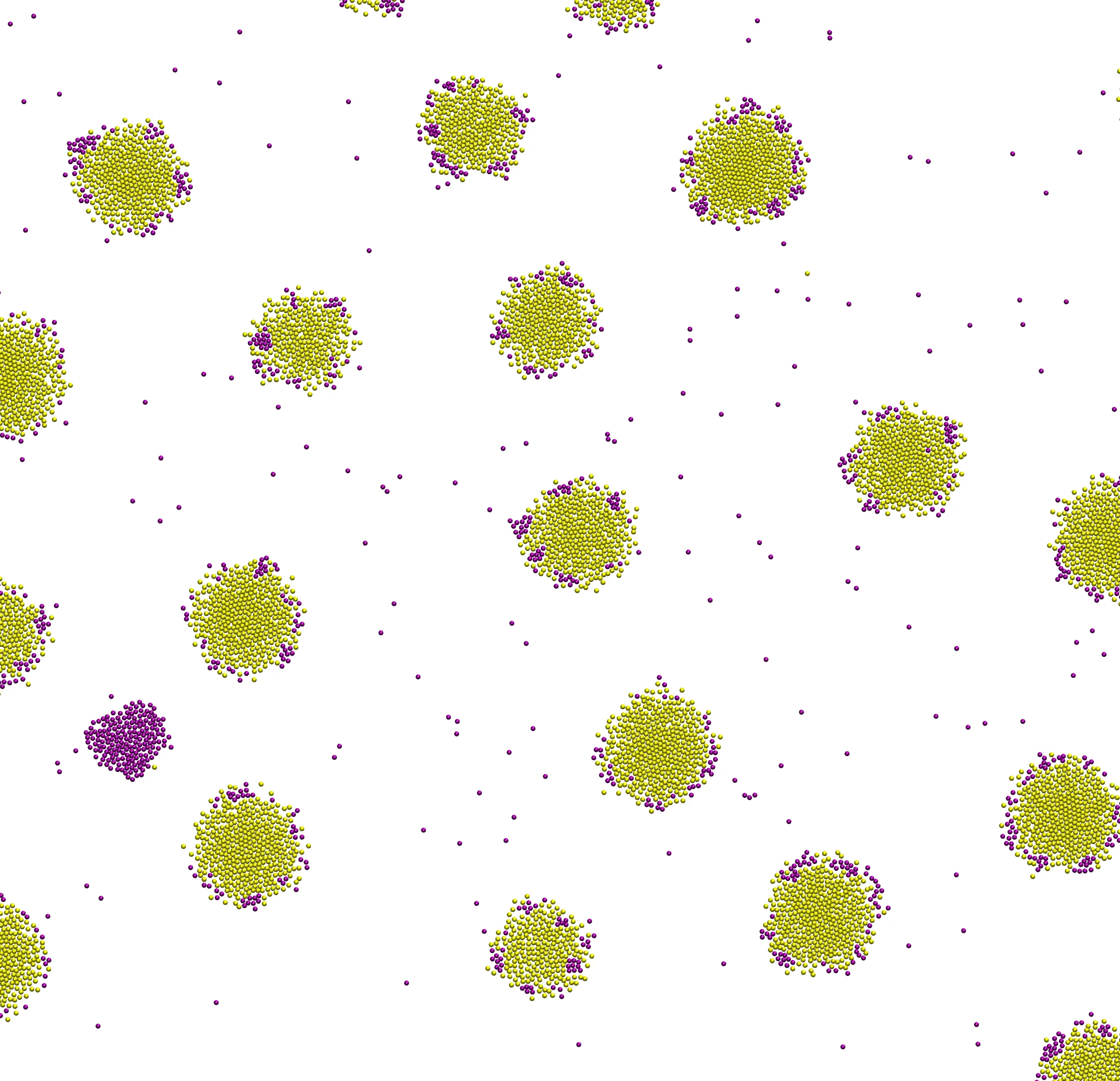
حفنة من الكرات المغناطيسية، إذا هززتها، تلتصق ببعضها في كتل. لكن أضف إلى المغناطيسات نوابض تدفع الكرات بعيدًا عن بعضها على مسافة — وستتفكك الكتل إلى جزر منتظمة. هذا تقريبًا سلوك الجسيمات التي تتناولها الدراسة الجديدة: تتجاذب عن قرب، لكنها تتنافر من بعيد.
قام الباحثون بحساب ملايين الاحتمالات لمثل هذا «الغراء بالنوابض» على الحاسوب. غيّروا ارتفاع حاجز التنافر، وأضافوا موجات على الحفرة اللاصقة، بل وجعلوا الجسيمات غير دائرية، بل ذات بقع لاصقة. واتضح أن حجم التكتلات وشكلها ودرجة انتظامها الداخلي يمكن التحكم بها بشكل شبه مستقل. المثير للاهتمام بشكل خاص: إذا أُضيف تموج خفيف إلى التجاذب، تتجمد الجسيمات داخل التكتل كما في البلورة، بينما تستمر التكتلات نفسها في الانزلاق بسلاسة — مثل قطع الثلج في العصيدة.
كما خلط الباحثون نوعين من الجسيمات ذات «طباع» مختلفة: بعضها يلتصق بقوة أكبر، وبعضها أضعف. مع الضبط الصحيح، داخل التكتل الواحد نحصل على كعكة طبقية: نوع واحد يتجمع في النواة، والآخر في الغلاف. وإذا كانت الجسيمات تحمل بقعًا لاصقة على جانب واحد فقط، فإن شكلها وعدد البقع يحددان ما إذا كانت ستتجمع في سلاسل أو حلقات أو فسيفساء.
هذا العمل يشبه دليل تركيب لعبة البناء، حيث بدل القطع لدينا قوانين التفاعل. بمعرفة القواعد، يمكننا مسبقًا حساب النمط الناتج. سيفيد هذا في صناعة مواد جديدة بخصائص غير عادية، وفي فك لغز كيفية تجميع الخلية لهياكلها الداخلية دون مخططات.
الملخص الأصلي
كما كتبه المؤلفون، بالإنجليزية arXiv:2601.01469
We investigate a set of design principles that link specific features of interparticle interactions to predictable structural and dynamic outcomes in two-dimensional self-assembly, a framework relevant to soft matter and biological condensates. Using extensive Molecular Dynamics simulations of single- and two-component systems, we systematically dissect how modifications to competing short-range attraction and long-range repulsion (SALR) potentials (both isotropic and anisotropic) serve as independent control parameters. In particular, we have focused on tuning the repulsive barrier height, decorating the attractive well with oscillatory components, and changing particle geometry. We demonstrate that these modifications dictate cluster size distributions, the degree of intra-cluster ordering, the geometry of the clusters, and the propensity for inter-cluster crystallization. A key finding is the decoupling of internal and global dynamics: oscillatory wells promote solid-like order within clusters while maintaining liquid-like cluster mobility. Furthermore, we show how asymmetric interactions in a binary SALR mixture can be designed to induce internal phase segregation within condensates. Complementing this, we observe that in anisotropic models in which the short rage component of the interaction stems from the presence of attractive patchy sites, stoichiometry and the geometric distribution of the patches are essential to control self-assembly and cluster morphology, whereas long-range repulsion can be used to tune cluster size and polydispersity. The extracted principles provide a causal road-map for engineering self-assembled materials and a set of basic physical concepts for interpreting the complex phase behavior of biomolecular condensates.
في تجارب الكرات المغناطيسية والنوابض، يمكن رؤية نفس الأنماط كما في النماذج الحاسوبية: إذا اخترت قوة المغناطيس وصلابة النوابض، ستترتب الكرات نفسها في شبكة سداسية ذات ثقوب.
في رواية ستانيسلاف ليم «المنيع» (The Invincible)، تشكل الجسيمات الدقيقة ذاتية التنظيم سحبًا قادرة على سلوك جماعي — صدى بعيد لمبادئ التجميع التي تدرسها هذه المقالة.