كيف يُخفي زحل مجاله المغناطيسي سريع
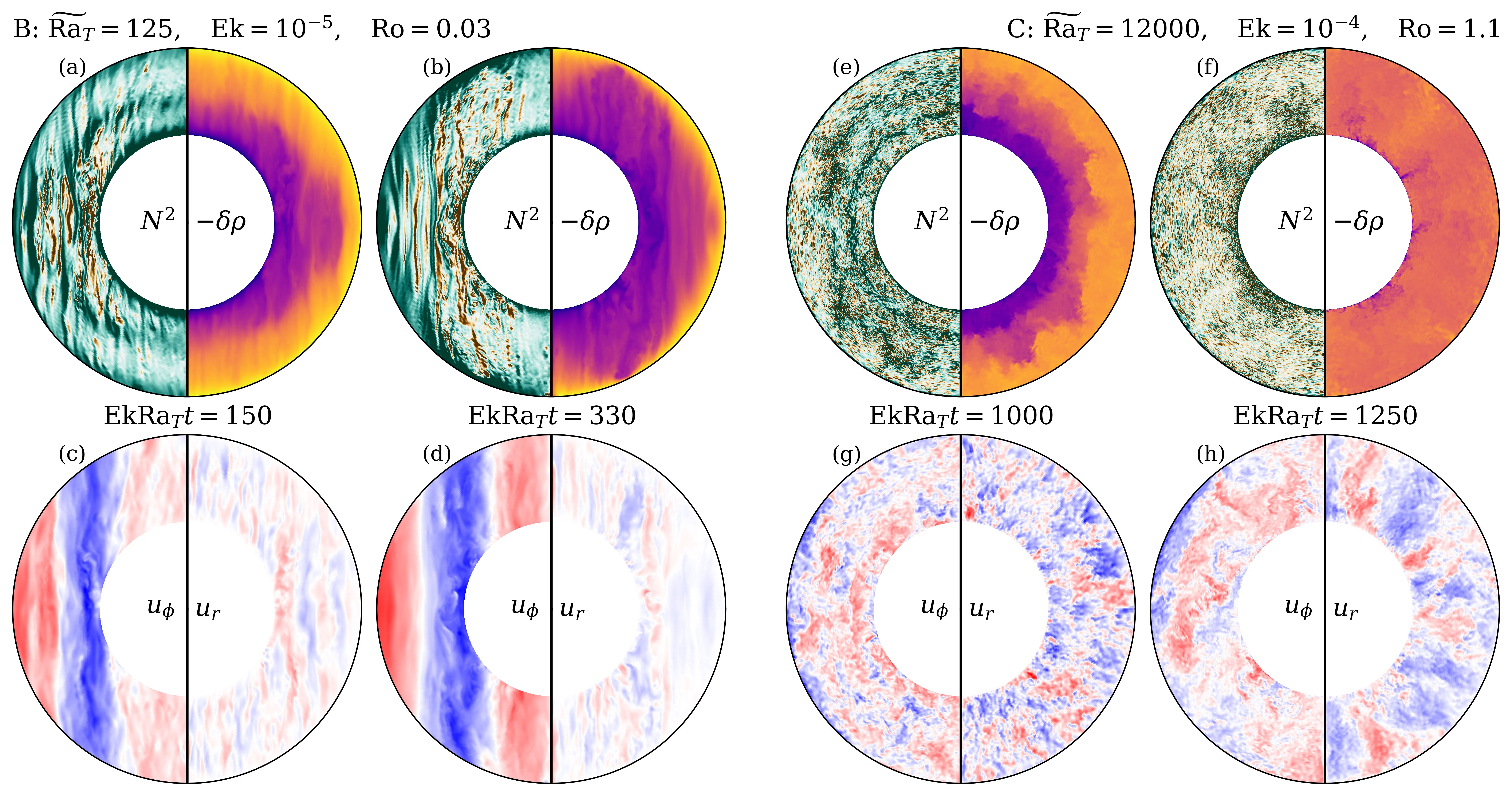
داخل الكواكب العملاقة مثل المشتري وزحل، لا ترتفع الحرارة دائمًا بحرية. فالعناصر الثقيلة، التي تكون أكثر وفرة في بعض الطبقات وأقل في طبقات أخرى، تمنع السائل الساخن من الصعود. وينشأ ما يسمى بالحمل الجزئي (semiconvection) — وهو خلط تنتشر فيه الحرارة والتركيب بسرعات مختلفة.
لأول مرة، قام العلماء بحساب هذه العملية في ظروف قريبة من الواقع: داخل كرة دوّارة مثل الكوكب. في البداية، ينفصل السائل تلقائيًا إلى درجات من الكثافة — طبقات رقيقة بحدود واضحة. ثم تبدأ الطبقات في الاندماج. في النهاية، يبقى إما طبقة واحدة مختلطة تمامًا، أو طبقة مختلطة تحت طبقة مستقرة في الأعلى.
عند تشغيل حسابات المجال المغناطيسي في هذه الحالة، كان الناتج مجالًا منتظمًا جدًا وموجهًا على طول محور الدوران — تمامًا مثل مجال زحل. عملت الطبقة المستقرة العلوية كمرشح: سمحت فقط بخطوط المجال الأبسط والأكثر نعومة. وهذا يفسر لماذا المجال المغناطيسي لزحل هادئ جدًا مقارنة بمجال الأرض.
الملخص الأصلي
كما كتبه المؤلفون، بالإنجليزية arXiv:2601.09358
Large regions of giant planets are thought to possess unstable thermal gradients stabilised by gradients in heavy-element composition. The fluid can then develop semi-convection, a double-diffusive instability driven by the unequal molecular diffusivities of heat and composition. While previous studies have focus mainly on local Cartesian models, we investigate semi-convection in rotating spherical shells, the geometry relevant to planetary interiors, using direct numerical simulations In a first non-linear phase, the flow spontaneously forms concentric density staircases composed of well-mixed layers separated by thin, strongly stratified interfaces. We propose scalings for both the thickness of these layers and their survival time in terms of the rotation rate and stratification. Over longer timescales, layers merge to produce statistically steady states consisting either of a fully convective shell or of a convective layer overlain by a persistent stably stratified layer (SSL), depending on the balance between stratification and rotation. Dynamo simulations show that flow within the convective region can generate a self-sustained magnetic field, which is filtered by zonal flows in the overlying SSL. This results in a strongly dipolar and axisymmetric external field, in encouraging agreement with Saturn's magnetic field. Across the explored parameter range, both the Rossby number and the thickness of the stably stratified layer are governed by a single combination of control parameters. This enables identification of a regime favourable to planetary-like dynamos.
المجال المغناطيسي لزحل شبه منتظم تمامًا — حيث يتطابق محوره مع محور دوران الكوكب. من بين جميع كواكب النظام الشمسي، لا يوجد هذا الأمر في أي مكان آخر.