نجم اشتعل فجأة مثل مصباح كهربائي سريع
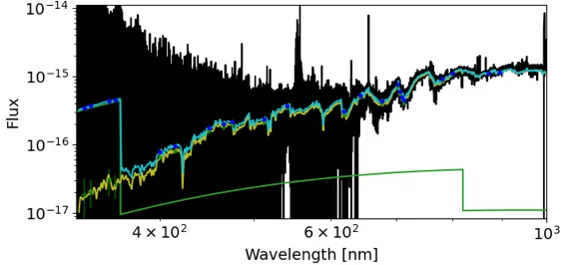
في عام 2023، أصبح نجم عادي في كوكبة الثور أكثر سطوعًا بعشرات المرات فجأة. هذا السلوك يشبه مصباحًا كهربائيًا أُدير فجأة إلى أقصى درجة: اشتعل النجم ثم عاد تدريجيًا إلى حالته السابقة.
رصد علماء الفلك هذه اللحظة ووجهوا عدة تلسكوبات نحو النجم. رأوا أن حول النجم قرصًا من الغاز والغبار يدور مثل دوامة الماء حول مصرف حوض الاستحمام. عادةً تتدفق المادة من هذا القرص نحو النجم في خيط رفيع، لكن أحيانًا، كما في أنبوب مسدود، تتجمع كتلة وتسقط فجأة إلى الداخل. هذه الكتلة بالتحديد هي التي سببت الاشتعال.
النجم نفسه صغير وبارد: درجة حرارته حوالي 3400 درجة، وكتلته أقل من ثلث كتلة الشمس. لكن حتى هذا النجم المتواضع قادر على تقديم عروض مبهرة. بعد الاشتعال، لاحظ علماء الفلك أن النجم يُطلق رياحًا — تيارات من الغاز تحمل جزءًا من المادة عائدة إلى القرص. هذا يشبه حوض استحمام لا يمتلئ فحسب، بل يرش الماء قليلًا أيضًا.
مثل هذه الاشتعالات ليست نادرة بين النجوم الشابة. إنها تُظهر كيف يكتسب النجم كتلته وكيف يتصرف محيطه خلال ذلك. ربما في هذه اللحظات تحديدًا تتشكل كتل في القرص، تتجمع منها الكواكب لاحقًا.
الملخص الأصلي
كما كتبه المؤلفون، بالإنجليزية arXiv:2602.09777
Stellar outbursts from variable or periodic accretion are thought to be ubiquitous across young stellar populations. However, relatively few outbursting objects have been discovered to date. Here, we present the characterisation of a new EXor-type episodic accretor. We aim to characterise the nature of the 2023 outburst of SPICY 97589/Gaia23bab and characterise the stellar source for the first time, while exploring how an accretion outburst contributes to disk evolution. We employ multi-waveband medium-resolution spectroscopy with UVB-VIS-NIR coverage during the peak of the 2023 outburst and the post-outburst quiescent object. The broad wavelength coverage of the dataset allows for robust measurements of the accretion rate using known line tracers. The addition of quiescent spectra provides a good estimation of stellar parameters of the central star while also informing us on the evolution of the disk during outburst phases. We find the stellar source to be a 3410\,K, M3.0 type star with a luminosity of 0.41 $$L_\odot$$ and an estimated stellar mass of 0.29 $$M_\odot$$. We measure the accretion rate of SPICY 97589 to be $$\dot M = 2.38\pm0.58\times10^{-7}\,\mathrm{M_\odot yr^{-1}}$$. This value is at two orders of magnitude greater than the quiescent accretion rate. Thus, we confirm that the 2023 outburst was driven by an influx of material from the surrounding environment to the central star, an accretion outburst. The spectral fingerprint of emission lines is also characteristic of an outbursting EXor-type source, including variable disk winds.
المعدل الذي امتص به النجم المادة أثناء الاشتعال هو حوالي 2.38×10⁻⁷ من كتلة الشمس في السنة. يبدو هذا رقمًا صغيرًا، لكن بالنسبة لنجم كتلته ثلث كتلة الشمس، فإنه يعني التهام كويكب صغير كل بضعة أيام.
في رواية «سولاريس» لستانيسلاف ليم، يتصرف محيط الكوكب بشكل غير متوقع، تمامًا مثل اشتعالات التراكم عند النجوم الشابة — لكن هناك اللغز في العقل، وهنا في الفيزياء.