لماذا لا ينخفض الضغط: الحلقات الوعائية سريع
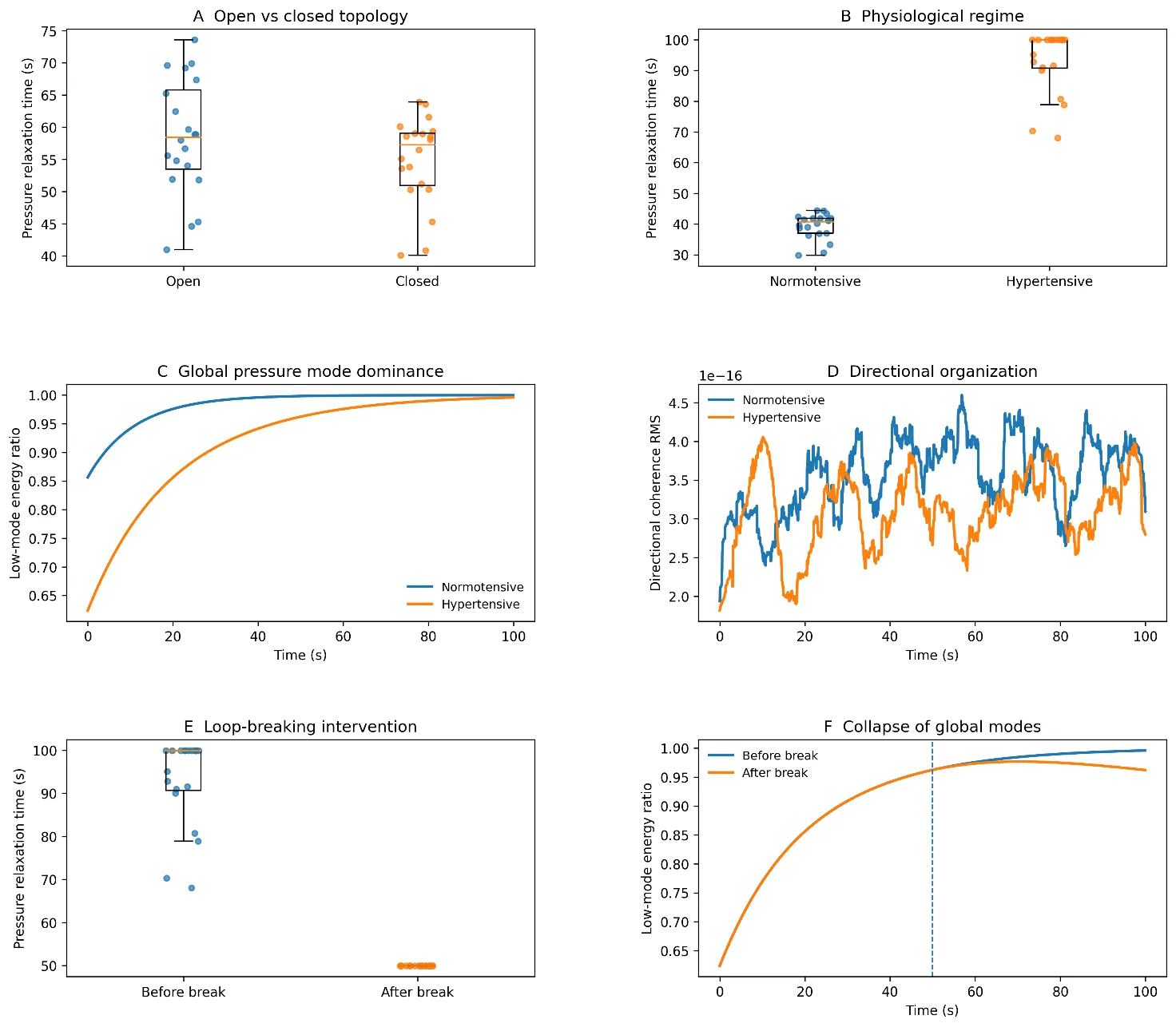
الماء في خرطوم حلقي يضخه مضخة لن يتوقف حتى لو ضغطت على جزء منه: سيجد التدفق طريقاً بديلاً ويستمر في الدوران. هكذا تقريباً تعمل بعض أجزاء جهازنا الدوري - ليس كأنابيب منفردة، بل كحلقات مغلقة.
بنى العلماء نموذجاً حاسوبياً لتدفق الدم وقارنوا حالتين: وعاء مفتوح وحلقة مغلقة. في الوعاء المفتوح، ينخفض الضغط بسرعة ويبقى فقط بالقرب من موضع التأثير. أما في الحلقة، فقد يستمر الضغط في الدوران حتى لو زادت المقاومة في مكان واحد.
هذا يفسر لغز ارتفاع ضغط الدم المقاوم: الأدوية تخفض الضغط في جزء واحد، لكن الحلقة تعيد توزيع التدفق وتحافظ على المستوى العام. وعندما تُقطع الحلقة - نتيجة تجلط أو جراحة أو انصمام - يتغير الضغط بشكل حاد في النظام بأكمله. هكذا يتبين أن طوبولوجيا الأوعية (طريقة اتصالها) لا تقل أهمية عن توترها.
الملخص الأصلي
كما كتبه المؤلفون، بالإنجليزية arXiv:2602.10011
Blood pressure regulation is commonly addressed in terms of local mechanisms such as vascular resistance, compliance and neurohumoral control. However, the human vasculature encompasses multiple quasi-closed flow loops under both physiological and pathological conditions. To test whether these loops could influence pressure dynamics beyond local control, we address the role of vascular topology in blood pressure regulation. Using one dimensional flow simulation models, we compared pressure dynamics in open vascular segments and closed vascular loops. We found that in open segments pressure fades away and remains spatially localized, whereas in closed loops pressure can keep circulating around the loop even if resistance in one spot is modified. Since parallel pathways within loops are dynamically coupled rather than independent, pressure changes in one place can affect the entire closed loop, allowing system level pressure patterns to emerge. Also, we assessed the temporal evolution of pressure fluctuations within closed vascular loops in normotensive and hypertensive parameter regimes, before and after loop breaking intervention. This topological approach helps clarifying why drugs or local interventions may fail to lower blood pressure in looped vascular architectures, providing a theoretical interpretation of some forms of resistant hypertension. Because disrupting a loop restores pressure relaxation, it may also help explain the disproportionate pressure changes observed after topology altering events like thrombosis, vascular surgery or embolization of arteriovenous malformations and shunts. Therefore, vascular topology can influence cardiovascular physiology by coupling local pressure flow relations to global constraints on blood pressure regulation, with physiological, pathological and clinical implications.
لدى الإنسان عدة حلقات وعائية طبيعية، مثل دائرة ويليس في الدماغ - حلقة من الشرايين تنقذ من السكتة الدماغية إذا انسد أحد الفروع.