شلال من الكواكب: لغز اختفاء العوالم المائية سريع
تليسكوب «كيبلر» ويليام بوروكي التقط الوميض الخافت لنجوم بعيدة واكتشف آلاف الكواكب حول شموس أخرى. ومن بينها توجد فجوة واسعة: تكاد لا توجد عوالم بأحجام بين الكرات الصخرية والعمالقة المائية الرخوة. وقد فُسر "وادي الأقطار" هذا بنموذج جديد: تنقسم الكواكب في الأصل إلى صخرية ومائية. العوالم المائية ذات الغلاف الجوي البخاري تملأ الفجوة، لكن عند حجم يساوي ثلاثة أضعاف حجم الأرض تنقطع فجأة — مثل سيل يهوي شلالاً.
عند وصول هذه الكواكب إلى كتلة حرجة، تلتقط الهيدروجين والهيليوم وتتحول إلى عملاق غازي. العوالم المائية الكبيرة لا تظهر — بل تتحول قبل ذلك. لكن بداخلها مفاجأة: يتحول الماء بفعل الضغط الهائل إلى جليد ساخن — صلب لكنه حار. قياسات الضوء من «كيبلر» تظهر أن المحيطات هناك بلا قاع. ورغم أن هذه العوالم المائية شائعة في المجرة، فإن نظامنا الشمسي ليس إلا وصفة واحدة من وصفات ممكنة.
الملخص الأصلي
كما كتبه المؤلفون، بالإنجليزية arXiv:2602.11923
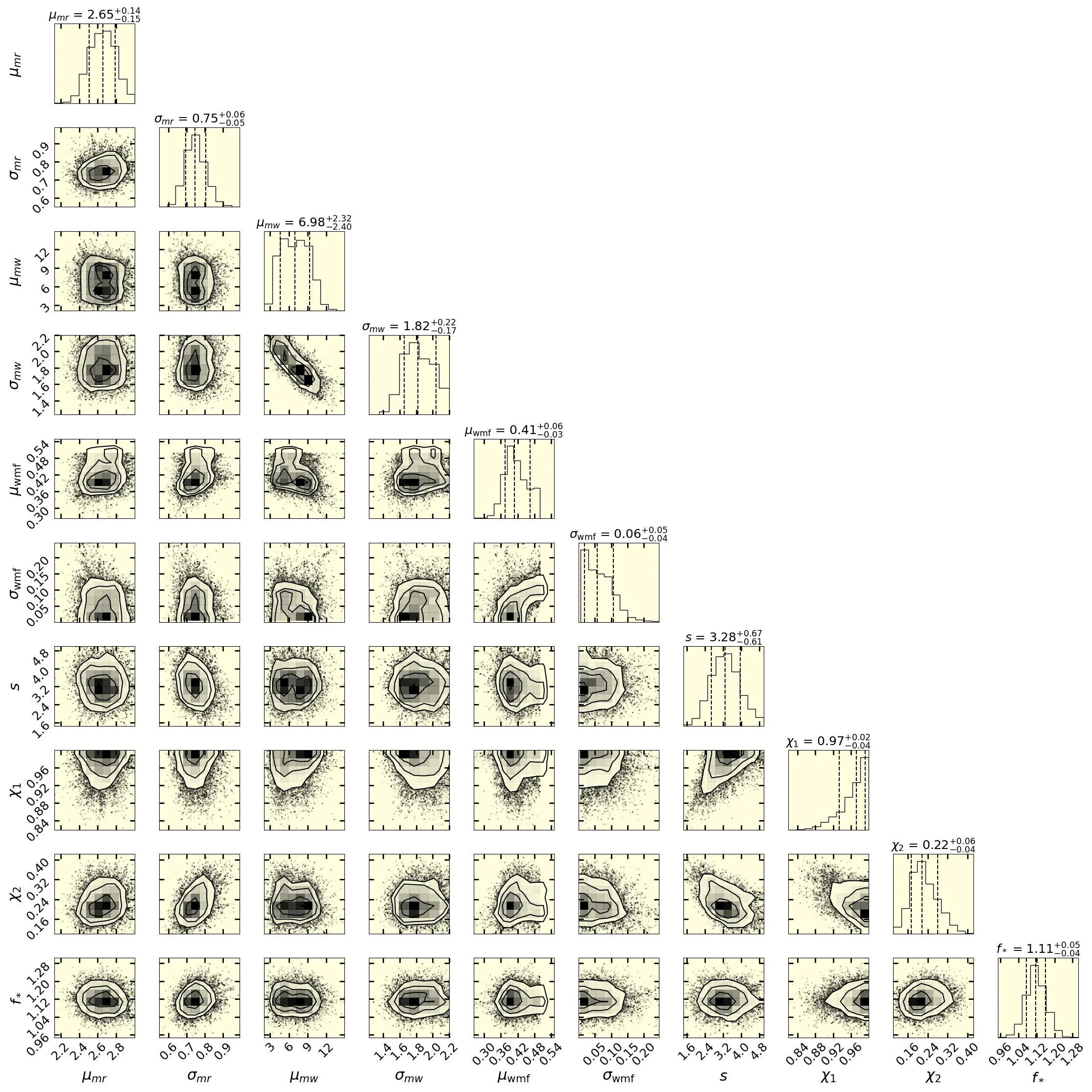
The demographics of Kepler planets provide a key testbed for models of planet formation and evolution, particularly for explaining the radius valley separating super-Earths and sub-Neptunes. A primordial interpretation based on differences in bulk densities -- where rocky and water-rich planets form via migration pathways -- offers an alternative to atmospheric loss scenarios. Updated interior structure models of water worlds with adiabatic steam atmospheres reproduce the observed valley near $$\sim2~R_\oplus$$ more accurately. Furthermore, migration models from our Genesis library suggest that these formation pathways can also account for the distinct period distributions of super-Earths and sub-Neptunes, as well as the emergence of the hot Neptune desert. Motivated by this, we develop a Bayesian hierarchical mixture model for close-in Kepler planets ($$P<100$$ days), combining rocky planets and water worlds without H/He envelopes. The inferred mass distributions of rocky and water-rich planets peak at $$\sim2.6~M_\oplus$$ and $$\sim7~M_\oplus$$, respectively, with the water mass fraction of water worlds peaking at $$\sim41\%$$. Water worlds provide a good representation of the Kepler sub-Neptune population, with the radius cliff emerging as a ``waterfall" -- a sharp decline in their occurrence. However, our mass-radius analysis shows that water worlds alone cannot explain planets with $$R \gtrsim 3~R_\oplus$$, implying that at least $$\sim20\%$$ of sub-Neptunes in the sample are enriched in H/He gas.
في الكواكب المائية، يتحول الماء بفعل الضغط الهائل إلى جليد ساخن — مادة صلبة تظل حارة. وهكذا يمكن أن تكون المحيطات هناك سائلة في الأعلى وجليدية في العمق في آن واحد.
في فيلم «إنترستيلر»، يزور الأبطال كوكب ميلر المغطى بمحيط ضحل. لكن العوالم المائية الحقيقية هي أشبه بقطرات عملاقة دون سطح صلب، وأعمق بكثير من أي بحار أرضية.