إثارة داكنة على الغرافين النقي سريع
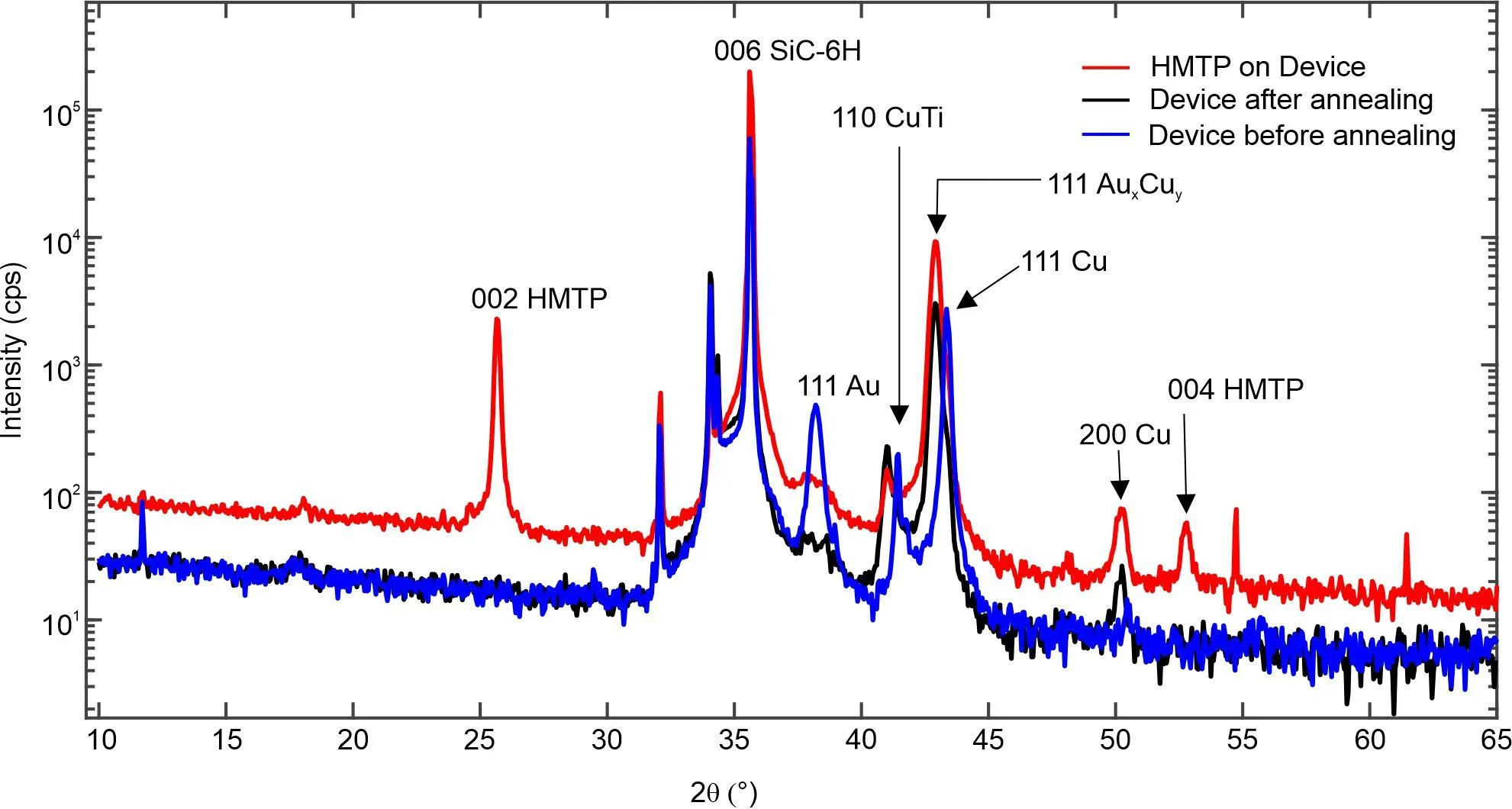
طبقة الغرافين على كربيد السيليكون تشبه طاولة مستوية تماماً، نحتاج إلى وضع جزيئات هشة عليها بحذر. أي ذرة غبار أو تفاوت يفسد الصورة: الجزيئات تستقر بشكل معوج، وتختفي خصائصها الكمومية. طور الباحثون طريقة تنظيف تعيد للسطح نقاءً يعادل الفراغ العميق. أظهر الفحص بحزمة إلكترونية أن الذرات على الغرافين اصطفت في شبكة مثالية.
على هذه الطاولة النظيفة، زرعت جزيئات HMTP — مركبات عضوية تتفاعل بقوة مع الضوء والاهتزازات. بسبب التناظر في التعبئة البلورية للجزيئات، تنقسم حالتها الطاقية الأساسية إلى حالتين: ساطعة وداكنة. الساطعة تطلق طاقتها بسرعة، بينما الداكنة تعيش طويلاً — الطاقة فيها محبوسة كالماء في زجاجة مغلقة. ووفقاً للحسابات، تبين أن الحالات الداكنة هي المسؤولة بشكل أساسي عن انبعاث الضوء: فهي تطلق الطاقة ببطء عبر اهتزازات الجزيئات.
لفهم كيفية تدفق الطاقة داخل الطبقة الجزيئية، جمع العلماء ثلاث طرق: قياس التيار الكهربائي تحت تأثير الضوء، وتوهج العينة، واهتزازات الجزيئات. أظهرت الحسابات المبنية على هذه البيانات أن الطاقة تنتقل أولاً إلى الحالة الداكنة، ومنها إلى الضوء. يشبه ذلك قطاراً لا يسير مباشرة، بل عبر مسار احتياطي: يستغرق وقتاً أطول، لكن دون خسائر.
هذا النهج — الجمع بين تقنية الغرافين الصناعية والدقة الجزيئية — يفتح الطريق لصنع أجهزة كمومية في الحالة الصلبة. يمكن للإثارة الداكنة أن تخزن المعلومات لفترة أطول من الساطعة، وبالتالي تصبح أساساً لذاكرة الحواسيب الكمومية.
الملخص الأصلي
كما كتبه المؤلفون، بالإنجليزية arXiv:2603.02301
The realization of high-fidelity organic-inorganic quantum emulators is frequently hindered by the interfacial imperfections introduced during device fabrication. Here, we demonstrate a robust nanofabrication protocol that restores the atomic-scale purity of epitaxial graphene on SiC to UHV-equivalent levels, as confirmed by Low-Energy Electron Diffraction, and Microscopy. This pristine interface enables the emergence of macroscopic excitonic coherence in epitaxial overlayers of 2,3,6,7,10,11-hexamethoxytriphenylene (HMTP), a model molecular system characterized by intense electron-phonon coupling. Through a combination of high-sensitivity Fourier Transform Photo-current Spectroscopy, photoluminescence, and dynamic Raman mapping, we resolve a complex vibronic manifold governed by Davydov splitting. We show that the $$P6_3/m$$ crystalline symmetry of the HMTP overlayer lifts the degeneracy of the HOMO-LUMO transition, creating discrete bright and dark excitonic branches. Using an analytical tight-binding model parameterized by ARPES-derived intermolecular coupling and Raman vibrational modes validated by molecular dynamics simulations, we quantify the polarization energy, the Huang-Rhys factor, and Herzberg-Teller corrections to the Franck-Condon model. Our results reveal that the dark-state branch dominates the radiative channel, following a polaron-mediated relaxation pathway consistent with Kasha's rule. By reconciling macroscopic device architecture with UHV-level surface science, this work establishes a scalable platform for the study of dark-exciton dynamics and the development of solid-state molecular quantum memories.
سميت الإثارة الداكنة بهذا الاسم لأنها لا تصدر ضوءاً مباشرة — لا يمكن رؤية طاقتها إلا بشكل غير مباشر، عبر الحرارة أو توهج خافت.
في مسلسل «الفضاء»، تستخدم الحواسيب الكمومية حالات غريبة من المادة لإجراء حسابات فورية — قد تكون الإثارة الداكنة خطوة حقيقية نحو هذا الخيال العلمي.