كيف تشكّل القطرات داخل الخلايا الأغشية سريع
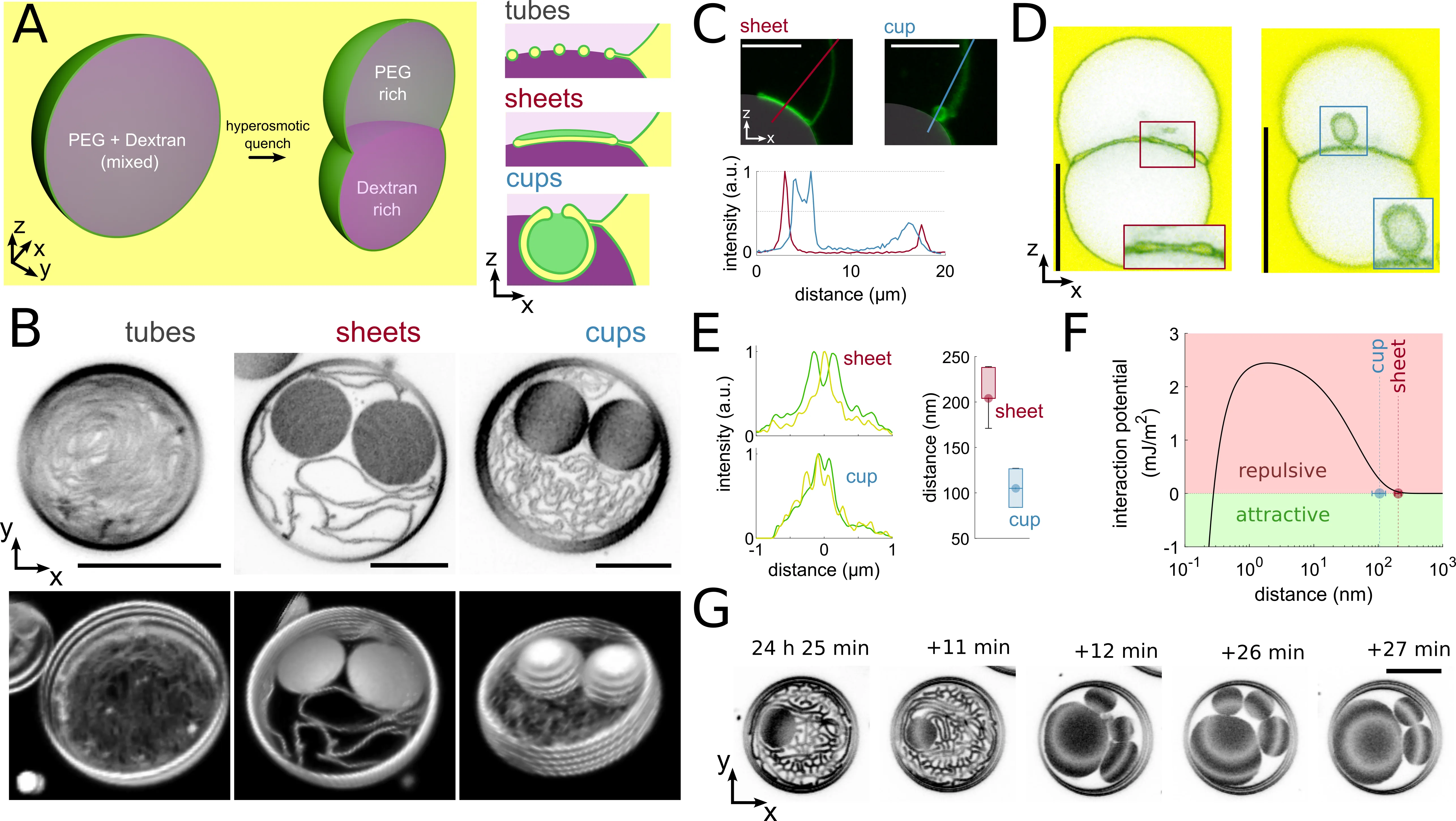
داخل الخلية الحية تسبح قطرات لا تمتزج مع السائل المحيط بها، مثل الزيت في الماء. هذه القطرات ليست مجرد تجمعات سلبية، بل تضغط بنشاط على الأغشية وتجعلها تنحني. لاحظ العلماء هذه العملية في الخلايا النباتية الحية، وأعادوا إنتاجها في أنبوب الاختبار، وحسبوها بالحاسوب.
اتضح أن شكل الغشاء يعتمد على قوة التوتر السطحي عند حدود القطرة. فإذا كان التوتر كبيراً، ينبسط الغشاء إلى صفيحة مسطحة. وإذا كان التوتر أضعف، يلتف الغشاء على شكل أنبوب أو كأس. والانتقال بين هذه الأشكال ليس دائماً عكسياً: للعودة من الكأس إلى الأنبوب، يجب تجاوز حاجز طاقة، ويبدو أن الغشاء «يتذكر» شكله السابق.
هذه الآلية تفسر كيف تتشكل «البصيلات» داخل الفجوات العصارية في الخلايا النباتية — وهي فقاعات كبيرة مليئة بالسائل. ينغزل غشاء الفجوة إلى الداخل بفعل القطرات ويكوّن بنى كأسية الشكل. وبالتحكم في خصائص سطح القطرات، تستطيع الخلية تشكيل الأغشية بالشكل المطلوب في اللحظة المناسبة.
الملخص الأصلي
كما كتبه المؤلفون، بالإنجليزية arXiv:2603.15904
Phase-separated biomolecular condensates with liquid-like properties play a key role in the organization and compartmentalization of the intracellular environment. Condensate-mediated capillary forces acting on membranes drive physiologically important reshaping of membrane-bound organelles, such as vacuoles and autophagosomes. Here, we explore condensate-mediated membrane shape transformations. We employ {\textit{in planta}} live-cell imaging, an \textit{in vitro} reconstitution system with tunable interfacial tension, and computer simulations of an elastic membrane model to describe three morphologies of membrane structures localized at condensate interfaces: tubes, sheets, and cups. We find that the forces associated with high interfacial tension drive the formation of stable sheets, while tubes and cups prevail at lower interfacial tension. We calculate the free energies of each membrane shape and identify the energy barriers that govern the transitions between the shapes. With this approach, we find that shape transformations depend on the history of the interfacial membrane and exhibit a tube-to-cup hysteresis. These findings indicate that temporal control of condensate surface properties can mediate the morphogenesis of cup-like structures in cells, such as the formation of "bulbs" within plant vacuoles. Our results further generalize how the interplay of condensates and membranes contributes to intracellular organization.
في الخلايا النباتية، يمكن أن تشغل الفجوات العصارية حتى 90% من الحجم، وتساعد القطرات داخلها على تشكيل بنى داخلية معقدة.